- Plants
- ›Vascular Plants
- ›flowering plants
- ›Dicots
- ›saxifrages, stonecrops, and allies
- ›stonecrop family
- ›Sempervivoideae
- ›Sedeae
- ›Dudleya
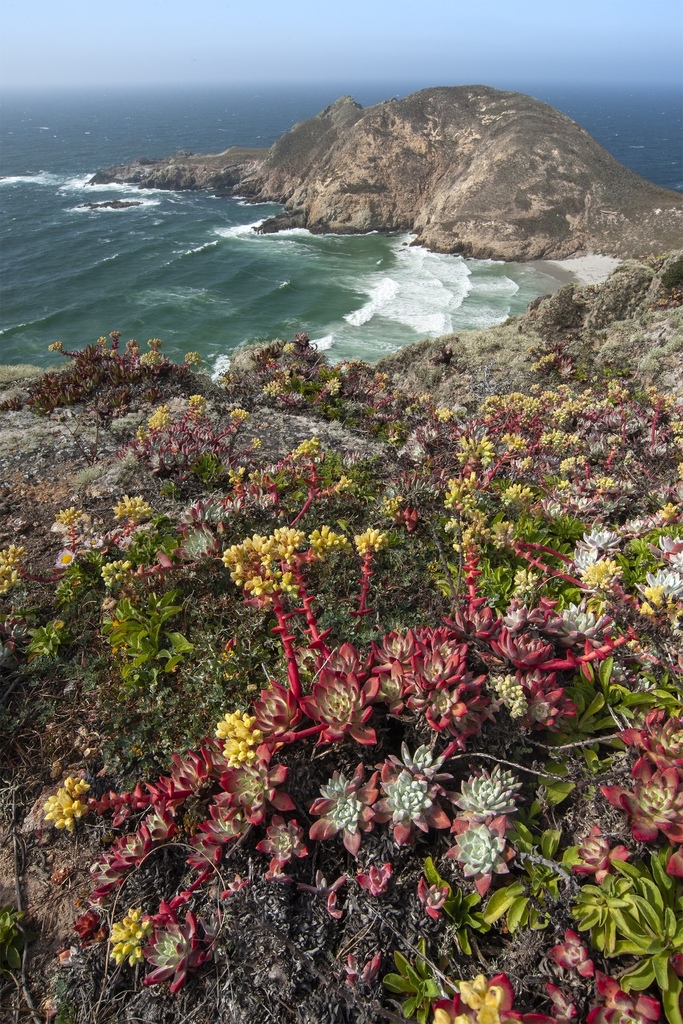
Greene's dudleya
Dudleya greenei
Dudleya greenei is a perennial species of succulent plant known by the common names Greene's liveforever, or Greene's dudleya. It is endemic to the Channel Islands of California, where it grows along the cliffs of four of the eight islands. It is a highly variable plant, presenting with multiple forms and varying levels of ploidy. Taxonomically, this species is an insular segregate of Dudleya caespitosa, and was placed as a stopgap taxon by Reid Moran in his 1951 thesis on the genus. It is characterized by white or green leaf rosettes, loomed over by inflorescences bearing pale yellow to white flowers. It is a member of the subgenus Dudleya, as it cannot be propagated from leaf cuttings, does not grow from a corm, and has tight petals.
From the article Dudleya greenei on Wikipedia (CC BY-SA), quoted section by section
Description
This species of Dudleya may or may not be caespitose; it can form clumps up to 1 meter wide. It may have anywhere from 1 to 100+ rosettes. Each rosette can range anywhere from 5 to 46 cm wide. The caudex is 2 to 5 cm wide, and may become elongated. Unlike the nearby D. candelabrum, the caudex is not swollen at the base. The leaves are evergreen, and are 3 to 22 cm long, 1 to 3.5 cm wide, and 4 to 8 mm thick. The leaf shape is variable. They may be covered in a white epicuticular wax, or present green. The base of the leaf is generally 1 to 3 cm wide, and may wound red or yellow when detached from the stem. The tip of the leaf is generally acute, while the margins of the leaves generally have 0 to 1 angles between the upper and lower leaf surfaces. The peduncle is 4.5 to 50 cm tall, and 3 to 5 mm wide. There are typically 3 first degree branches on the inflorescence, which may rebranch 0 to 2 more times. The terminal branches are 1 to 9 cm long, and hold 2 to 15 flowers. The bracts are 10 to 30 mm long, and 5 to 12 mm wide. The bracts are shaped lanceolate to oblong, and are more or less thick; they are also not bent backwards (reflexed). The pedicels are 1 to 5 mm long. The flower has sepals 1.5 to 5 mm long, shaped deltate. The petals are 8 to 12 mm long, 3 to 5 mm wide, and are connate (fused to form a tubular corolla) 1.5 to 2.5 mm. …
Wikipedia: “Morphology”
Range & habitat
This species is distributed throughout the northern Channel Islands: Santa Cruz, San Miguel, and Santa Rosa islands with the exception of Anacapa. Plants on Anacapa are D. caespitosa. It is found on coastal cliffs and rock outcrops. Tetraploid representatives of this species are also present on Catalina Island. However, some plants with campanulate flowers on Catalina may be of hybrid origin between Dudleya greenei and Dudleya virens subsp. insularis.
Wikipedia: “Distribution and habitat”
In human culture
The first collection of this plant was made by Edward Lee Greene in 1886, on Santa Cruz Island in the Channel Islands of California. In their 1903 work on the North American Crassulaceae, Joseph Nelson Rose and Nathaniel Lord Britton circumscribed the genus Dudleya. The species Dudleya greenei was described off of Greene's collection by Rose. in 1932, botanist Donald A. Johansen, writing in his "Contributions Toward a Monograph of the Genus Dudleya," published within the Cactus and Succulent Society of America's journal, described two new species from the Channel Islands based on collections made by Ralph Hoffmann, a naturalist and explorer of the islands who died the same year after an accident on San Miguel Island. Hoffmann made several collections of Dudleya from San Miguel Island, its adjacent islets, and Santa Rosa Island. Johansen named Dudleya hoffmannii and Dudleya regalis from collections by Hoffmann on Prince Island, which is off of San Miguel Island. D. regalis was noted as distinct for its white flowers and size and number of rosettes. The specific epithet of D. regalis is a reference to the name of the island, and also due to their "regal" appearance described by Johansen. D. …
Wikipedia: “Taxonomic history”
Where it lives
Recorded sightings
—
geo-referenced records in GBIF, from museums, herbaria and field observers.
Drag the globe to turn it. Dots are where records exist, not a range map; darker means more records.
In the stacks
Searching the stacks…
Every page naming Dudleya greenei in the Biodiversity Heritage Library →
This page is assembled live from iNaturalist, GBIF, Wikipedia, the Source Library and the Internet Archive. It is not yet part of the hand-edited codex. iNaturalist taxon 76732.