- Plants
- ›Vascular Plants
- ›flowering plants
- ›Dicots
- ›saxifrages, stonecrops, and allies
- ›stonecrop family
- ›Sempervivoideae
- ›Sedeae
- ›Dudleya
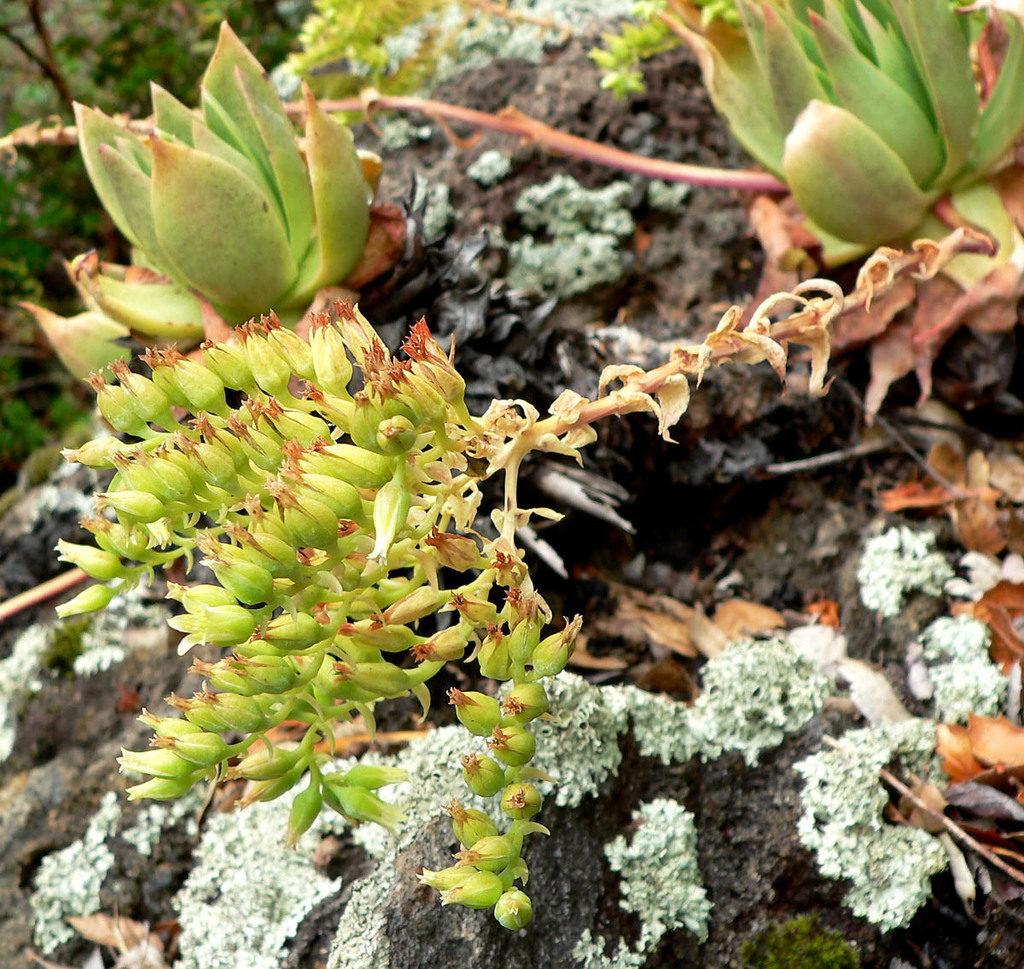
candleholder dudleya
Dudleya candelabrum
Dudleya candelabrum is a species of succulent plant known by the common names candleholder liveforever or candleholder dudleya. Endemic to California, this species grows wild only on the northern Channel Islands, where it is found in open rocky places and north-facing slopes. It is characterized by thin, spade-shaped green leaves and an inflorescence covered in long, reflexed bracts, with pale yellow flowers. It has been threatened by poachers shipping plants to South Korea.
From the article Dudleya candelabrum on Wikipedia (CC BY-SA), quoted section by section
Description
This species typically grows from an often solitary basal rosette up to half a meter wide atop a thick, hardy caudex that is swollen at the base. There are 20 to 45 evergreen leaves on the rosette. The leaves are a pale green to pinkish-green, shaped obovate to oblong-oblanceolate, and more or less thin. The leaves may be glaucous, and when torn from the rosette, leave a purple-red wound. Each leaf measures anywhere from 6–22 cm (2.4–8.7 in) long by 3–7 cm (1.2–2.8 in) wide, with an acuminate tip. The unbranched peduncle is generally erect but often bending under the weight of the inflorescence it holds. The peduncle is usually 15–54 cm (5.9–21.3 in) tall while only 6–11 mm (0.24–0.43 in) wide. The bracts are long and reflexed, bending backwards. The lowermost bracts are 1–4 cm (0.39–1.57 in) long. The inflorescence first branches 3 to 7 times, and then those branch another 1 to 2 times. The terminal branches are 2.5–13 cm (0.98–5.12 in) and hold up to 25 flowers. The flower has pale-yellow petals 8–12 mm (0.31–0.47 in) long within its pink-tinged green sepals. Flowering is from May to July. Chromosome number is 17.
Range & habitat
Dudleya candelabrum is endemic to the Santa Cruz and Santa Rosa Islands. It occurs on rocky, north-facing slopes below 1,200 ft.
Wikipedia: “Distribution and habitat”
In human culture
The type specimen was collected by Professor E. L. Greene on Santa Cruz Island, in July and August 1886. The species was described in 1903 with Nathaniel Lord Britton and Joseph Nelson Rose's taxonomic revision of North American Crassulaceae, as part of the creation of the genus Dudleya. Later, German botanists such as Fedde in 1904 and Berger in 1930 would classify it as Cotyledon candelabrum and Echeveria candelabrum respectively, but these redefinitions were outdated after Reid Moran's revision of the genus, along with later phylogenetic work that showed Dudleya as being more closely related to Sedum than to Echeveria.
Wikipedia: “Taxonomic history”
Where it lives
Recorded sightings
—
geo-referenced records in GBIF, from museums, herbaria and field observers.
Drag the globe to turn it. Dots are where records exist, not a range map; darker means more records.
In the stacks
Searching the stacks…
Every page naming Dudleya candelabrum in the Biodiversity Heritage Library →
This page is assembled live from iNaturalist, GBIF, Wikipedia, the Source Library and the Internet Archive. It is not yet part of the hand-edited codex. iNaturalist taxon 76728.