- Plants
- ›Vascular Plants
- ›flowering plants
- ›monocots
- ›grasses, sedges, cattails, and allies
- ›Sedges
- ›Cyperoideae
- ›Cypereae
- ›Cyperus
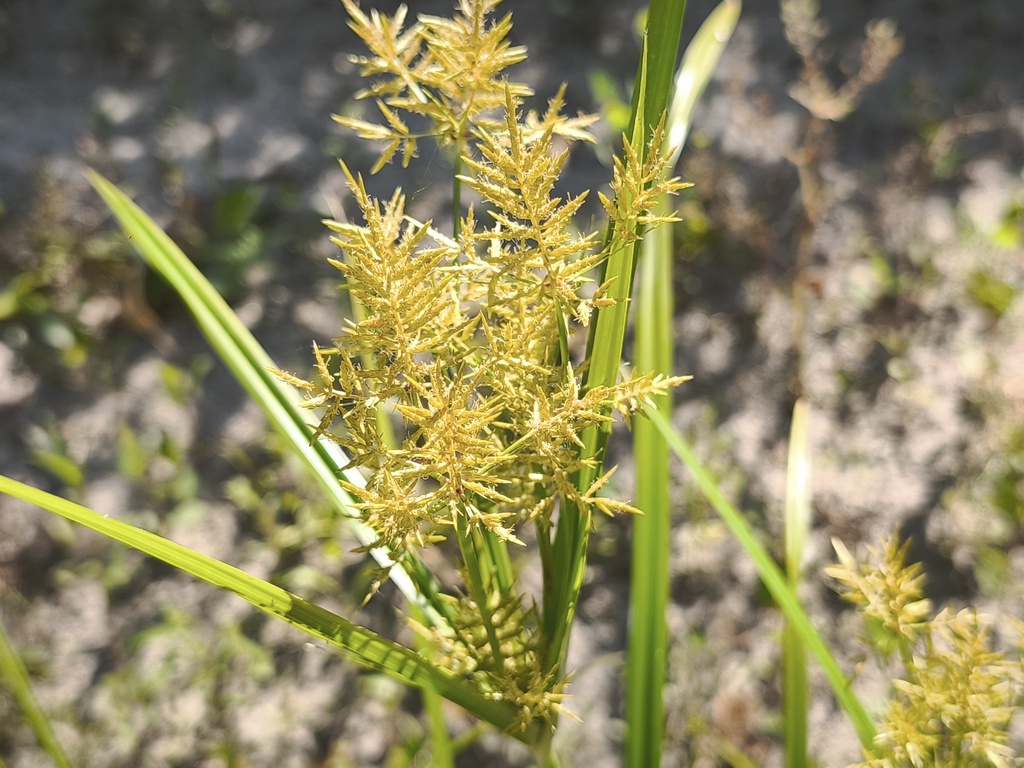
yellow nutsedge
Cyperus esculentus
Cyperus esculentus (also called chufa, tiger nut, atadwe, yellow nutsedge, earth almond, and in Chishona, pfende) is a species of plant in the sedge family widespread across much of the world. It is found in most of the Eastern Hemisphere, including Southern Europe, Africa and Madagascar, as well as the Middle East and the Indian subcontinent. C. esculentus is cultivated for its edible tubers, called earth almonds or tiger nuts (due to the stripes on their tubers and their hard shell), as a snack food and for the preparation of horchata de chufa, a sweet, milk-like beverage.
Cyperus esculentus can be found wild, as a weed, or as a crop. It is an invasive species outside its native range, and is readily transported accidentally to become invasive. In many countries, C. esculentus is considered a weed. It is often found in wet soils such as rice paddies and peanut farms as well as well-irrigated lawns and golf courses during warm weather.
From the article Cyperus esculentus on Wikipedia (CC BY-SA), quoted section by section
Description
Cyperus esculentus is an annual or perennial plant, growing to 90 centimetres (3 feet) tall, with solitary stems growing from a tuber. The plant is reproduced by seeds, creeping rhizomes, and tubers. Due to its clonal nature, C. esculentus can take advantage of soil disturbances caused by anthropogenic or natural forces. The stems are triangular in section and bear slender leaves 3–10 millimetres (1⁄8–3⁄8 inch) wide. The spikelets of the plant are distinctive, with a cluster of flat, oval seeds surrounded by four hanging, leaf-like bracts positioned 90 degrees from each other. They are 5 to 30 mm (1⁄4 to 1+1⁄8 in) long and linear to narrowly elliptic with pointed tips and 8 to 35 florets. The color varies from straw-colored to gold-brown. They can produce up to 2420 seeds per plant. The plant foliage is very tough and fibrous and is often mistaken for a grass. The roots are an extensive and complex system of fine, fibrous roots and scaly rhizomes with small, hard, spherical tubers and basal bulbs attached. The tubers are 0.3–2.5 cm (1⁄8–1 in) in diameter and the colors vary between yellow, brown, and black. One plant can produce several hundred to several thousand tubers during a single growing season. …
What it does
Cyperus esculentus is a highly invasive species in Oceania, Mexico, some regions of the United States (where it is native), and the Caribbean, mainly by seed dispersion. It is readily transported internationally, and is adaptable to re-establish in varied climate and soil environments. In Japan, it is an exotic clonal weed favorable to establish in wet habitats. Cyperus esculentus serves as a larval host for Euphyes vestris (dun skipper) and Diploschizia impigritella (yellow nut-sedge moth) in North America. Cyperus esculentus likely reached the New World through ocean currents before the Holocene.
Wikipedia: “Ecology”
At the table
Dried tiger nut has a smooth, tender, sweet, and nutty taste. It can be consumed raw, roasted, dried, baked or as tiger nut milk, tiger nut drink or oil.
Drink. In Spain, the drink now known as horchata de chufa (also sometimes called horchata de chufas or, in West African countries such as Nigeria and Mali, kunun aya) is the original form of horchata. It is made from soaked, ground and sweetened tiger nuts mixed with sugar and water. It remains popular in Spain, where a regulating council exists to ensure the quality and traceability of the product in relation to the designation of origin. There it is served ice-cold as a natural refreshment in the summer, often served with fartons. The majority of the Spanish tiger nut crop is utilised in the production of horchata de chufa. Alboraya is the most important production centre. The tubers can be roasted and ground into a coffee substitute.
Food. The tubers are edible raw or cooked. They have a slightly sweet, nutty flavour, compared to the more bitter-tasting tuber of the related Cyperus rotundus (purple nutsedge). They are quite hard and are generally soaked in water before they can be eaten, making them much softer and giving them a better texture. They are a popular snack in West Africa. The tubers can also be dried and ground into flour. In Northern Nigeria, it is called aya and it is usually eaten fresh. …
Wikipedia: “Uses”
How it is grown
Cyperus esculentus is cultivated in Egypt, Spain, Nigeria, the United States, Guatemala, Mexico, Chile, Brazil, Lebanon, Syria, Jordan, Saudi Arabia, Oman, Iran, Iraq, Pakistan, India, Yemen, Morocco, Ivory Coast, Sudan, South Sudan, Gambia, Guinea Bissau, Ghana, Niger, Burkina Faso, Togo, Benin, Cameroon, and Mali, where they are used primarily as animal feed or as a side dish, but in Hispanic countries they are used mainly to make horchata, a sweet, milk-like beverage.
Climate requirements. Cyperus esculentus cultivation requires a mild climate. Low temperature, shade, and light intensity can inhibit flowering. Tuber initiation is inhibited by high levels of nitrogen, long photoperiods, and high levels of gibberellic acid. Flower initiation occurs under photoperiods of 12 to 14 hours per day.
Soil requirements. Tubers can develop in soil depths around 30 cm, but most occur in the top or upper part. They tolerate many adverse soil conditions including periods of drought and flooding and survive soil temperatures around −5 °C (23 °F). They grow best on sandy, moist soils at a pH between 5.0 – 7.5. The densest populations of C. esculentus are often found in low-lying wetlands. They do not tolerate salinity.
Cultivation process. Cyperus esculentus is normally planted on previously tilled flat soils with ridges to facilitate irrigation. …
Wikipedia: “Cultivation”
Where it lives
Recorded sightings
—
geo-referenced records in GBIF, from museums, herbaria and field observers.
Drag the globe to turn it. Dots are where records exist, not a range map; darker means more records.
In the old herbals & bestiaries


In the stacks
Searching the stacks…
Every page naming Cyperus esculentus in the Biodiversity Heritage Library →
This page is assembled live from iNaturalist, GBIF, Wikipedia, the Source Library and the Internet Archive. It is not yet part of the hand-edited codex. iNaturalist taxon 76584.