- Plants
- ›Vascular Plants
- ›flowering plants
- ›Dicots
- ›nightshades, bindweeds, gooseweeds, and allies
- ›bindweed family
- ›Cuscuteae
- ›Cuscuta
- ›Grammica
- ›Cleistogrammica
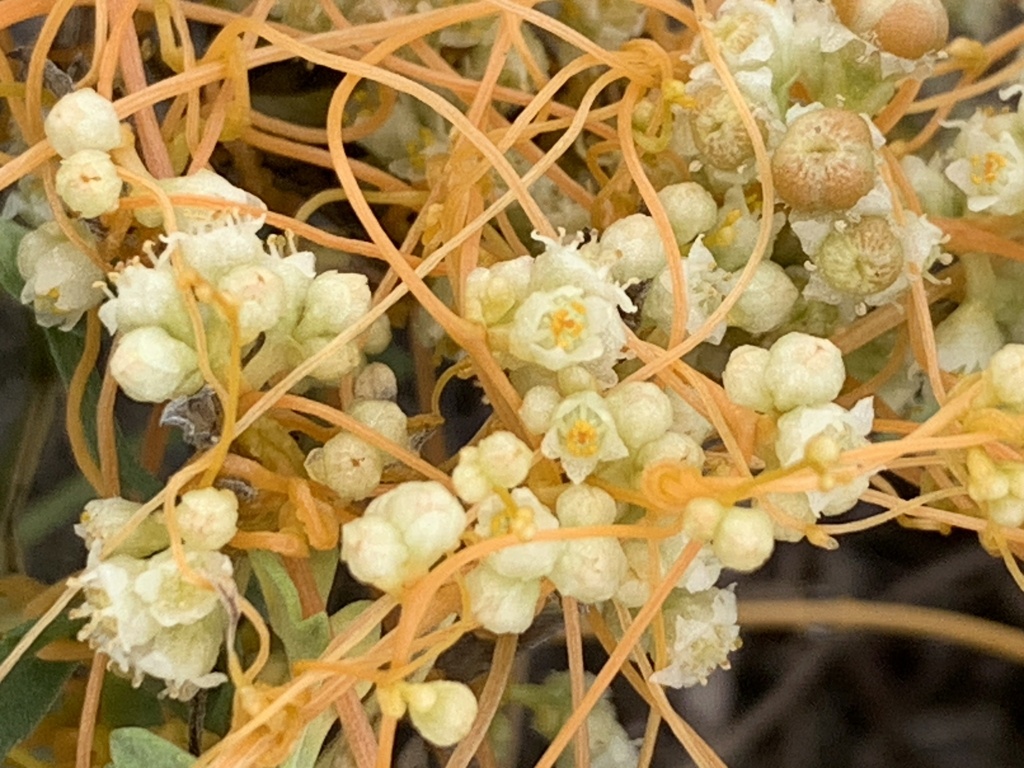
Field Dodder
Cuscuta campestris
Cuscuta campestris, with the common names field dodder, golden dodder, large-seeded alfalfa dodder, yellow dodder and prairie dodder, is a parasitic plant which belongs to the family Convolvulaceae. It was formerly classified in the family Cuscutaceae.
It is native to central North America. It is a parasite of a wide range of herbaceous plants.
From the article Cuscuta campestris on Wikipedia (CC BY-SA), quoted section by section
Description
The life cycle of the Cuscuta starts with seed germination. The seeds germinate near the surface of the soil, sending up thin pale green and yellow stems. The thread-like stems grow slowly until they touch another plant and begin to wrap themselves around it. Once fully wrapped around a host plant, Cuscuta campestris will form sucker-like roots, called haustoria, and penetrate the body of the host, stealing nutrients from them. If the seedlings do not make contact with a host plant, they will die. The seedlings cannot survive for long they find the appropriate plant stem by recognizing plant chemo-attractants. Cuscuta campestris is known for reducing the growth of their host plants. This mechanism gives them the ability to control other populations of plants such as Mikania micrantha. Another mechanism by which dodders recognize which plants to parasitize depends on the light reflected off the host plant. Cuscuta campestris is highly attracted to "far red light", which is a wavelength that is reflected by most plant surfaces. Dodders that were exposed to unfiltered light were able to attach to their host before their energy had been totally exhausted, but dodders that were only exposed to red light lost their way. Cuscuta campestris is a parasitic weed that is one of the most widespread in the world. …
Range & habitat
The native range of this species is unclear but thought to be North America, specifically Canada, US, and Mexico. It is also found in parts of the Caribbean, including Cuba, Bahamas, Jamaica, Martinique, and possibly parts of South America. It is widely naturalised in parts of coastal and subcoastal regions of Australia, found predominantly in the Southeastern Australia along the Murray River. Cuscuta campestris can be found growing in grasslands, open woodlands, gardens, riparian zones, and wetlands. Cuscuta campestris has a tolerance for a wide range of climatic conditions, from warm temperate regions to subtropical or tropical regions.
Wikipedia: “Distribution and habitat”
What it does
Reproduction is through seed or vegetative spread. Pollination for C. campestris is autogamous, or self-fertilizing, and the species can produce up to 16,000 seeds on a single plant. In North America, flowering occurs in mid-summer, with less flowering occurring in humid, high rainfall locations. Cuscuta campestris seeds have a hard seed coating that requires scarification, reducing the danger of all seeds germinating at once. Germination can occur regardless of the amount of light available, as long as temperatures are between 10-30 °C. The seeds are able to remain viable for up to 10 years in soil.
Wikipedia: “Reproduction”
Where it lives
Recorded sightings
—
geo-referenced records in GBIF, from museums, herbaria and field observers.
Drag the globe to turn it. Dots are where records exist, not a range map; darker means more records.
In the stacks
Searching the stacks…
Every page naming Cuscuta campestris in the Biodiversity Heritage Library →
This page is assembled live from iNaturalist, GBIF, Wikipedia, the Source Library and the Internet Archive. It is not yet part of the hand-edited codex. iNaturalist taxon 76545.