- Plants
- ›Vascular Plants
- ›flowering plants
- ›Dicots
- ›rockflowers, bladdernuts, and allies
- ›Crossosomataceae
- ›Crossosoma
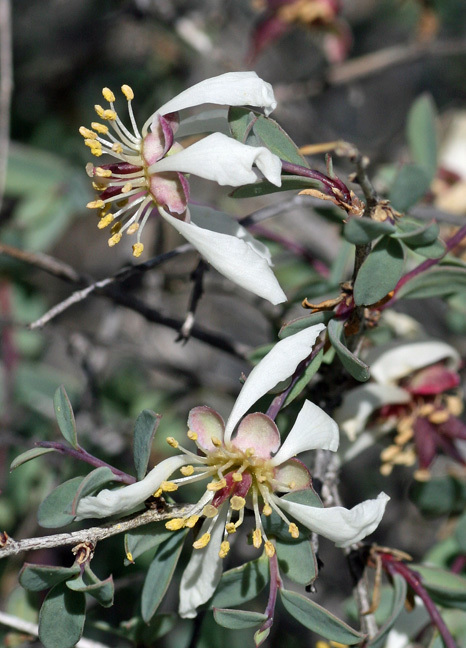
Bigelow's crossosoma
Crossosoma bigelovii
Crossosoma bigelovii, known by the common name ragged rockflower, is one of only a few species in the flowering plant family Crossosomataceae.
It is native to the Mojave, Chihuahuan, and Sonoran Deserts of North America. It has been reported from the states of Arizona, California, Nevada, Baja California, Chihuahua, and Sonora.
From the article Crossosoma bigelovii on Wikipedia (CC BY-SA), quoted section by section
Description
The species is a shrub that grows up to 1–2 metres (3.3–6.6 ft) tall. It is intricately divided into thorn-tipped branches lined with clusters of small, deciduous, gray-green leaves no longer than about 1.5 centimeters. The inflorescence bears a single flower, which has 5 white to purple-tinged petals about a centimeter long and narrowing to claws at their bases.
At the table
Ragged rockflower is occasionally used as an ornamental plant in habitat gardens and natural landscaping. It can be grown from seed in well-drained soil for a desert butterfly garden. It is a difficult plant for the average homeowner to grow, as over-watering will kill it.
Wikipedia: “Uses”
Where it lives
Recorded sightings
—
geo-referenced records in GBIF, from museums, herbaria and field observers.
Drag the globe to turn it. Dots are where records exist, not a range map; darker means more records.
In the stacks
Searching the stacks…
Every page naming Crossosoma bigelovii in the Biodiversity Heritage Library →
This page is assembled live from iNaturalist, GBIF, Wikipedia, the Source Library and the Internet Archive. It is not yet part of the hand-edited codex. iNaturalist taxon 76482.