- Plants
- ›Vascular Plants
- ›flowering plants
- ›Dicots
- ›Roses, Elms, Figs, and Allies
- ›rose family
- ›Amygdaloideae
- ›Maleae
- ›Crataegus
- ›Sanguineae
- ›Douglasia
- ›Douglasianae
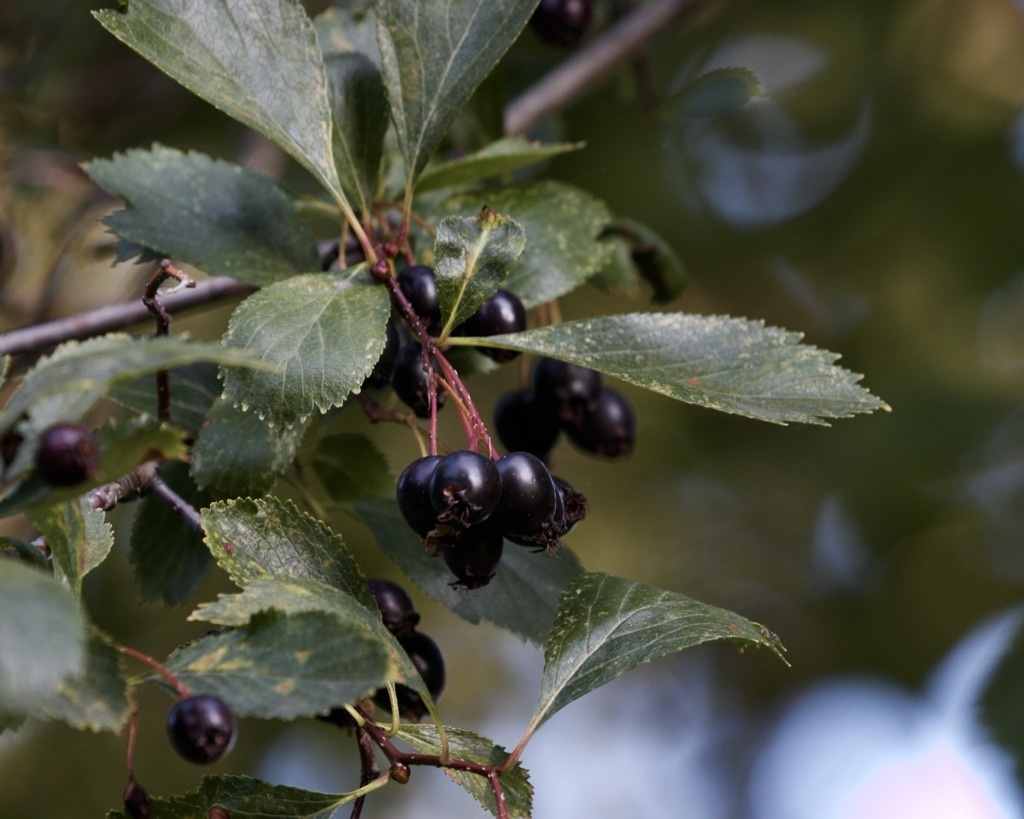
Black Hawthorn
Crataegus douglasii
Crataegus douglasii is a North American species of hawthorn known by the common names black hawthorn and Douglas' thornapple. It is named after David Douglas, who collected seed from the plant during his botanical explorations.
From the article Crataegus douglasii on Wikipedia (CC BY-SA), quoted section by section
Description
Crataegus douglasii is a compact erect bushy shrub growing to 8–9 metres (26–30 feet) tall with a trunk of up to 10 centimetres (4 inches) thick. It is covered in fan-shaped green leaves about 2.5–5 cm (1–2 in) long with teeth along the distal margin. Thorns along the branches are 1–2.5 cm long. White flowers with greenish centers grow in bunches at the ends of each thin branch. The fruit is a blackish pome up to about 1 cm across, containing 3–5 rocklike seeds.
Range & habitat
The thorny shrub is native to northern and western North America, most abundantly in the Pacific Northwest. It grows in varied habitats from forest to scrubland, including moist open places, forest edges, thickets, shorelines, streamside areas, roadsides and coastal bluffs at low to middle elevations.
Wikipedia: “Distribution and habitat”
What it does
The foliage is browsed by cattle and sheep. Various birds, including quail, the Hungarian partridge, and ring-necked pheasant feed on the berries, as do bears and other animals. Magpies nest in the branches. The species is a larval host to the gray hairstreak, mourning cloak, pale tiger swallowtail, and western tiger swallowtail.
Wikipedia: “Ecology”
At the table
The edible fruits were a good food source for Native American peoples such as the Cheyenne and Nlaka'pamux. The Syilx/Okanagan use the ripening of the black hawthorn as an indicator that, in the highlands, black mountain huckleberries are ripening, too.
Wikipedia: “Uses”
Where it lives
Recorded sightings
—
geo-referenced records in GBIF, from museums, herbaria and field observers.
Drag the globe to turn it. Dots are where records exist, not a range map; darker means more records.
In the stacks
Searching the stacks…
Every page naming Crataegus douglasii in the Biodiversity Heritage Library →
This page is assembled live from iNaturalist, GBIF, Wikipedia, the Source Library and the Internet Archive. It is not yet part of the hand-edited codex. iNaturalist taxon 76469.