- Plants
- ›Vascular Plants
- ›flowering plants
- ›Dicots
- ›Roses, Elms, Figs, and Allies
- ›rose family
- ›Amygdaloideae
- ›Maleae
- ›Cotoneaster
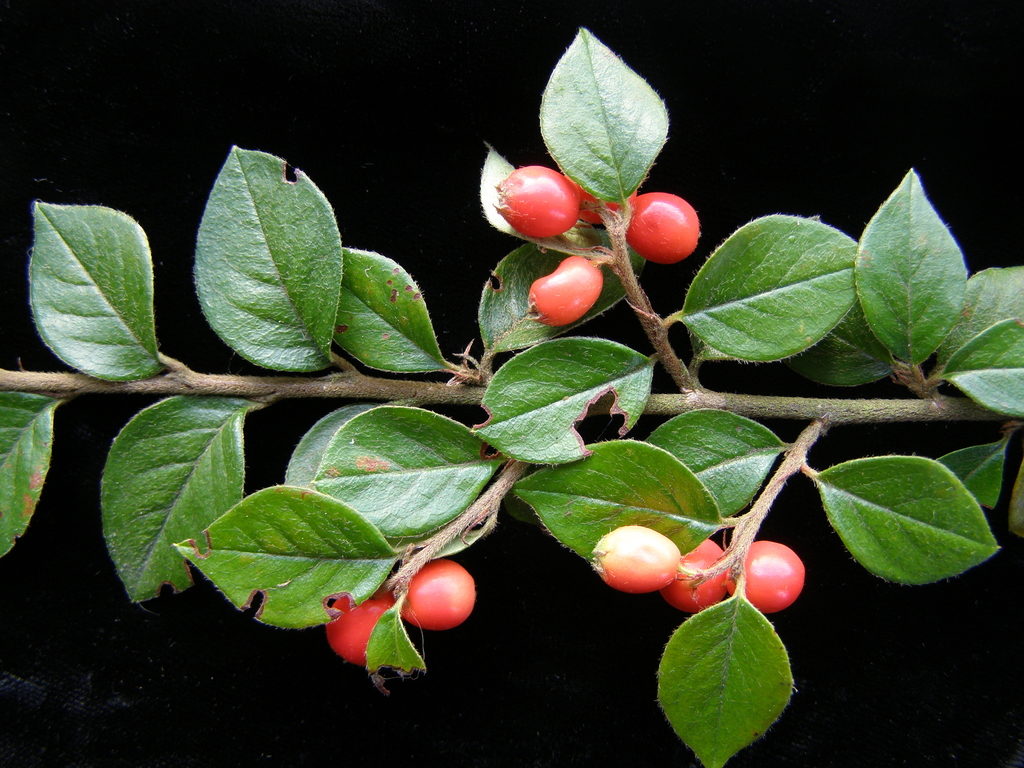
Himalayan cotoneaster
Cotoneaster simonsii
Cotoneaster simonsii (syn. Cotoneaster newryensis), the Himalayan cotoneaster, is a species of flowering plant in the family Rosaceae. It is native to Nepal, the eastern Himalayas, Assam, and Myanmar, and has been introduced to a number of locales in Europe, the west coast of North America, and Australia as a garden escapee. The Royal Horticultural Society considers it to be an undesirable invasive non-native species.
From the article Cotoneaster simonsii on Wikipedia (CC BY-SA), quoted section by section
Description
The species is 3–5 m (10–16 ft) tall. It apex is acute, while the base is either cuneate or obtuse. Its petioles are 5–7 mm (0.2–0.3 in) and are both strigose and villous. Its fertile shoots not to mention 3–5 leaves are 30–50 mm (1.2–2.0 in) in length with the stamens being of 18–20 mm (0.7–0.8 in) long. Both the fruits and the flowers are 7–8 mm (0.28–0.31 in) in length. The fruits are globose, obovoid, red and shiny, with green coloured calyx lobes which are flat. The flowers bloom in June, while fruits ripen from September to October.
How it is grown
As its synonym C. newryensis, it was first raised at Thomas Smith's Daisy Hill Nursery in Ireland from where it was moved to be distributed by Barbier Nursery in France. It appeared at Lemoine nursery catalogue by 1911 in Nancy, France. The plant has its detractors, such as garden designer Russell Page: "It is a horrid ungainly plant which I would usually exclude from any garden."
== References ==
Wikipedia: “Cultivation history”
Where it lives
Recorded sightings
—
geo-referenced records in GBIF, from museums, herbaria and field observers.
Drag the globe to turn it. Dots are where records exist, not a range map; darker means more records.
In the stacks
Searching the stacks…
Every page naming Cotoneaster simonsii in the Biodiversity Heritage Library →
This page is assembled live from iNaturalist, GBIF, Wikipedia, the Source Library and the Internet Archive. It is not yet part of the hand-edited codex. iNaturalist taxon 76461.