- Plants
- ›Vascular Plants
- ›flowering plants
- ›Dicots
- ›Mints, Plantains, Olives, and Allies
- ›broomrape family
- ›Pedicularideae
- ›Cordylanthus
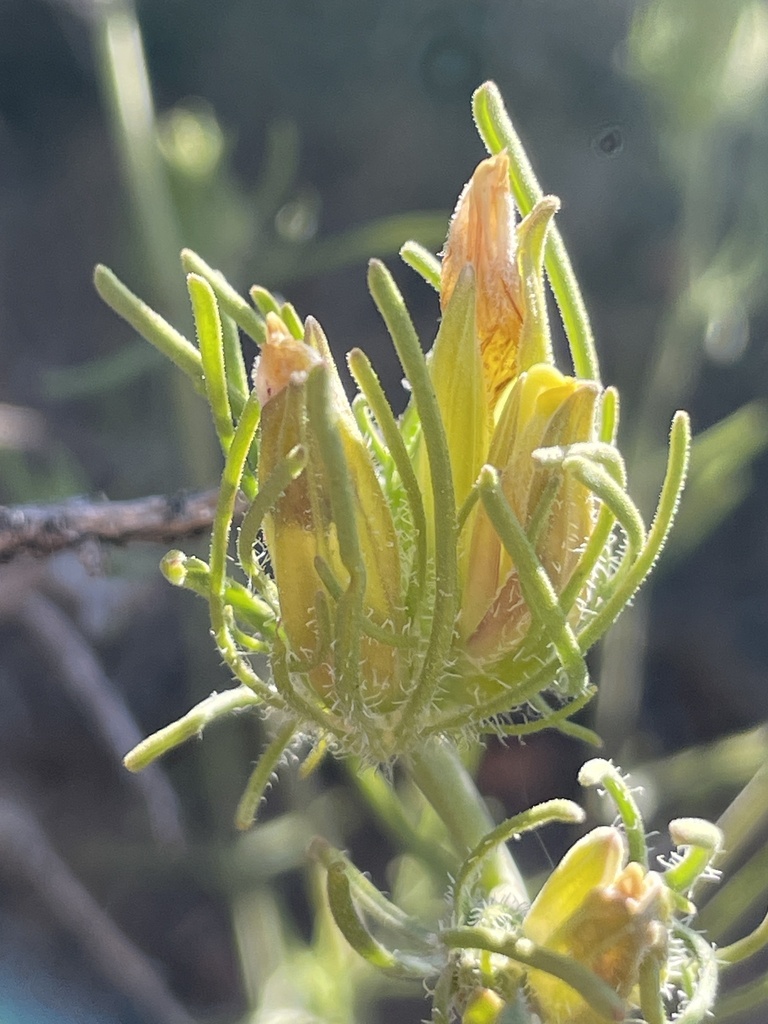
Bushy Bird's-beak
Cordylanthus ramosus
Cordylanthus ramosus is a species of flowering plant in the family Orobanchaceae known by the common name bushy bird's beak. It is native to the western United States where it grows in mountains and plateau, including the sagebrush of the Great Basin. It is an annual herb producing an erect, branching gray-green form, often tinted with red, becoming bushy at its most robust and appearing not unlike a sagebrush. The small leaves are narrow and linear or divided into several narrow, thready lobes. The inflorescence is a small spike of a few flowers surrounded by bracts which are linear or divided into narrow, thready lobes like the leaves. The bracts are faintly woolly and occasionally bristly in texture. The flower is one to two centimeters long with a hairy yellow pouch enclosed in darker, tougher reddish sepals. This plant had a number of historical medicinal uses for the Navajo people, who used it as an emetic.
From the article Cordylanthus ramosus on Wikipedia (CC BY-SA), quoted section by section
Description
Bushy bird's beak has stems that are covered in puberulent hairs, ones that are fine, short, and erect, though sometimes pilose, somewhat long and soft. They usually grow to between 10 and 30 centimeters (4 and 12 in), occasionally reaching as much as 90 cm (35 in). Its lower leaves are also covered in puberulent hairs and 1–4 cm long. They have three to five lobes, each 1–2 millimeters wide. Upper leaves are 1–1.5 cm long and just 0.5–1 mm wide and lack lobes.
Where it lives
Recorded sightings
—
geo-referenced records in GBIF, from museums, herbaria and field observers.
Drag the globe to turn it. Dots are where records exist, not a range map; darker means more records.
In the stacks
Searching the stacks…
Every page naming Cordylanthus ramosus in the Biodiversity Heritage Library →
This page is assembled live from iNaturalist, GBIF, Wikipedia, the Source Library and the Internet Archive. It is not yet part of the hand-edited codex. iNaturalist taxon 76443.