- Plants
- ›Vascular Plants
- ›flowering plants
- ›Dicots
- ›pinks, cactuses, and allies
- ›Amaranth family
- ›saltbush subfamily
- ›Chenopodieae
- ›Chenopodium
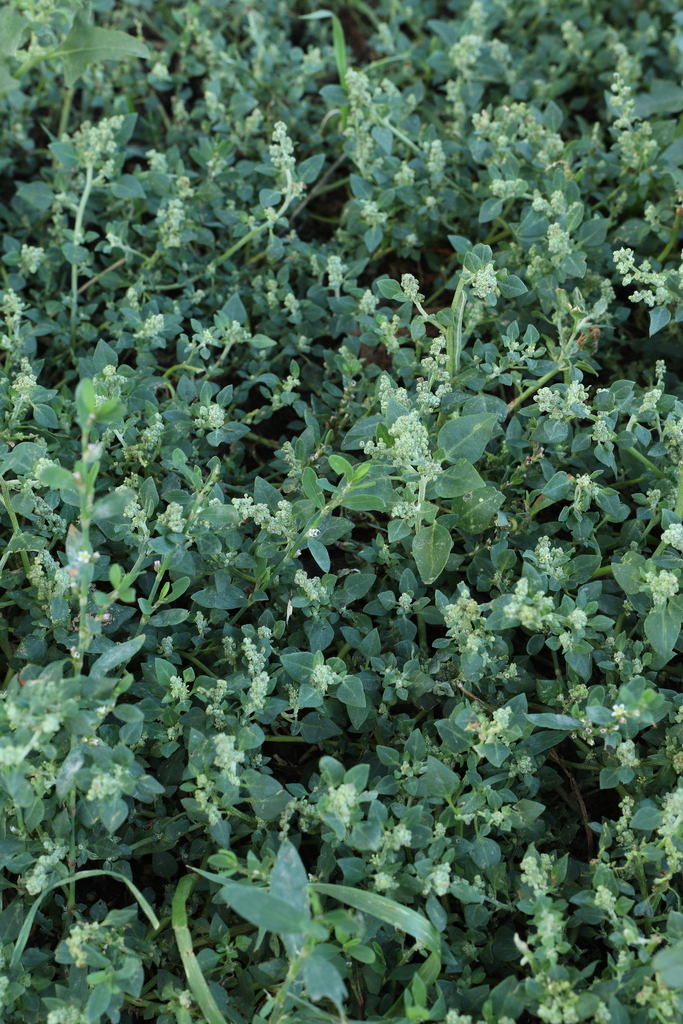
Stinking Goosefoot
Chenopodium vulvaria
Chenopodium vulvaria, stinking goosefoot is a foul-smelling plant that grows on bare ground in coastal habitats in the Mediterranean region and is associated with dung heaps and disturbed ground inland. It is native to southern Europe and western Asia and has spread to northern Europe and other temperate parts of the world with agriculture.
From the article Chenopodium vulvaria on Wikipedia (CC BY-SA), quoted section by section
Description
Stinking goosefoot is a small, prostrate to ascending annual with stems up to 60 cm (2 ft) long, smelling strongly of rotten fish. The stems are about 2 mm in diameter with reddish ridges and green mealy hollows. The leaves are grey-green, alternate, entire or with a single tooth, ovate to kite-shaped and measure 1.0–2.5 cm in length. Grey vesicular hairs are present on the stem and underside of the leaves giving it the 'mealy' appearance.
The inflorescence is a cyme consisting of small clusters of rounded green flowers with four to five tepals (perianth segments) and one to five stamens on the bisexual flowers, or just one style with two stigmas on the female flowers. The fruits are membranous achenes that fall with the remains of the perianth (flower parts). The shiny, blackish seeds are about 1.2 mm in diameter and are lens-shaped, with faint radial furrows on the testa (seed coat).
Range & habitat
The native distribution of stinking goosefoot is not entirely certain, but it is most likely to have been around the Mediterranean and Atlantic coasts of southern Europe and North Africa, spreading north by repeated introductions that tended not to persist. In recent times it has dispersed to many other areas around the globe, including both North and South America, Africa and Australasia. Stinking goosefoot has not yet been assessed for its global status, but in France Chénopode fétide is common in the south and generally has the status LC (least concern) in the Mediterranean départements, while in the north it is much rarer: in Picardy it is classified as CR (critically endangered), while it is VU (vulnerable) in Brittany, EN (endangered) in Alsace and Lower Normandy, and considered to be extinct in Upper Normandy. In Britain, it was shown in the 1950s to be present around the Thames Estuary and the southern coasts of England and Wales, with scattered populations as far north as southern Scotland. There had also (mostly historically) been a number of inland sites for it, but these were mostly considered to be introductions. Later studies showed a dramatic decline, including the loss of all the inland populations, and by the 1990s there were thought to be just 3 populations remaining. …
Wikipedia: “Distribution and status”
What it does
In Spain, stinking goosefoot is considered to be an annual therophyte of old fields, which is dispersed by ectozoochory (the seeds being attached to the skin or fur or feathers of animals). It is typical of bare ground and disappears as abandoned land undergoes natural succession. In Northern Europe, by contrast, it was historically often found in dung heaps, by the sides of roads, and at the bases of walls, leading to the conjecture that it is an archaeophyte which was frequently re-introduced from the south, by various (unknown) transport routes.
Although it occurs in several plant communities in France, there is one in which it is particularly characteristic, the Chenopodium vulvaria - Atriplex rosea association, which occurs in the Camargue and elsewhere. This is described as a "highly nitrophilic, thermophilic wasteland in the vicinity of stables and other nitrogenous places in the Mediterranean region." In central and eastern Europe the typical habitat for it is the Malva neglecta – Chenopodium vulvaria community, which occurs on roadside verges and disturbed and trampled soils. …
Wikipedia: “Habitat and ecology”
At the table
Following the doctrine of signatures, mediaeval herbals contain mainly gynaecological uses for stinking goosefoot. Culpeper was enthusiastic in his praise for this plant: "it is common almost upon every dunghill. The works of God are freely given to man, his medicines are common and cheap, and easily to be found. I commend it for an universal medicine for the womb, and such a medicine as will easily, safely, and speedily cure any disease thereof." By the 20th century, however, it had rather fallen out of favour with herbalists. The chemical that gives stinking goosefoot its characteristic smell, TMA is now used in chemical processes and is known to be toxic at high concentrations.
Wikipedia: “Uses”
Where it lives
Recorded sightings
—
geo-referenced records in GBIF, from museums, herbaria and field observers.
Drag the globe to turn it. Dots are where records exist, not a range map; darker means more records.
In the old herbals & bestiaries

In the stacks
Searching the stacks…
Every page naming Chenopodium vulvaria in the Biodiversity Heritage Library →
This page is assembled live from iNaturalist, GBIF, Wikipedia, the Source Library and the Internet Archive. It is not yet part of the hand-edited codex. iNaturalist taxon 76288.