- Plants
- ›Vascular Plants
- ›flowering plants
- ›Dicots
- ›Gentians, Dogbanes, Madders, and Allies
- ›gentian family
- ›Chironieae
- ›centauries, rose gentians, and Zeltneras
- ›Centaurium
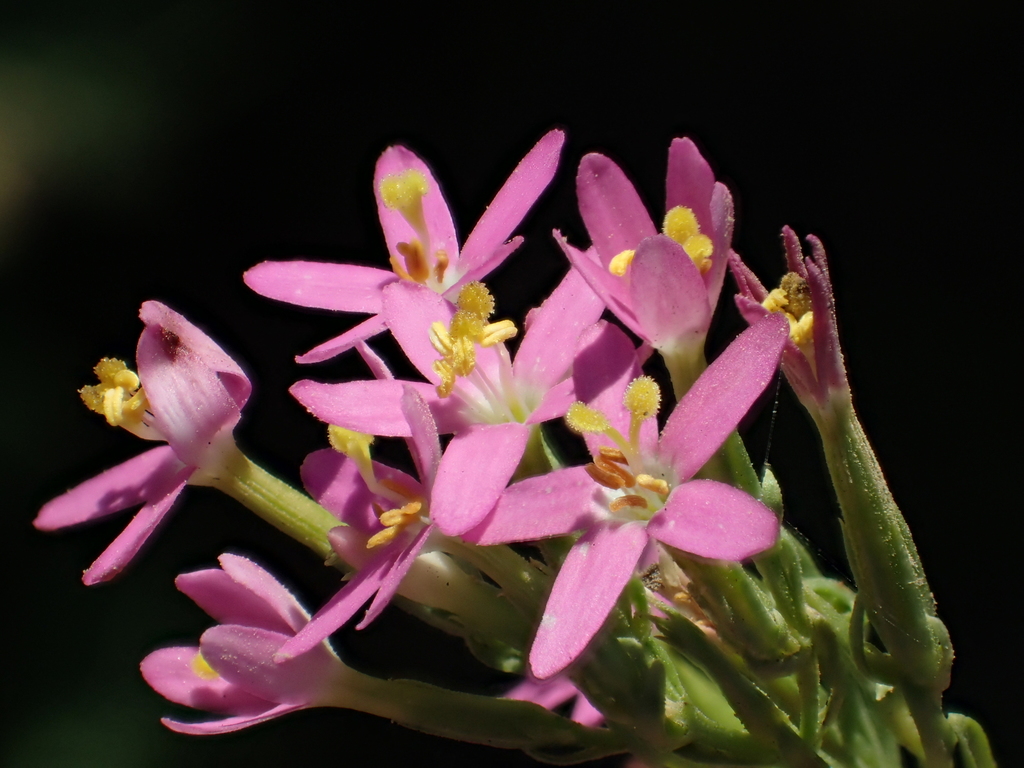
Lesser Centaury
Centaurium pulchellum
Centaurium pulchellum is a species of flowering plant in the gentian family known by the common name lesser centaury, or slender centaury. It differs from Centaurium erythraea by lacking basal rosette of leaves and by having a developed peduncle below the flowers. It is often much smaller, less than ten centimetres. It is native to the southern temperate parts of Europe.
From the article Centaurium pulchellum on Wikipedia (CC BY-SA), quoted section by section
Description
Lesser centaury is an erect annual herb branching from the base, often less than 10 cm (4 in) tall, and much smaller than common centaury (Centaurium erythraea). Sometimes it is reduced to a single stem with one flower. By the time it flowers, from June to September, there is no basal rosette. The leafy stem has opposite pairs of narrow oval leaves. The inflorescence is a group of a few pale pink star-like flowers, each with a short stalk, a tube and five narrow petals, about 1 cm (0.4 in) across, flat-faced with yellow anthers. Like other members of the family, the flowers close in the afternoon. The calyx is about as long as the fruit, which is a cylindrical capsule.
Range & habitat
This plant is found in the southerly temperate zones of Europe. It occurs mainly in the southern half of the British Isles, especially near the south coast of England. It grows on a range of soil types, from calcareous to mildly acidic. On the coast it can be found in open sandy and muddy turf, often in saltmarshes, sand dunes and beside estuaries. Inland it inhabits lowland dry, open grasslands, heaths, woodland glades and rides, marl pits and other unshaded, disturbed ground. In Morecambe Bay, it is at the northern end of its range on the saltmarshes, growing with Juncus gerardii, Juncus maritimus, Blysmus rufus and Eleocharis quinqueflora.
== References ==
Wikipedia: “Distribution and habitat”
Where it lives
Recorded sightings
—
geo-referenced records in GBIF, from museums, herbaria and field observers.
Drag the globe to turn it. Dots are where records exist, not a range map; darker means more records.
In the old herbals & bestiaries

De medicinali materia libri sex
Dioscorides · 1552 · p.368

On the Names of Plants
Hieronymus Bock (Tragus) · 1552 · p.212

Commentaries on the Six Books of Dioscorides
Pietro Andrea Mattioli · 1560 · p.471

Commentaries on the Six Books of Dioscorides on Medical Matter
Pietro Andrea Mattioli · 1563 · p.456

Six Groups of the History of Plants
Rembert Dodoens · 1583 · p.355

The Dutch Herbarium or Herbal
Petrus Nylandt · 1670 · p.134
In the stacks
Searching the stacks…
Every page naming Centaurium pulchellum in the Biodiversity Heritage Library →
This page is assembled live from iNaturalist, GBIF, Wikipedia, the Source Library and the Internet Archive. It is not yet part of the hand-edited codex. iNaturalist taxon 76217.