- Plants
- ›Vascular Plants
- ›flowering plants
- ›monocots
- ›grasses, sedges, cattails, and allies
- ›Sedges
- ›Cyperoideae
- ›Cariceae
- ›Carex
- ›Carex
- ›Vesicariae
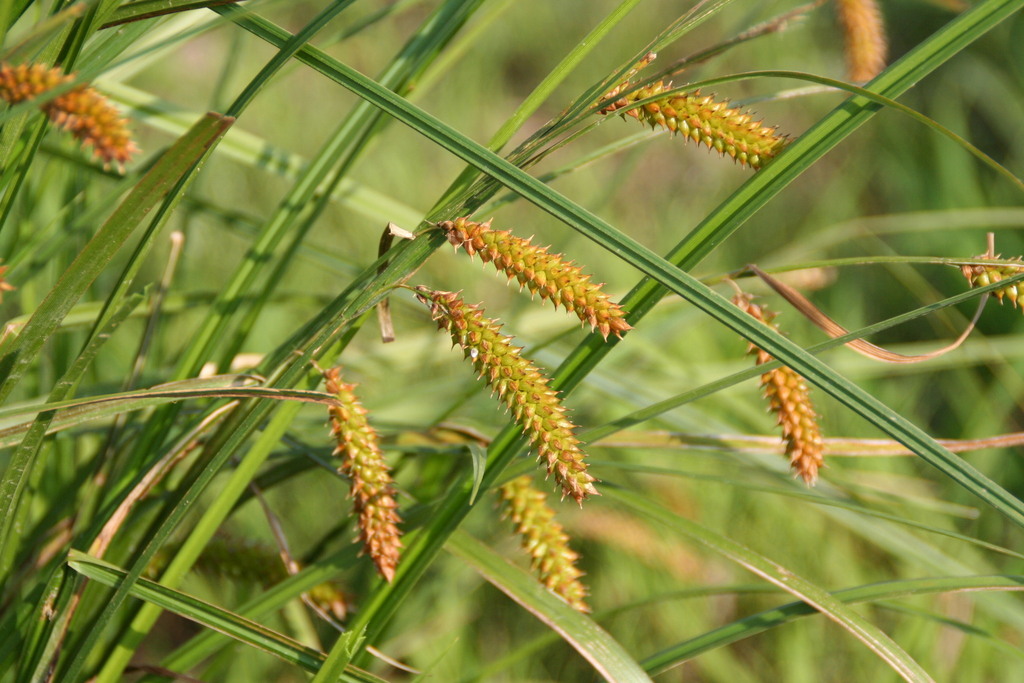
inflated sedge
Carex vesicaria
Carex vesicaria is an essentially Holarctic species of sedge known by the common names bladder-sedge, blister sedge. The dried fibers, sometimes used as thermal insulation in polar regions, are known as sennegrass, saennegrass or similar, from the plant's Bokmål name sennegras.
From the article Carex vesicaria on Wikipedia (CC BY-SA), quoted section by section
Description
Carex vesicaria is a perennial plant with short creeping rhizomes which grow shoots resembling small tufts. It grows to heights of 30 to 120 cm (12 to 47 in). Its stems are rough near the tip but smoother towards their base. The narrow, ridged and pleated leaves can grow to around 1 m (3.3 ft) in length or more, and have fine toothed edges and sharp points. The fruits are erect, glossy and bulbous. The flower clusters are long and cylindrical in shape and each contains up to 150 developing fruits.
Range & habitat
Bladder sedge has a circumpolar, boreo-temperate distribution. It is native to northern North America being recorded over most of Canada and the northern United States, as far south as California. It can also be found in nearly all of northern Europe and northern Asia as far as Japan and Korea. It is widespread in Britain and Ireland although it is absent from the Orkney and Shetland and very rare in the Western Isles.
Wikipedia: “Distribution”
At the table
Carex vesicaria was cultivated in North America by indigenous people as its rhizomes were used for basketry, The dried fibres, were sometimes used as thermal insulation in footwear in polar regions, are known as sennegrass, saennegrass or similar, from the plant's Bokmål name sennegras.
Wikipedia: “Uses”
Where it lives
Recorded sightings
—
geo-referenced records in GBIF, from museums, herbaria and field observers.
Drag the globe to turn it. Dots are where records exist, not a range map; darker means more records.
In the stacks
Searching the stacks…
Every page naming Carex vesicaria in the Biodiversity Heritage Library →
This page is assembled live from iNaturalist, GBIF, Wikipedia, the Source Library and the Internet Archive. It is not yet part of the hand-edited codex. iNaturalist taxon 76127.