- Plants
- ›Vascular Plants
- ›flowering plants
- ›Dicots
- ›myrtles, evening primroses, and allies
- ›evening primrose family
- ›Camissoniopsis
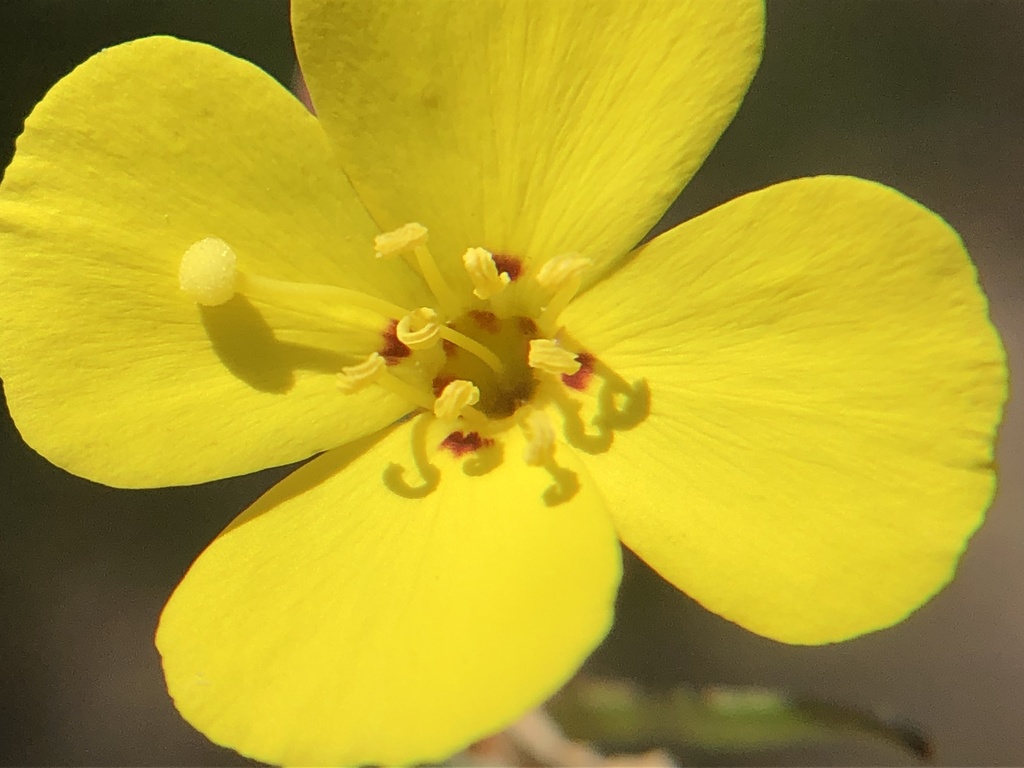
California sun cup
Camissoniopsis bistorta
Camissoniopsis bistorta is a species of flowering plant in the evening primrose family known by the common names southern suncup and California suncup. It is native to southern California and Baja California, where it grows in several types of plant community along the coast and in the coastal hills and mountain ranges. This is a hairy annual or short-lived perennial herb spreading from a basal rosette, with stems reaching up to 80 centimeters long. The leaves are narrow and sometimes toothed, and 1 to 12 centimeters in length. Toward the end of the spreading stems are nodding inflorescences of flowers, each flower with four bright yellow petals dotted with red at their bases.
From the article Camissoniopsis bistorta on Wikipedia (CC BY-SA), quoted section by section
Description
This herbaceous plant grows as an annual or short-lived perennial. It can be found in a wide range of sizes, with the young plants having a mean size of approximately 2 to 3 cm (0.79 to 1.18 in). It is covered in strigose or spreading hairs. The plant is occasionally simple, but most often several stems are present. The slender stems are prostrate or decumbent to relatively ascending, reaching 50 to 80 cm (20 to 31 in) in length, with older epidermis peeling. The leaves are alternately-arranged and measure 1.2 to 12 cm (0.47 to 4.72 in) long. Sometimes the leaves have a constriction on them, giving them a spatulate end with less hair. The basal leaves arise on petioles up to 4 cm (1.6 in) from a rosette, and are shaped narrowly elliptic. The cauline leaves tend to be (sub)sessile, and are generally shaped lanceolate, with the margins being minutely dentate (toothed) to roughly entire (smooth). The inflorescence is a spike that is nodding in bud. The hairs on the inflorescence are short and erect. The flowers are self-incompatible, and open at dawn. The hypanthium is 2 to 6 mm (0.079 to 0.236 in) long. There are 4 sepals, which are 5 to 8 mm (0.20 to 0.31 in) long. There are 4 yellow, fading red petals, which are 7 to 15 mm (0.28 to 0.59 in) long, with 1 to 2 red spots near the base. There are 8 stamens, with the anthers attached at the middle. …
Range & habitat
This species is native to California in the United States and Baja California in Mexico. In California, it is found in the southwestern portion of the state, from Kern and Ventura counties south to San Diego County and inland to the Peninsular Ranges and Transverse Ranges. In Baja California, this species is found from the border to inland to Tecate south to the Colonet area. Hybrids with Camissoniopsis cheiranthifolia are found on Pacific beaches between Tijuana and Ensenada. This species is commonly found growing in sandy fields near the coast, but is also found in clay soils in grasslands to openings in coastal sage scrub and chaparral. In some locations in San Diego County, it occurs with deceptively similar looking (when young) rare plants such as Chorizanthe orcuttiana and Mucronea californica.
Wikipedia: “Distribution and habitat”
Where it lives
Recorded sightings
—
geo-referenced records in GBIF, from museums, herbaria and field observers.
Drag the globe to turn it. Dots are where records exist, not a range map; darker means more records.
In the stacks
Searching the stacks…
Every page naming Camissoniopsis bistorta in the Biodiversity Heritage Library →
This page is assembled live from iNaturalist, GBIF, Wikipedia, the Source Library and the Internet Archive. It is not yet part of the hand-edited codex. iNaturalist taxon 75975.