- Plants
- ›Vascular Plants
- ›flowering plants
- ›monocots
- ›grasses, sedges, cattails, and allies
- ›grasses
- ›Paniceae, andropogoneae, paspaleae, and allies
- ›bluestems, lemon grasses, silvergrasses, and allies
- ›Anthistiriinae
- ›Bothriochloa
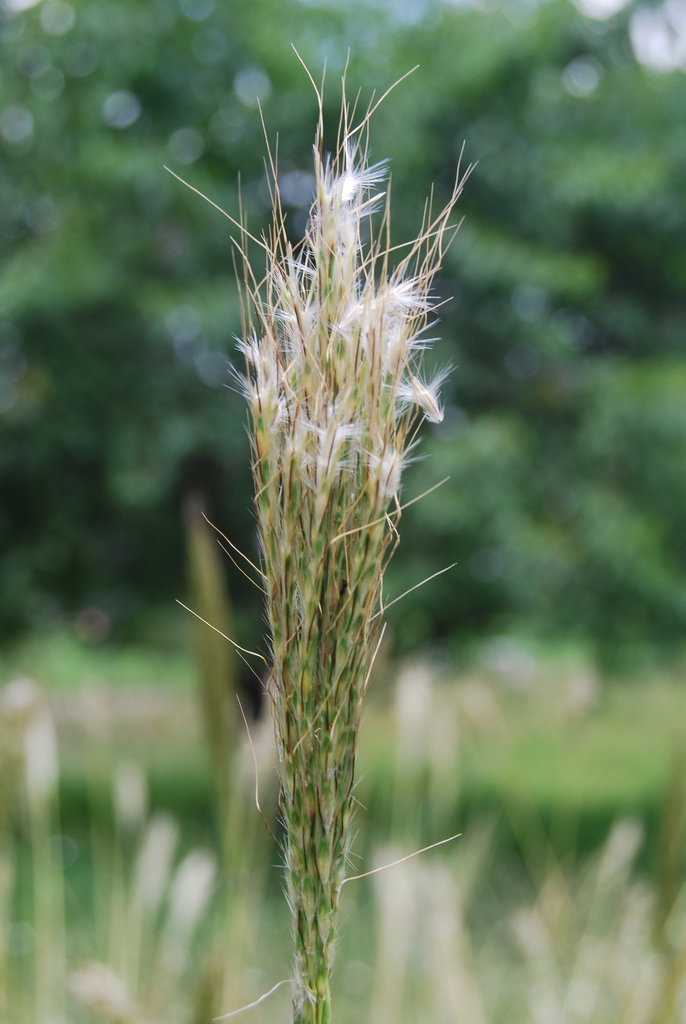
Cane Bluestem
Bothriochloa barbinodis
Bothriochloa barbinodis is a species of grass known by the common name cane bluestem. It is native to the Americas, including most of South and Central America, Mexico, and the southernmost continental United States from California to Florida.
It is a perennial bunchgrass growing in upright clumps 60 to 120 centimeters (24–48 inches) tall. The straw-colored stems have nodes at intervals, which are fringed with fluffy hairs. The leaves are 20 to 30 centimeters (8–12 inches) long and blue-green when new, drying to a reddish yellow. The inflorescence is a feathery array of spikelet units. Each unit is composed of one hairy, tan, fertile spikelet with a twisted awn up to 3.5 centimeters long twinned with a stalked, sterile spikelet which is much smaller and lacks an awn. The long-haired spikelets are wind-dispersed.
Where it lives
Recorded sightings
—
geo-referenced records in GBIF, from museums, herbaria and field observers.
Drag the globe to turn it. Dots are where records exist, not a range map; darker means more records.
In the stacks
Searching the stacks…
Every page naming Bothriochloa barbinodis in the Biodiversity Heritage Library →
This page is assembled live from iNaturalist, GBIF, Wikipedia, the Source Library and the Internet Archive. It is not yet part of the hand-edited codex. iNaturalist taxon 75841.