- Plants
- ›Vascular Plants
- ›flowering plants
- ›Dicots
- ›Mustards, Capers, and Allies
- ›mustard family
- ›Brassicoideae
- ›Camelinodae
- ›Cardamineae
- ›Armoracia
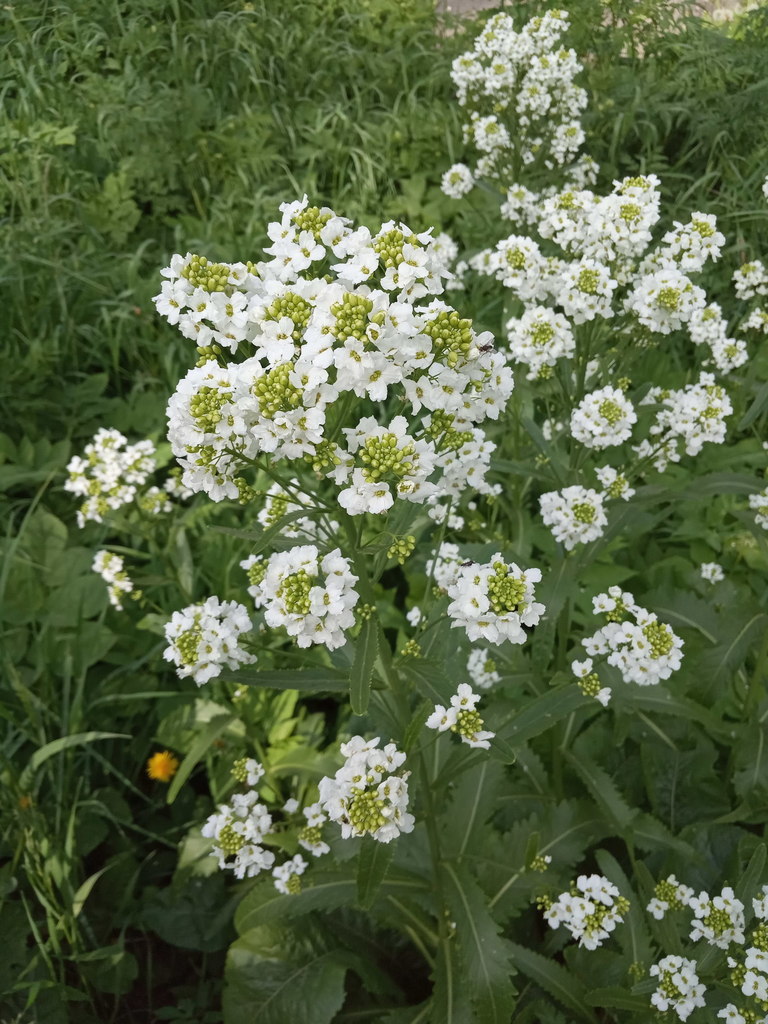
Horseradish
Armoracia rusticana
Horseradish (Armoracia rusticana, syn. Cochlearia armoracia) is a perennial plant of the family Brassicaceae (which also includes mustard, wasabi, broccoli, cabbage, and radish). It is a root vegetable, cultivated and used worldwide as a spice and as a condiment. The species is likely native to Southeastern Europe and Western Asia.
From the article Horseradish on Wikipedia (CC BY-SA), quoted section by section
Description
Horseradish grows up to 1.5 meters (5 feet) tall, with hairless bright green unlobed leaves up to 1 m (3 ft 3 in) long that may be mistaken for docks (Rumex). It is cultivated primarily for its large, white, tapered root. The white four-petalled flowers are scented and are borne in dense panicles. Established plants may form extensive patches and may become invasive unless carefully managed. Intact horseradish root has little aroma. When cut or grated, enzymes from within the plant cells digest sinigrin (a glucosinolate) to produce allyl isothiocyanate (mustard oil), which irritates the mucous membranes of the sinuses and eyes. Once exposed to air or heat, horseradish loses its pungency, darkens in color, and develops a bitter flavor.
At the table
The distinctive pungent taste of horseradish is from the compound allyl isothiocyanate. Upon crushing the flesh of horseradish, the enzyme myrosinase is released and acts on the glucosinolates sinigrin and gluconasturtiin, which are precursors to the allyl isothiocyanate. The allyl isothiocyanate serves the plant as a natural defense against herbivores. Since allyl isothiocyanate hurts the plant, it is stored in the harmless form of glucosinolate, separate from the enzyme myrosinase. When an animal chews the plant, the allyl isothiocyanate is released, repelling the animal. Allyl isothiocyanate is an unstable compound, degrading over days at 37 °C (99 °F). Because of this instability, horseradish sauces lack the pungency of freshly crushed roots. Cooks may use the terms "horseradish" or "prepared horseradish" to refer to the mashed (or grated) root of the horseradish plant mixed with vinegar. Prepared horseradish is white to creamy beige. It can be stored for up to 3 months under refrigeration, but eventually will darken, indicating less flavour. The leaves of the plant are edible as well, either cooked or raw when young, with a similar but less pronounced flavor. On Passover, many Ashkenazi Jews use grated horseradish as a choice for Maror (bitter herbs) at the Passover Seder.
Horseradish sauce. …
Wikipedia: “Culinary uses”
In medicine
The enzyme horseradish peroxidase (HRP), found in the plant, is used extensively in molecular biology and biochemistry primarily for its ability to amplify a weak signal and increase the detectability of a target molecule. HRP has been used in decades of research to visualize under microscopy and assess non-quantitatively the permeability of capillaries, particularly those of the brain.
Wikipedia: “Biomedical uses”
How it is grown
Horseradish is perennial in hardiness zones 2–9 and can be grown as an annual in other zones, although not as successfully as in zones with both a long growing season and winter temperatures cold enough to ensure plant dormancy. After the first frost in autumn kills the leaves, the root is dug and divided. The main root is harvested and one or more large offshoots of the main root are replanted to produce next year's crop. Horseradish left undisturbed in the garden spreads via underground shoots and can become invasive. Older roots left in the ground become woody, after which they are no longer culinarily useful, although older plants can be dug and re-divided to start new plants. The early season leaves can be distinctively different, asymmetric spiky before the mature typical flat broad leaves start to be developed.
Pests and diseases. Introduced by accident, "cabbageworms", the larvae of Pieris rapae, are a common caterpillar pest in horseradish. Mature caterpillars chew large, ragged holes in the leaves leaving the large veins intact. Handpicking is an effective control strategy in home gardens. Another common pest of horseradish is the mustard leaf beetle (Phaedon cochleariae). These beetles are undeterred by the defense mechanisms produced by Brassicaceae plants like horseradish.
Wikipedia: “Cultivation”
In human culture
Horseradish has been cultivated since antiquity. Dioscorides listed horseradish equally as Persicon sinapi (Diosc. 2.186) or Sinapi persicum (Diosc. 2.168), which Pliny's Natural History reported as Persicon napy; Cato discusses the plant in his treatises on agriculture. A mural in Ostia Antica shows the plant. Horseradish is probably the plant mentioned by Pliny the Elder in his Natural History under the name of Amoracia, and recommended by him for its medicinal qualities, and possibly the wild radish, or raphanos agrios of the Greeks. The early Renaissance herbalists Pietro Andrea Mattioli and John Gerard showed it under Raphanus. Its modern Linnaean genus Armoracia was first applied to it by Heinrich Bernhard Ruppius, in his Flora Jenensis, 1745, but Linnaeus himself called it Cochlearia armoracia. Both roots and leaves were used as a traditional medicine during the Middle Ages. The root was used as a condiment on meats in Germany, Scandinavia, and Britain. It was introduced to North America during European colonization; both George Washington and Thomas Jefferson mention horseradish in garden accounts. Native Americans used it to stimulate the glands, stave off scurvy, and as a diaphoretic treatment for the common cold. William Turner mentions horseradish as Red Cole in his "Herbal" (1551–1568), but not as a condiment. …
Wikipedia: “History”
Where it lives
Recorded sightings
—
geo-referenced records in GBIF, from museums, herbaria and field observers.
Drag the globe to turn it. Dots are where records exist, not a range map; darker means more records.
In the old herbals & bestiaries

Latin Herbal with German Synonyms
1486 · p.244

Book of Herbs
Hieronymus Bock (Tragus) · 1546 · p.593

Latin Herbal
1484 · p.243

Herbarius
1485 · p.244

Herbarius latinus (with Dutch synonyms)
1486 · p.241

The Book of Health: The Art of Distillation
Brunschwig, Hieronymus · 1505 · p.193

On the Names of Plants
Hieronymus Bock (Tragus) · 1552 · p.806

Commentaries on the Six Books of Pedanius Dioscorides on Medical Matter
Pietro Andrea Mattioli · 1565 · p.612

Six Groups of the History of Plants
Rembert Dodoens · 1583 · p.688

The Book of Household Management
Mrs Isabella Beeton · 1861 · p.269

The Book of Household Management
Mrs Isabella Beeton · 1861 · p.374

The Book of Household Management
Mrs Isabella Beeton · 1861 · p.641
In the stacks
Searching the stacks…
Every page naming Armoracia rusticana in the Biodiversity Heritage Library →
This page is assembled live from iNaturalist, GBIF, Wikipedia, the Source Library and the Internet Archive. It is not yet part of the hand-edited codex. iNaturalist taxon 75566.