- Plants
- ›Vascular Plants
- ›flowering plants
- ›Dicots
- ›Heathers, Balsams, Primroses, and Allies
- ›heath family
- ›madrones, bearberries, and allies
- ›Arctostaphylos
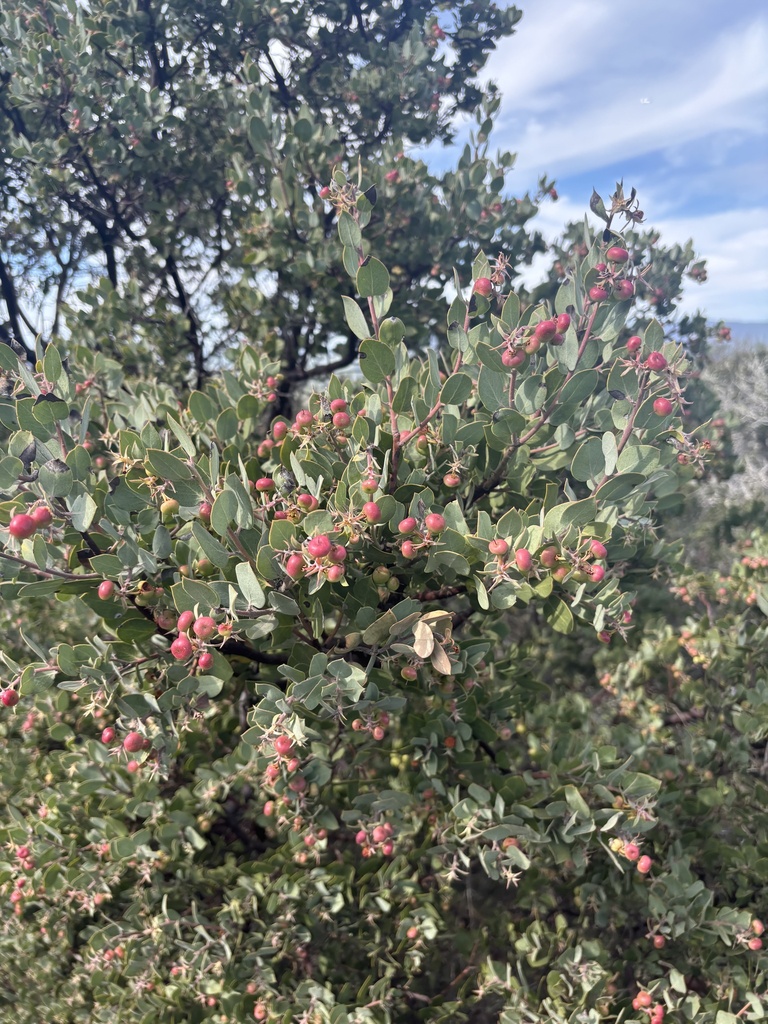
Bishop manzanita
Arctostaphylos obispoensis
Arctostaphylos obispoensis is a species of manzanita, known by the common names bishop manzanita and serpentine manzanita, endemic to California....
From the article Arctostaphylos obispoensis on Wikipedia (CC BY-SA), quoted section by section
Description
Arctostaphylos obispoensis is an upright shrub or multi-trunked tree growing to 1–4 metres (3.3–13.1 ft) in height. The small branches and newer leaves are woolly. The mature leaves are glaucous-gray, hairless, and oblong (northern range) to widely lance-shaped (southern range), and up to 4.5 centimeters long. The inflorescence is a dense cluster of white urn-shaped and downward facing "manzanita" flowers. The red fruit is a round waxy drupe, 9–14 millimetres (0.35–0.55 in) in diameter.
Range & habitat
The plant is endemic to the southern Santa Lucia Mountains, in the Central Coast region of California. It is found primarily in San Luis Obispo County, and extends into southern Monterey County. It grows in chaparral and closed-cone pine forest habitats, usually on serpentine soil. It is found at elevations of 60–950 metres (200–3,120 ft).
Conservation It is protected within the Cuesta Ridge Botanical Special Interest Area of the Los Padres National Forest, growing in the endemic Sargent cypress (Cupressus sargentii) forest. The species is listed on the California Native Plant Society Inventory of Rare and Endangered Plants as a rare but not currently endangered species.
Wikipedia: “Distribution”
Where it lives
Recorded sightings
—
geo-referenced records in GBIF, from museums, herbaria and field observers.
Drag the globe to turn it. Dots are where records exist, not a range map; darker means more records.
In the stacks
Searching the stacks…
Every page naming Arctostaphylos obispoensis in the Biodiversity Heritage Library →
This page is assembled live from iNaturalist, GBIF, Wikipedia, the Source Library and the Internet Archive. It is not yet part of the hand-edited codex. iNaturalist taxon 75530.