- Plants
- ›Vascular Plants
- ›flowering plants
- ›Dicots
- ›borages
- ›borage family
- ›Boraginoideae
- ›Boragineae
- ›Boragininae
- ›Anchusa
- ›Anchusa
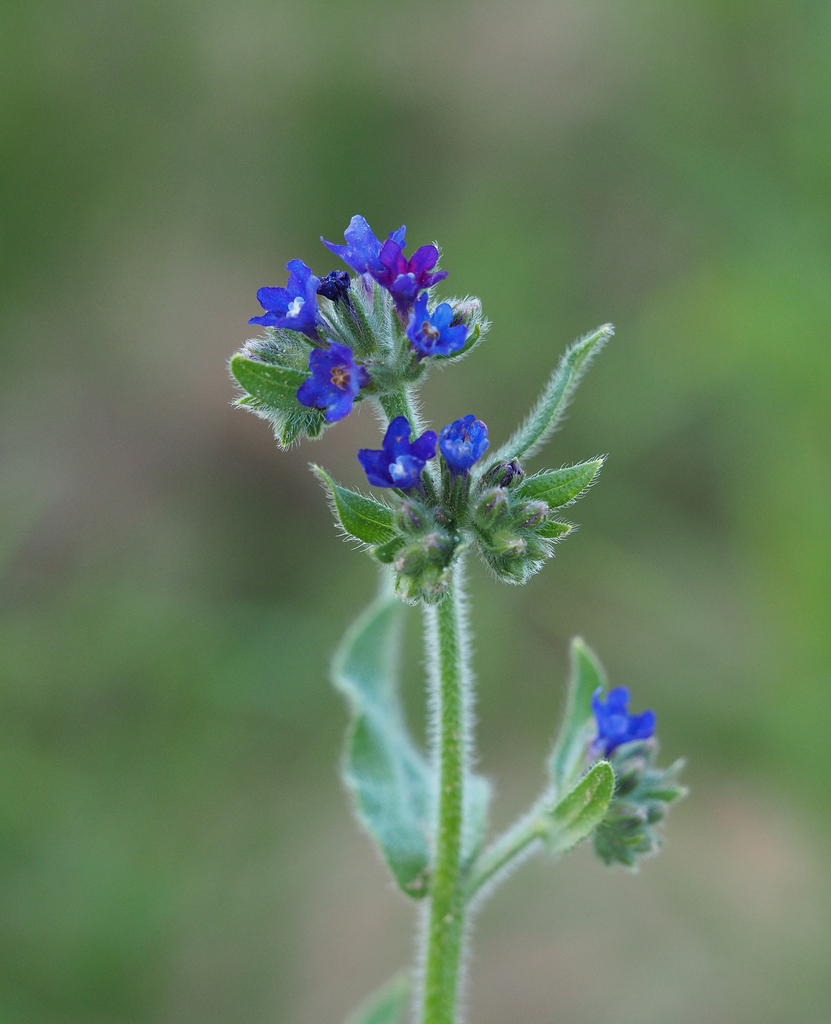
common alkanet
Anchusa officinalis
Anchusa officinalis, also knowns as common bugloss or common alkanet, is a species of flowering plant in the borage family. It is native to Europe and small parts of western Asia, but has been escaped from cultivation to grow in additional locations in Europe and the Americas. The flowers are noted for their popularity with bumblebees due to a large nectar flow. The plants have been used in traditional medicines, but were falling out of favor by the early 1800s. They are still planted in gardens for their popularity with bees and their blue flowers.
From the article Anchusa officinalis on Wikipedia (CC BY-SA), quoted section by section
Description
This herbaceous plant with well developed stems most often grows 40 to 70 centimeters (16 to 28 in) tall, but may reach 100 centimeters (39 in) tall in ideal conditions. It may be an annual, biennial, or perennial. The whole of the plant is covered in short, coarse hairs. Plants have a strong taproot that may be as long as one meter. Bugloss has leaves that are shaped like a narrow spear head (lance-linear), with the widest portion in the middle and tapering towards both ends. Leaves located lower down on the stems have their own leaf stems while those towards the ends of the stems have bases that clasp the stem. Leaves are arranged alternately on the stem. The length of the leaves is 6–20 centimeters (2.4–7.9 in) and the width is 1–2.5 centimeters.
The flowering clusters (cymes) at the ends of the stems are densely packed with blooms along one side of the stem. When new the flowers are dark pink or crimson in color and typically become dark purple-blue with a white center as they age. However, they may also be violet, reddish, white, or yellowish in color. The fused petals (the corolla) are 6–11 millimeters long and 6–11 millimeters wide. When blooming the sepals (calyx) may be 5–7 millimeters long, but they persist into fruiting and become 8–12 millimeters long. The white center of the flowers are scales that close the throat of the flower. …
Range & habitat
The native range of the species is in Europe from France into Russia west of the Ural Mountains and then south in to Kazakhstan. It has been introduced to additional places in Europe such as the United Kingdom, Ireland, Belgium, and Finland. It has also been introduced to North America and is found on the Pacific coast from British Columbia to California and in many of the Rocky Mountain states including Idaho, Montana, Utah, and Colorado. In the eastern US, it is found in Connecticut, Illinois, Maine, Massachusetts, Michigan, New Hampshire, New Jersey, New York, Ohio, Ontario, Pennsylvania, Rhode Island, and Wisconsin. Elsewhere, it also grows in northeastern Argentina. Common alkanet grows in varied environments such as sandy grasslands in coastal dunes, wastelands that were formerly developed or farmed areas, in shrub communities, the slopes of former quarry sites, and along roadsides.
Wikipedia: “Range and habitat”
What it does
The plant provides a great deal of nectar for pollinators. It was rated ninth in nectar production (nectar per unit cover per year) in a UK plants survey conducted by the Agriland project. Bumblebees and cuckoo bumblebees visit the flowers of common bugloss significantly more frequently than other bees, often representing over 90% of the visitors to flowers. The common European species, Bombus subterraneus, is one that is specifically identified as a pollinator. Females of the specialist bee species Hoplitis adunca only visit flowers of genus Echium to collect pollen, but they frequently visit other blue flowers like Anchusa officinalis to collect nectar.
Weed status. Common bugloss has been considered a noxious weed in Washington State since 1988 with prohibitions on transporting or selling plants in the state. It is similarly listed as a noxious weed in Oregon on their "B List" and "T List", as a regionally common weed that is a focus of preventive control. In British Columbia it is listed as an invasive plant and a "regional noxious weed" in the Regional District of Kootenay Boundary. It is of concern in agriculture both for competing with more desirable forage species in fields and for causing baled hay to rot due to the high moisture content of its leaves.
Wikipedia: “Ecology”
At the table
The young leaves and young shoots of bugloss, when the hairs are still soft, are eaten in southern France and parts of Germany. Like the leaves of spinach they are steamed or boiled before consumption. Young leaves are also sometimes used in salads. However, the pyrrolizidine alkaloid lycopsamine has been found in the seeds and the upper parts of the plant. While there are no records of toxic effects in humans or animals similar unsaturated pyrrolizidine alkaloids have caused toxic effects and further studies have been urged as the plant flowers are occasionally sold as a food ingredient.
Wikipedia: “Culinary”
In medicine
Though physicians in his time regarded Nicholas Culpeper as "something of a fraud", his book The English Physician Enlarged was also very popular, five editions of it being printed before 1698. Culpeper wrote of Anchusa officinalis under the names "alkanet", "orchanet", "Spanish bugloss", and "enchusa". He claimed many virtues for the plant, including that it would cure snake bites and the extraordinary claim that, "if any one that hath newly eaten it, do but spit into the mouth of a serpent, the serpent instantly dies." In European medical herbalism it was used prior to about 1810 for having "aperient and refrigerant" virtues (laxative and fever lowering). However, the physician and botanist William Woodville wrote, "as all the common oloraceous plants are cooling and laxative, these properties are no peculiar recommendation of Bugloss." The Greek physician in the 1st century Pedanius Dioscorides wrote of the astringent effect of the root of common bugloss. He also said that it was effective for the healing of burns and old ulcers when the root was boiled in oil. Preparations of the root were also used externally to treat pain and soothe the skin as well as promoting wound healing. The late medieval botanist Hieronymus Bock recommended it to treat depression and strengthen the heart. …
Wikipedia: “Traditional uses”
Where it lives
Recorded sightings
—
geo-referenced records in GBIF, from museums, herbaria and field observers.
Drag the globe to turn it. Dots are where records exist, not a range map; darker means more records.
In the old herbals & bestiaries


In the stacks
Searching the stacks…
Every page naming Anchusa officinalis in the Biodiversity Heritage Library →
This page is assembled live from iNaturalist, GBIF, Wikipedia, the Source Library and the Internet Archive. It is not yet part of the hand-edited codex. iNaturalist taxon 75430.