- Plants
- ›Vascular Plants
- ›flowering plants
- ›Dicots
- ›Roses, Elms, Figs, and Allies
- ›rose family
- ›brambles, roses, strawberries, and allies
- ›agrimonies and burnets
- ›burnet subtribe
- ›Acaena
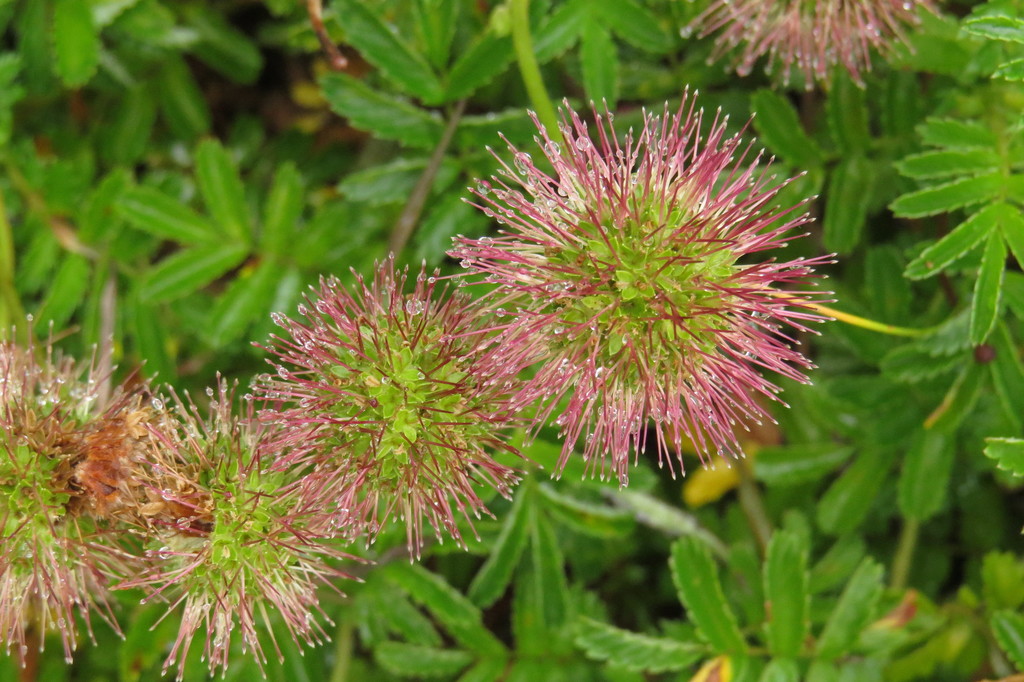
Sand bidibid
Acaena pallida
Acaena pallida, commonly known as the sand bidibid, sand piripiri, pale bidibid, or dune buzzy, is a prostrate, herbaceous plant in the Rosaceae family that is native to New Zealand and south-eastern Australia, including Tasmania. It lives in coastal areas, primarily on sand dunes.
From the article Acaena pallida on Wikipedia (CC BY-SA), quoted section by section
Description
Acaena pallida is a small perennial, herbaceous plant with a prostrate, stoloniferous growth habit. The main stems reach up to 1m in length and are usually 3-4mm in diameter. Younger stems are green and densely hairy, while older stems are tough and woody with dark brown bark, and may be as thick as 10mm. Erect stems reach up to 15cm in height. Stolons will root at the nodes, allowing the plant to expand and form a loose, trailing mat. The leaves are 2.5-12cm in length, divided into 9-15 leaflets, 45-100mm long, with many blunt teeth. The upper surface of the leaf is glossy green with a wrinkled appearance. The lower surface is hairy and pale green to white, with epicuticular wax.
The inflorescence scape is 7-18cm long and hairy, terminating in a spherical inflorescence head of 80-90 florets. The head is approximately 10-12mm in diameter at flowering, reaching 25-40mm at fruiting. The individual florets consist of: 4 sepals, ovate to oblong and hairy underneath; 2 stamens, with white anthers; and 1 style, which is white. The florets have no petals. The fruit are conical and hairy, becoming dry and brown at maturity, with 4 barb-tipped spines on the top, and 1-2 much shorter subsidiary spines lower down on the fruit. The 4 top spines are red to light brown and 10-20mm long. Information on phenology varies between sources. …
Range & habitat
Acaena pallida is a specialist species that grows exclusively in coastal regions, where it is found primarily on sand dunes and in dune swales, and sometimes on fine gravels. It favours disturbed, unstable sand, particularly the foredune, and acts as a pioneer species colonizing and stabilizing these areas. It favours open, high sunlight areas with good drainage.
Wikipedia: “Habitat”
What it does
Acaena pallida has a "guerilla" growth strategy, meaning that it foregoes density in favour of rapid lateral expansion of stolons. This strategy is associated with species that like disturbance, allowing the plant to act as a pioneer species and opportunistically colonise newly disturbed areas. It functions as a sand binding plant, helping to stabilise sand dunes. Wind-blown sand is trapped by the dense hairs on the stems and the loose mat-like structure of the plant. The barbed spines present on A. pallida fruit can attach to animal fur or feathers, or human clothing, helping to disperse seed over longer distances. In Tasmania, it is commonly found as an understorey component of Austrofestuca littoralis grassland.
== References ==
Wikipedia: “Ecology”
Where it lives
Recorded sightings
—
geo-referenced records in GBIF, from museums, herbaria and field observers.
Drag the globe to turn it. Dots are where records exist, not a range map; darker means more records.
In the stacks
Searching the stacks…
Every page naming Acaena pallida in the Biodiversity Heritage Library →
This page is assembled live from iNaturalist, GBIF, Wikipedia, the Source Library and the Internet Archive. It is not yet part of the hand-edited codex. iNaturalist taxon 75257.