- Plants
- ›Vascular Plants
- ›flowering plants
- ›Dicots
- ›Roses, Elms, Figs, and Allies
- ›rose family
- ›brambles, roses, strawberries, and allies
- ›agrimonies and burnets
- ›burnet subtribe
- ›Acaena
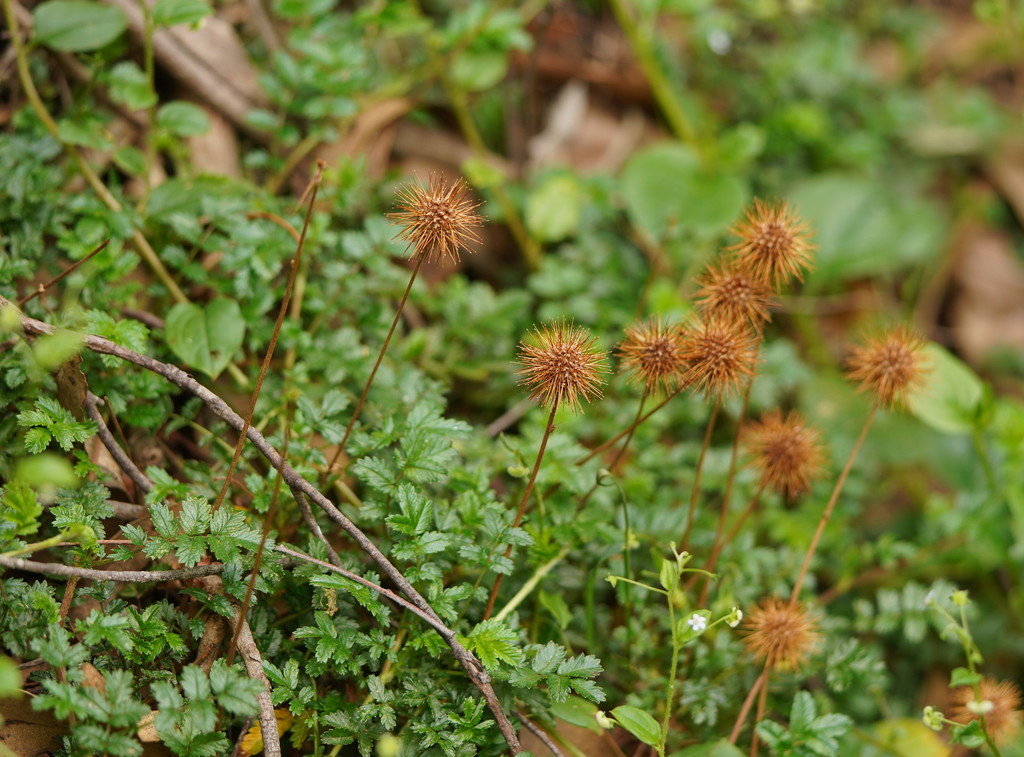
Biddy-biddy
Acaena novae-zelandiae
Acaena novae-zelandiae (bidi-bidi, biddy-biddy, bidgee-widgee, or piri-piri-bur) is an ornamental plant native to New Zealand and Australia. It can also be found elsewhere as an introduced species, and is considered a noxious weed in some areas, such as Hawaii and California. The common name bidi-bidi is a corruption of the Māori name for this plant, piripiri.
From the article Acaena novae-zelandiae on Wikipedia (CC BY-SA), quoted section by section
Description
Acaena novae-zelandiae is a small herbaceous perennial. It is stoloniferous with prostrate stems of 1.5 – 2 mm diameter. Damage to stolons encourages new shoots to be produced. It has imparipinnate leaves, with 9–15 toothed, oblong leaflets, which are approximately 2 –11 cm long. The adaxial surface of the leaves is dark green and shiny, and the abaxial surface is hairy and glaucous green in colouration. The rachis of the leaves is often red.
The scape is 10 – 15 cm long and bears a globular, terminal inflorescence, of 20 – 25 mm diameter, with 70 – 100 flowers. The flowers lack petals and can range in colour from green to white or purple. The flowers are wind pollinated. Each flower produces one achene, bearing four approximately 10 mm long spines, tipped with barbs, which aid dispersal by attaching to wool, feathers and various clothing materials. When the fruit are ripe, these spines are red in colouration, later becoming brown.
Range & habitat
Red bidibid is native to New Zealand, Australia and New Guinea. It has also become naturalised in California, Great Britain and Ireland. It is regarded as invasive in Great Britain where it has established itself in places such as dune habitats on Lindisfarne. It occurs within a wide range of habitats, including woodlands, shrublands and grasslands, from coastal areas to alpine areas. It grows in freely draining soils such as silty and sandy loams, typically on sites which receive a high amount of sunlight. It also establishes readily on disturbed sites such as roadsides.
Wikipedia: “Distribution and habitat”
At the table
Acaena novae-zelandiae may be used for ground cover in gardens or as a lawn substitute. This plant can be prevented from spreading by limiting disturbance to stolons, thus reducing vegetative propagation, and by mowing flowers before the burrs form. It has also been suggested that dried "tiny tips" of young succulent leaves may be brewed as tea.
Wikipedia: “Uses”
Where it lives
Recorded sightings
—
geo-referenced records in GBIF, from museums, herbaria and field observers.
Drag the globe to turn it. Dots are where records exist, not a range map; darker means more records.
In the stacks
Searching the stacks…
Every page naming Acaena novae-zelandiae in the Biodiversity Heritage Library →
This page is assembled live from iNaturalist, GBIF, Wikipedia, the Source Library and the Internet Archive. It is not yet part of the hand-edited codex. iNaturalist taxon 75256.