- Plants
- ›Vascular Plants
- ›flowering plants
- ›Dicots
- ›Mints, Plantains, Olives, and Allies
- ›figwort family
- ›Myoporeae
- ›Myoporum
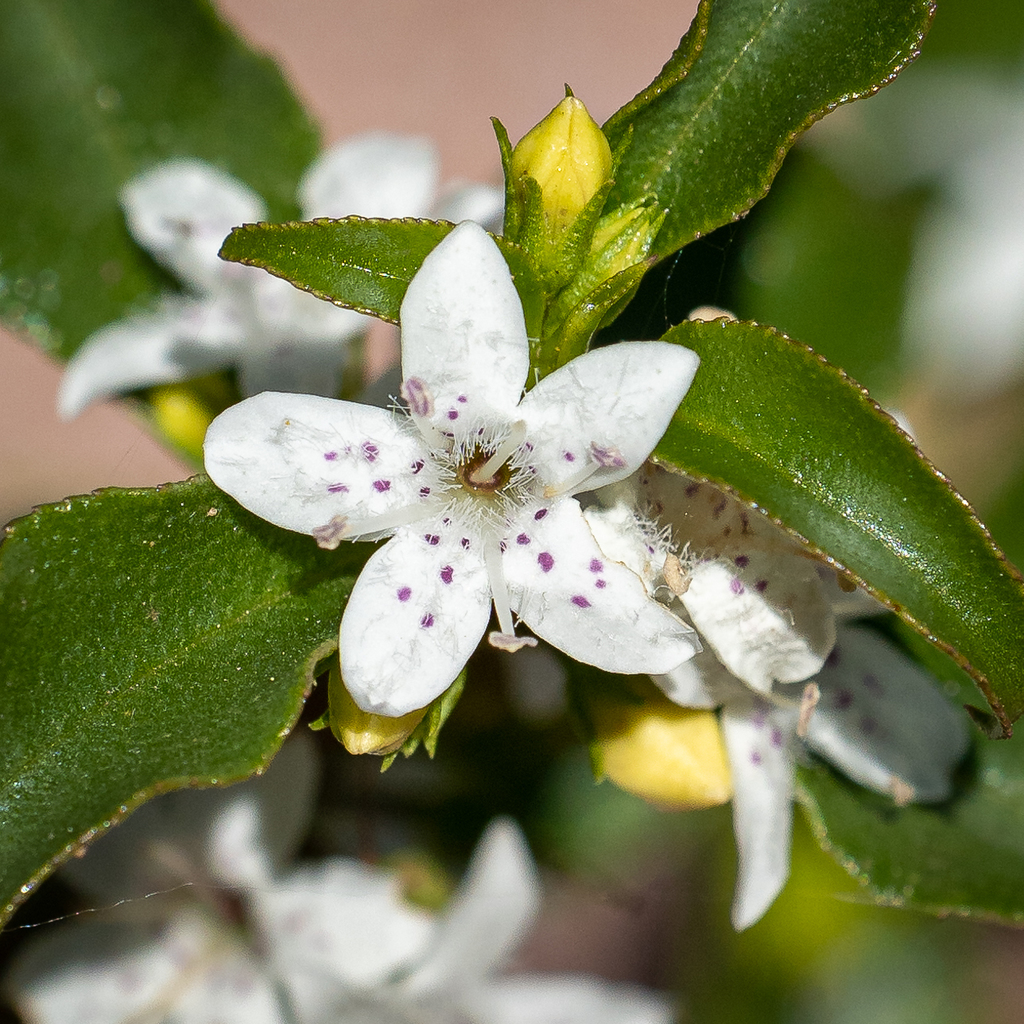
Myoporum viscosum
Myoporum viscosum, commonly known as sticky boobialla, is a plant in the figwort family, Scrophulariaceae and is endemic to South Australia. It is unusual in that sometimes, especially when the leaves are crushed, it has an extremely unpleasant smell.
From the article Myoporum viscosum on Wikipedia (CC BY-SA), quoted section by section
Description
Myoporum viscosum is a shrub which sometimes grows to 2 metres (7 ft) in height with young branches that are flattened and sticky. The leaves are arranged alternately and mostly 20–52 millimetres (0.8–2 in) long, 7–20 millimetres (0.3–0.8 in) wide, thick and stiff. The base of the leaf partly wraps around the stem and the leaf blade is folded or curved with serrated edges and has many oil dots. The flowers appear in the leaf axils in clusters of 5 to 8 on a stalk 4–8 millimetres (0.2–0.3 in) long. There are 5 triangular sepals and 5 petals joined at their bases to form a bell-shaped tube. The petals are white with a slight purplish flush and purple spots. The petal tube is 3–4 millimetres (0.1–0.2 in) long, the lobes are about the same length and the inside of the tube as well as the bases of the lobes are hairy. The main flowering period is from June to November and is followed by fruits which are succulent, rounded purplish drupes around 3–5 millimetres (0.1–0.2 in) in diameter.
Range & habitat
For many years this species has been confused with the much more common species Myoporum petiolatum which has thinner, noticeably petiolate and non-odorous leaves. Myoporum viscosum has a restricted distribution encompassing Kangaroo Island and coastal areas of the Eyre and Yorke peninsulas.
Wikipedia: “Distribution and habitat”
How it is grown
Sticky boobialla is a hardy plant which can tolerate salt spray and can be used as a low screening plant. It is readily propagated from cuttings and grows best in full sun.
== References ==
Wikipedia: “Use in horticulture”
Where it lives
Recorded sightings
—
geo-referenced records in GBIF, from museums, herbaria and field observers.
Drag the globe to turn it. Dots are where records exist, not a range map; darker means more records.
In the stacks
Searching the stacks…
Every page naming Myoporum viscosum in the Biodiversity Heritage Library →
This page is assembled live from iNaturalist, GBIF, Wikipedia, the Source Library and the Internet Archive. It is not yet part of the hand-edited codex. iNaturalist taxon 752220.