- Animals
- ›Chordates
- ›Vertebrates
- ›Mammals
- ›Therians
- ›Placental Mammals
- ›Primates, Rodents, and Allies
- ›Rodents
- ›Mice, Rats, and Hamsters
- ›Muroids
- ›Hamsters, Voles, Lemmings, and Allies
- ›South American Mice and Rats
- ›Rice Rats
- ›Transandinomys
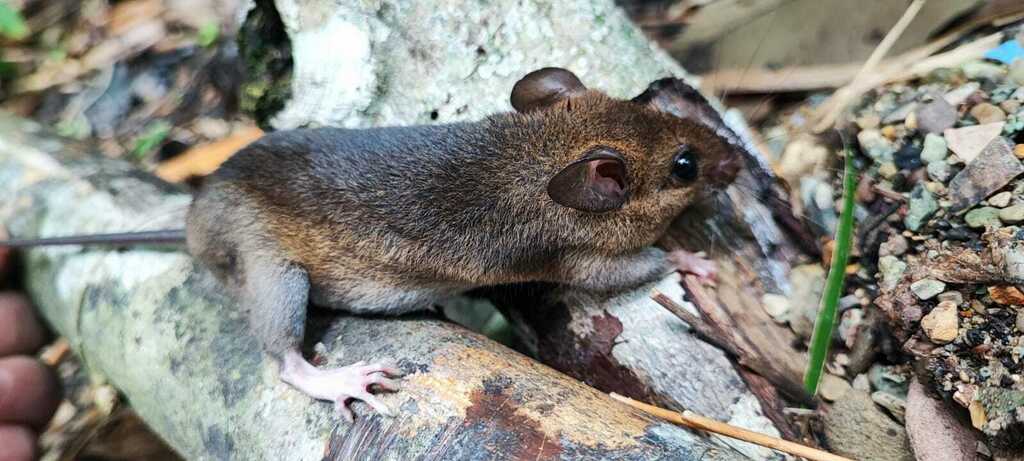
Bolivar rice rat
Transandinomys bolivaris
Transandinomys bolivaris, also known as the long-whiskered rice rat, is a rodent in the genus Transandinomys. It is found in humid forest from northeastern Honduras to western Ecuador, up to 1,800 m (5,900 ft) above sea level. Since it was first described in 1901 from Ecuador, six scientific names have been introduced for it, but their common identity was not documented until 1998 and the species has long been known under the name Oryzomys bombycinus, described from Panama...
From the article Transandinomys bolivaris on Wikipedia (CC BY-SA), quoted section by section
Description
Transandinomys bolivaris is a medium-sized rice rat with very long superciliary vibrissae (more than 50 mm (2.0 in) long and extending well beyond the ears when laid back against the head). According to Fiona Reid's Mammals of Southeastern Mexico & Central America, it is distinguishable from any similarly sized rice rats by the length of these whiskers; T. talamancae also has long superciliary vibrissae, but not as long as in T. bolivaris. In both species, the mystacial vibrissae (above the mouth) are also long and extend beyond the ears when laid back, but they are again much longer in T. bolivaris. The vibrissae are mostly dark, but translucent at the tips. Handleyomys alfaroi, a rice rat with which young T. bolivaris are often confused, is much smaller. In T. bolivaris, the cheeks may be light gray, buff, or reddish. The ears are dark brown to black and are sparsely haired.
The fur, which is soft, dense, and thick, is dark brown to gray on the upperparts, grading to black on the midback and yellowish brown on the sides. The underparts are sharply different in color. There, the hairs are dark gray at their bases and white at the tips, so that the fur appears grayish white. The fur is shorter and darker than in T. talamancae and softer and thicker than in H. alfaroi. Young animals have darker, finer, and softer fur. …
Range & habitat
Transandinomys bolivaris is an uncommon species. Its known distribution extends from northeastern Honduras, on the Caribbean seaboard, through eastern Nicaragua, Costa Rica, and Panama, into coastal western Colombia and northwestern and west-central Ecuador. It has been found near sea level and the upper altitudinal records are at nearly 1,500 m (4,900 ft) in Panama and 1,800 m (5,900 ft) in Ecuador. This distribution coincides with that of the humid Transandean forest. It generally occurs in areas with mean temperatures above 16 °C (60.8 °F) and annual rainfall of 4,000 to 6,000 mm (157 to 236 in), prefers mid-elevation forests (600 to 900 m or 1,970 to 2,950 ft), and often occurs near water. The actual range of this species may be expected to extend further north and west, perhaps into Veracruz, southern Mexico, and western Venezuela, where it has not yet been recorded. Omar Linares mentioned a possible record from the Lake Maracaibo region of northwestern Venezuela in 1998. Its range is similar to that of various other rainforest animals, including the semiplumbeous hawk (Leucopternis semiplumbeus), the rice rats Sigmodontomys alfari and S. aphrastus, the spiny rats Proechimys semispinosus and Hoplomys gymnurus, and the opossum Marmosa zeledoni. T. talamancae and H. alfaroi are often found in the same localities as T. …
Wikipedia: “Distribution, ecology, and behavior”
Listen
Looking for field recordings…
Where it lives
Recorded sightings
—
geo-referenced records in GBIF, from museums, herbaria and field observers.
Drag the globe to turn it. Dots are where records exist, not a range map; darker means more records.
In the stacks
Searching the stacks…
Every page naming Transandinomys bolivaris in the Biodiversity Heritage Library →
This page is assembled live from iNaturalist, GBIF, Wikipedia, the Source Library and the Internet Archive. It is not yet part of the hand-edited codex. iNaturalist taxon 75197.