- Animals
- ›Chordates
- ›Vertebrates
- ›Mammals
- ›Therians
- ›Placental Mammals
- ›Primates, Rodents, and Allies
- ›Primates
- ›Monkeys, Apes, and Tarsiers
- ›Monkeys and Apes
- ›Apes and Old World Monkeys
- ›Old World Monkeys
- ›Colobines
- ›Langurs, Surilis, and Lutungs
- ›Pygathrix
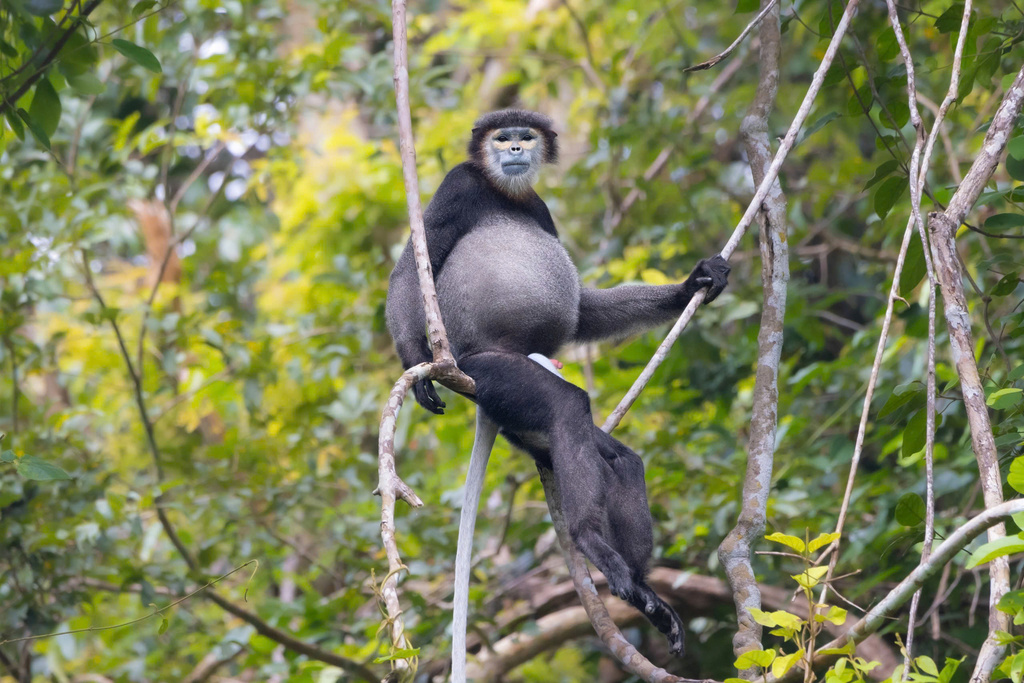
Black-shanked Douc Langur
Pygathrix nigripes
The black-shanked douc (Pygathrix nigripes) is an endangered species of douc found mostly in the forests of Eastern Cambodia, with some smaller populations in Southern Vietnam. The region they are mostly found in is called the Annamite Range, a mountainous area that passes through Cambodia and Vietnam. Its habitat is mostly characterized by evergreen forest in the mountains, in the middle to upper canopy. They move around quadrupedally and by brachiation up in the trees. This species is unique with its coloration among the doucs as it has a bluish face with yellow rings around its eyes a blue scrotum and a pink penis. Like other doucs, this species has a tail as long as its body and head length. Black-shanked douc have been observed in groups ranging from 3 to 30 individuals, depending on their habitat. Group tend to have a fission-fusion dynamic that changes with food availability. Their diet varies from dry to wet season. Regardless of the season, their diet consists mostly of leaves, but they have also been found to consume considerable amounts of fruits and flowers during wet season. The species changed conservation status in 2015 from endangered to critically endangered in the IUCN Red List of Endangered Species. This reassessment is due to an increase of the rate of population decline. No global population estimate exists. The majority of the population can be found in Cambodia, with smaller populations in Vietnam.
From the article Black-shanked douc on Wikipedia (CC BY-SA), quoted section by section
Description
Like all species of Pygathrix, the black-shanked douc is characterized by its colorations. The colors on its head and neck are what differentiates the black-shanked douc from other species of the Pygathrix genus. Their most unique characteristic is their bluish face with large yellow eye-rings. It also has thin and short whiskers. The outline of its face has a thin chestnut coloration before the back of its head which is black. The region around its throat is white. Its back is dark grey. Its belly is light grey. Their rest of their body is black, which includes legs and arms, excluding the pubic patch area which is white, their scrotum is blue, and their penis is pink. While the majority of individuals have those standard colors, there has been color variations observed in few individuals, who were confirmed by genetic sampling to be black-shanked doucs. Amongst those observations, color variations occurred for the forearms which were partially or completely white and the lower leg which was dark red. Though it is not fully understood, an explanation for those color variations would be due to hybrid between douc species. It has a tail as long as its body and head length. …
Range & habitat
Species from the Pygathrix genus are all Indochina endemic species, that can be found in Cambodia, Laos, and Vietnam, but the black-shanked douc is only found in Cambodia and Vietnam. Studies on douc species have shown differentiation in ecological niche. The findings were that each douc species are spread out from North to South of Vietnam, each having their own latitudinal range. For the black-shanked douc, they estimated its geographic range is at a narrow latitudinal range of 11° N to 13.5°N, in Eastern Cambodia and Southern Vietnam. They can be found living in different types of forest: broad-leafed evergreen, semievergreen, mixed, dipterocarp lowland. More specifically, those species of the Pygathrix genus are mostly found in the Annamite Range, a mountainous landscape in Eastern Indochina. Like all douc species, the black-shanked douc is an arboreal species that moves around quadrupedally and through brachiation as locomotion. It is mostly found in the middle to upper forest canopy for most of the time. The range of elevation of the terrain where they have been seen goes from sea level to 1500 meters. However, most of the forest at lower elevation have been torn down over the years. Therefore, most sightings occur at higher elevations.
Wikipedia: “Geographic range and habitat”
What it does
Four major social units occur in the species: one-male units, bands comprising several one-male units, bachelor groups and lone males. In a study in Keo Seima Wildlife Sanctuary, one-male units averaged 7.5 individuals, and were composed of a single male, several females and offspring. Their social hierarchy is therefore male dominant. Black-shanked doucs have a fission-fusion social system, with fusion of one-male units into bands occurring more commonly in the wet season due to higher food availability. Group size can vary from 3 up to 35 individuals. The reason for such variability in size has been associated with the quality of their habitat and the level of human disturbance. Groups that were observed in the wild were of multi-male, multi-female disposition, with a higher ratio of males, the bigger the group was.
Wikipedia: “Behaviour”
Listen
Looking for field recordings…
Where it lives
Recorded sightings
—
geo-referenced records in GBIF, from museums, herbaria and field observers.
Drag the globe to turn it. Dots are where records exist, not a range map; darker means more records.
In the stacks
Searching the stacks…
Every page naming Pygathrix nigripes in the Biodiversity Heritage Library →
This page is assembled live from iNaturalist, GBIF, Wikipedia, the Source Library and the Internet Archive. It is not yet part of the hand-edited codex. iNaturalist taxon 74992.