- Animals
- ›Chordates
- ›Vertebrates
- ›Mammals
- ›Therians
- ›Placental Mammals
- ›Ungulates, Carnivorans, and Allies
- ›Even-toed Ungulates and Cetaceans
- ›Ruminants
- ›Bovids
- ›Bovines
- ›Cattle and Bison
- ›Pseudoryx
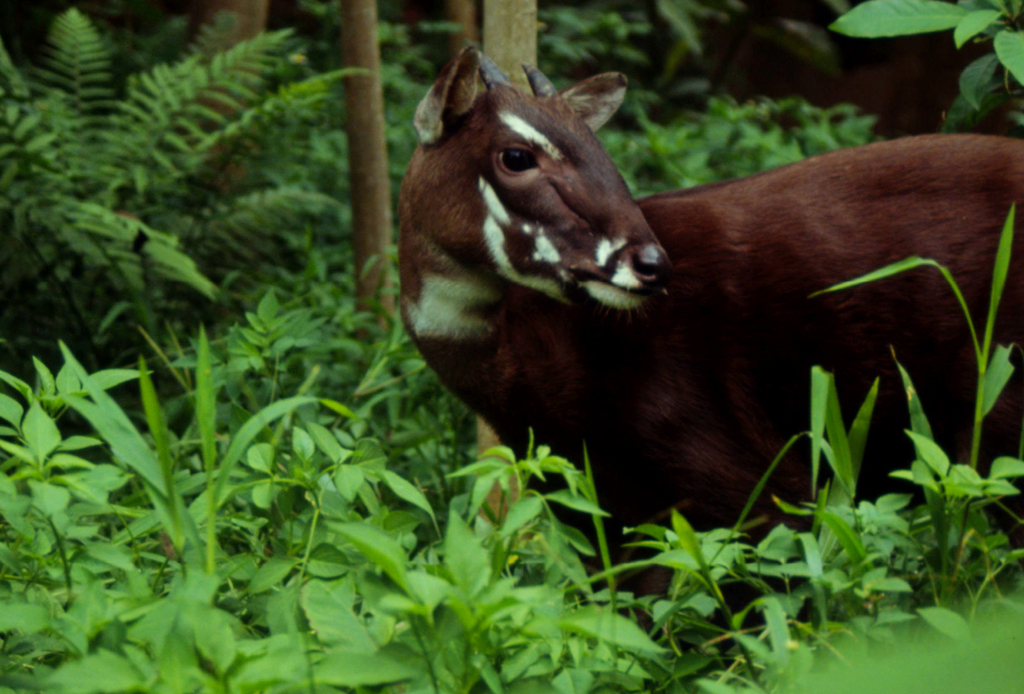
Saola
Pseudoryx nghetinhensis
The saola (Pseudoryx nghetinhensis), also called the spindlehorn, Asian unicorn, or infrequently, Vũ Quang bovid, is a forest-dwelling bovid native to the Annamite Range in Vietnam and Laos. It was first described in 1993 following a discovery of remains in Vũ Quang National Park by a joint survey of the Vietnamese Ministry of Forestry and the World Wide Fund for Nature, Saolas have since been kept in captivity multiple times, although only for short periods as they died within a matter of weeks to months.
Saola live in restricted areas of high-altitude wet evergreen forest and have probably always had a relatively low population density. The first photograph of a living saola was taken in captivity in 1993. The most recent one was taken in 2013 by a movement-triggered camera in the forest of central Vietnam, which represents the most recent record of the saola. The saola is listed as critically endangered by the IUCN, being heavily threatened by snares intended to trap other animals within their forest habitat and to a lesser extent by habitat destruction, with an estimated population of 50–300 individuals as of 2015. There is concern that the species may already be extinct, and even if individuals are still alive, extinction has been described as "inevitable" within 10 years from 2025 without intervention.
From the article Saola on Wikipedia (CC BY-SA), quoted section by section
Description
In a 1998 publication, William G. Robichaud, the coordinator of the Saola Working Group, recorded physical measurements for a captive female saola he dubbed 'Martha', in a Laotian menagerie. She was observed for around 15 days until she died from unknown causes. Robichaud noted the height of the female as 84 cm (33 in) at the shoulder; the back was slightly elevated, nearly 12 cm (4.7 in) taller than the shoulder height. The head-and-body length was recorded as 150 cm (59 in). The general characteristics of the saola, as shown by studies during 1993–5 as well as the 1998 study, include a chocolate brown coat with patches of white on the face, throat and the sides of the neck, a paler shade of brown on the neck and the belly, a black dorsal stripe, and a pair of nearly parallel horns, present on both sexes. Robichaud noted that the hair, straight and 1.5–2.5 cm (0.59–0.98 in) long, was soft and thin–a feature unusual for an animal that is associated with montane habitats in at least a few parts of its range. While the hair was found to be short on the head and the neck, it thickened to woolly hair on the insides of the forelegs and the belly. Studies before 1998 reported a hint of red in the inspected skins. The neck and the belly are a paler shade of brown compared to the rest of the body. …
Range & habitat
The saola has one of the smallest ranges of any large mammal. It inhabits wet evergreen or deciduous forests in eastern Southeast Asia, preferring river valleys. Sightings have been reported from steep river valleys at 300–1,800 m (980–5,910 ft) above sea level. In Vietnam and Laos, the species' range appears to cover approximately 5,000 km2 (1,900 sq mi), including four nature reserves. During the winters, it migrates to the lowlands. In the northern Annamite Mountains, it was sighted mostly near streams at elevations of 592–1,112 m (1,942–3,648 ft).
Wikipedia: “Distribution and habitat”
What it does
Local people reported that the saola is active in the day as well as at night, but prefers resting during the hot midday hours. Robichaud noted that the captive female was active mainly during the day, but pointed out that the observation could have been influenced by the unfamiliar surroundings the animal found herself in. When she rested, she would draw her forelegs inward to her belly, extend her neck so that her chin touched the ground, and close her eyes. Though apparently solitary, saola have been reported in groups of two or three as well as up to six or seven. Grouping patterns of the saola resemble those of the Cape bushbuck, anoa and sitatunga. Robichaud observed that the captive female was calm in the presence of humans, but was afraid of dogs. On an encounter with a dog, she would resort to snorting and thrust her head forward, pointing her horns at her opponent. Her erect ears pointed backward, and she stood stiffly with her back arched. Meanwhile, she hardly paid any attention to her surroundings. This female was found to urinate and defecate separately, dropping her hind legs and lowering her lower body – a common observation among bovids. She would spend considerable time grooming herself with her strong tongue. Marking behaviour in the female involved opening up the flap of the maxillary gland and leaving a pungent secretion on rocks and vegetation. …
Wikipedia: “Ecology and behaviour”
In human culture
In May 1992, the Ministry of Forestry, Vietnam sent a survey team to examine the biodiversity of the newly established Vu Quang National Park. On this team were Do Tuoc, Le Van Cham and Vu Van Dung (of the Forest Inventory and Planning Institute); Nguyen Van Sang (of the Institute of Ecological and Biological Resources); Nguyen Thai Tu (of Vinh University); and John MacKinnon (of the World Wildlife Fund). On 21 May, the team procured a skull featuring a pair of strange, long and pointed horns from a local hunter. They came across a similar pair in the Annamite Range in the northeastern region of the reserve the following day. The team ascribed these features to a new bovid species, calling it the "saola" or the "Vu Quang ox" to avoid confusion with the sympatric serow. The WWF officially announced the discovery of the new species on 17 July 1992. According to biodiversity specialist Tony Whitten, though Vietnam boasts a variety of flora and fauna, many of which have been recently described, the discovery of as large an animal as the saola was quite unexpected. The saola was the first large mammal to be discovered in the area for 50 years. Observations of live saola have been few and far between, restricted to the Annamite Range. The scientific name of the saola is Pseudoryx nghetinhensis. It is the sole member of the genus Pseudoryx and is classified under the family Bovidae. …
Wikipedia: “History of research and taxonomy”
Listen
Looking for field recordings…
Where it lives
Recorded sightings
—
geo-referenced records in GBIF, from museums, herbaria and field observers.
Drag the globe to turn it. Dots are where records exist, not a range map; darker means more records.
In the stacks
Searching the stacks…
Every page naming Pseudoryx nghetinhensis in the Biodiversity Heritage Library →
This page is assembled live from iNaturalist, GBIF, Wikipedia, the Source Library and the Internet Archive. It is not yet part of the hand-edited codex. iNaturalist taxon 74973.