- Animals
- ›Chordates
- ›Vertebrates
- ›Mammals
- ›Therians
- ›Placental Mammals
- ›Primates, Rodents, and Allies
- ›Primates
- ›Monkeys, Apes, and Tarsiers
- ›Monkeys and Apes
- ›Apes and Old World Monkeys
- ›Old World Monkeys
- ›Cercopithecines
- ›Guenons, Vervet Monkeys, and Talapoins
- ›Miopithecus
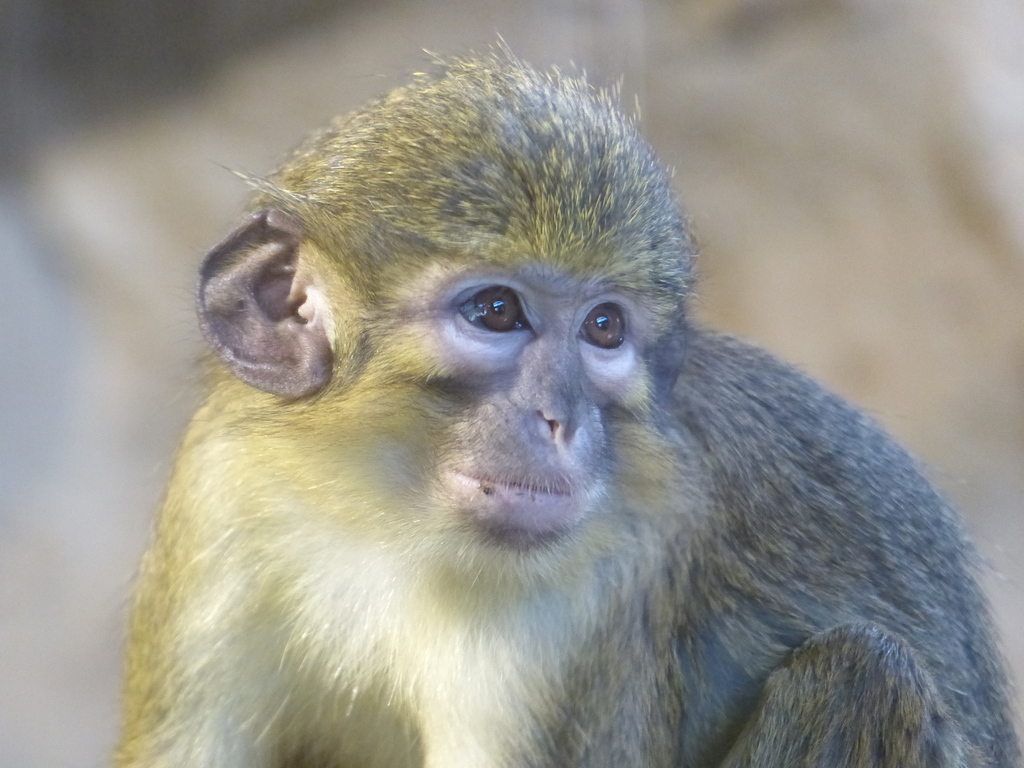
Northern Talapoin
Miopithecus ogouensis
The Gabon talapoin (Miopithecus ogouensis), also known as the northern talapoin, is a small species of African monkey native to riparian habitats in Cameroon, Equatorial Guinea, Gabon, the western Republic of the Congo and the far western Democratic Republic of Congo. It may have been introduced to Bioko and the Canary Islands. Classified in the genus Miopithecus, it was given the name Miopithecus ogouensis, based on the River Ogooué, distinguishing it from the other species, the Angolan talapoin, also known as Miopithecus talapoin.
Gabon talapoins are large-headed monkeys with yellow-olive tinted coating and can be differentiated from the Angolan talapoin by its flesh-coloured ears (not blackish). They are always found near watercourses and can dive and swim away when disturbed. Males and females live together in mixed groups, but rarely interact with each other outside of mating season. Females tend to give birth annually during the rainy season, with mating season taking place during the dry season. Its diet constitute of mostly foraged fruits, seeds, leaves and insects, and crops raided from cultivated plantations. The Gabon talapoins are dependent on thick coverings to protect them from predation due to their small size, but their elusiveness have also made it difficult to observe their behaviors in the wild.
From the article Gabon talapoin on Wikipedia (CC BY-SA), quoted section by section
Description
Female Gabon talapoins have a head and body length ranging from 230–340 millimetres (9.1–13.4 in), and weigh 0.8–1.2 kilograms (1.8–2.6 lb). Males are larger and take six years to reach full adult size, with head and body length ranging from 260–360 millimetres (10–14 in), and weigh 1.0–1.72 kilograms (2.2–3.8 lb). Gabon talapoins have an average tail length ranging from 310–450 millimetres (12–18 in). Infants weigh approximately 180 grams (6.3 oz) at birth, and the size of a newborn's head is almost as big as its body. Gabon talapoins are the smallest of the Old World monkey and are considered as dwarf guenons. They are large headed, and unlike the related Angolan talapoin, the Gabon talapoin has flesh-coloured (not blackish) ears and facial skin. There are no distinct colour differences between mature males and females and the young. The Gabon talapoin is short furred, and has a vivid, grizzled yellow-olive crown and back, with golden-yellow coating to its thin limbs, and a dark tipped tail. Its eyelids and lips are yellowish in colour, with noticeable dark streaks on its nose and cheeks. They also have cheek pouches that are useful for storing food. Females have a pink sexual swelling, and males are characterized by their large pale blue scrotum.
Range & habitat
Distribution of the Gabon talapoin is centered around the River Ogooué, native to the equatorial coastal ridges between Cabinda and the Nyong River, and further extends to some Congo River branches. It can be found in Cameroon, Equatorial Guinea, Republic of the Congo and the Cabinda province of Angola. Presence of Gabon talapoin have been documented along the Djérem River in the gallery forest, within the transition zone between the Central African forest block and the Guinea-Congolia/Sudania savannas. The distribution of the Gabon talapoin is thought to be even larger, but not all observations have been confirmed.
Wikipedia: “Geographic distribution”
What it does
Gabon talapoins usually look for food on the ground, but such terrestrial foraging is seldom observed due to their small size and preference in inhabiting within dense coverings. Foraging is usually done in sub groups, with one feeding session in the morning and one in the late afternoon. Fruits make up nearly 80% of the Gabon talapoin's diet, favouring plums (Uapaca), figs, umbrella tree (Musanga) and mokenjo (Pseudospondias), oil-palm nuts, and fruits of African ginger (Aframomum). Insects consist of about one third of its diet, mainly consisting of orthopterans, with the occasional beetles, caterpillars and spiders. Seeds and leaves form part of their diet as well. Cultivated plantations such as bananas, pawpaws and maize are also attractive food sources for the Gabon talapoin. Near human settlements, harvested cassava tubers soaked in rivers are also sought after by the Gabon talapoins when other food sources are scare. Their fruit and insect rich diets also support ecological balance through the dispersion of seeds and maintenance of insect colonies.
Wikipedia: “Diet and feeding”
Listen
Looking for field recordings…
Where it lives
Recorded sightings
—
geo-referenced records in GBIF, from museums, herbaria and field observers.
Drag the globe to turn it. Dots are where records exist, not a range map; darker means more records.
In the stacks
Searching the stacks…
Every page naming Miopithecus ogouensis in the Biodiversity Heritage Library →
This page is assembled live from iNaturalist, GBIF, Wikipedia, the Source Library and the Internet Archive. It is not yet part of the hand-edited codex. iNaturalist taxon 74633.