- Animals
- ›Chordates
- ›Vertebrates
- ›Mammals
- ›Therians
- ›Placental Mammals
- ›Primates, Rodents, and Allies
- ›Primates
- ›Monkeys, Apes, and Tarsiers
- ›Monkeys and Apes
- ›Apes and Old World Monkeys
- ›Old World Monkeys
- ›Cercopithecines
- ›Guenons, Vervet Monkeys, and Talapoins
- ›Chlorocebus
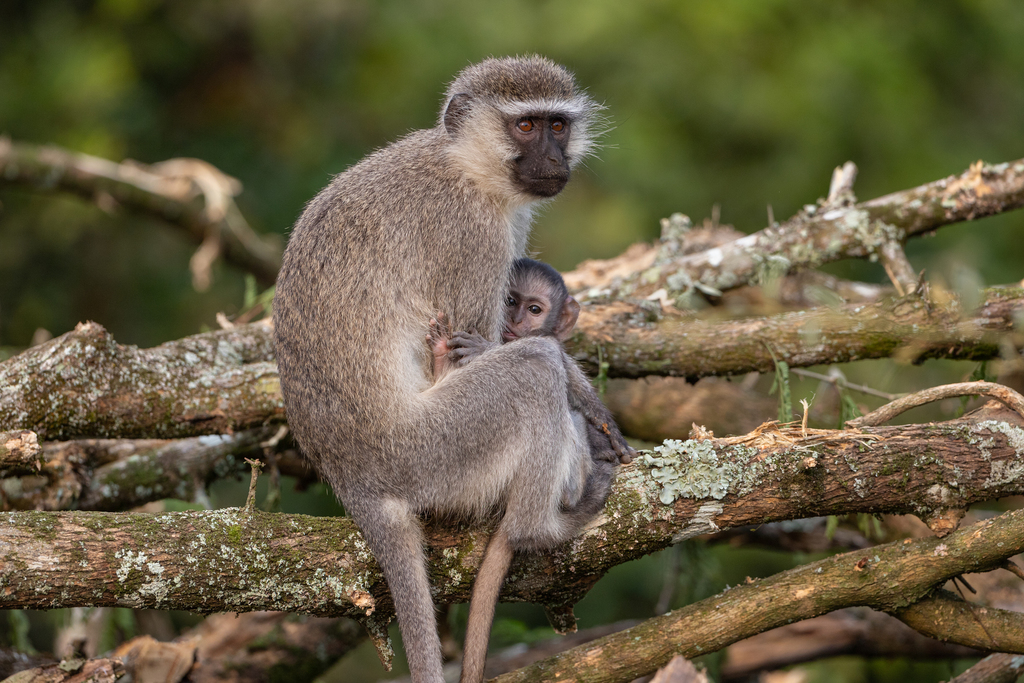
Tantalus Monkey
Chlorocebus tantalus
The tantalus monkey (Chlorocebus tantalus) is an Old World monkey from Africa that ranges from Ghana to Sudan. It was originally described as a subspecies of the grivet (Chlorocebus aethiops). All species in Chlorocebus were formerly in the genus Cercopithecus. It is a common species with a wide range, and the International Union for Conservation of Nature has rated its conservation status as being of "least concern".
From the article Tantalus monkey on Wikipedia (CC BY-SA), quoted section by section
Description
A medium-sized species, the tantalus monkey has a black face and a long tail. There is a distinctive undulating white or yellowish browband above the eyes. The cheeks and temples are white, the long hairs being swept backwards and often covering the ears in older individuals. The crown and dorsal surface of the body is grizzled and greenish or golden. The underparts are white and the tail and outer surfaces of the limbs grey. The tail may have a whitish tip. The male is larger than the female and has a bright blue scrotum surrounded by orange hairs.
Range & habitat
This monkey is found in tropical central Africa. Its native range includes Benin, Burkina Faso, Cameroon, Central African Republic, Chad, Congo, Democratic Republic of Congo, Ghana, Kenya, Niger, Nigeria, South Sudan, Sudan, Togo and Uganda. It is an adaptable species able to inhabit open woodland, savannah, forest-grassland mosaic and riverside forest. It is at home in secondary forest and rural and urban locations.
Wikipedia: “Distribution and habitat”
What it does
Tantalus monkeys live in troops averaging about thirty individuals, with up to ten adult males and eighteen adult females, and varying numbers of juveniles and young. Some adult males move about singly. There is a social hierarchy within the group. These monkeys are demi-terrestrial and spend much of their time on the ground. The troop maintains a territory, defending it with vocalizations and threats, but some groups are less aggressive than others and share part of their territory with a neighbouring troop. Breeding takes place at different times of year in different parts of the range. A single offspring is the norm, with females giving birth for the first time when about five years old.
Wikipedia: “Ecology”
Listen
Looking for field recordings…
Where it lives
Recorded sightings
—
geo-referenced records in GBIF, from museums, herbaria and field observers.
Drag the globe to turn it. Dots are where records exist, not a range map; darker means more records.
In the stacks
Searching the stacks…
Every page naming Chlorocebus tantalus in the Biodiversity Heritage Library →
This page is assembled live from iNaturalist, GBIF, Wikipedia, the Source Library and the Internet Archive. It is not yet part of the hand-edited codex. iNaturalist taxon 74191.