- Animals
- ›Chordates
- ›Vertebrates
- ›Mammals
- ›Therians
- ›Placental Mammals
- ›Ungulates, Carnivorans, and Allies
- ›Even-toed Ungulates and Cetaceans
- ›Ruminants
- ›Bovids
- ›Antelopes, Goats, and Sheep
- ›Goats and Sheep
- ›Capricornis
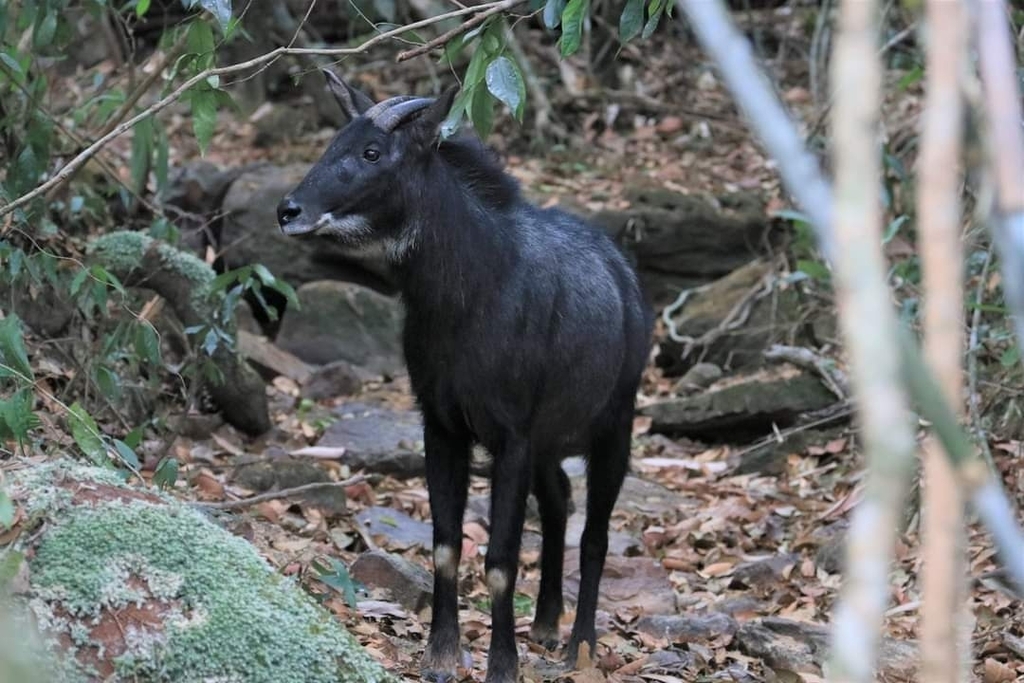
Mainland Serow
Capricornis sumatraensis
The Sumatran serow (Capricornis sumatraensis), also known as the southern serow, is a species of goat-antelope native to mountain forests in the Thai-Malay Peninsula and on the Indonesian island of Sumatra. The former name of this species is "mainland serow", as all the mainland species of serow (Chinese, red and Himalayan) were previously considered subspecies of this species. The Sumatran serow is threatened due to habitat loss and hunting, leading to it being evaluated as vulnerable...
From the article Mainland serow on Wikipedia (CC BY-SA), quoted section by section
Description
The mainland serow possesses guard hairs on its coat that are bristly or coarse and cover the layer of fur closest to its skin to varying degrees. The animal has a mane that runs from the horns to the middle of the dorsal aspect of the animal between the scapulae covering the skin. The horns are only characteristic of the males and are light-colored, approximately 150 mm (6 in) in length, and curve slightly towards its back. Both male and female are around 91 cm (3 ft) high at the shoulder, and typically weigh around 91 kg (200 lb).
Wikipedia: “Characteristics”
Range & habitat
The mainland serow occurs in central and southern China, India, Vietnam, Cambodia, Laos, Myanmar, Thailand, and in the Indonesian island of Sumatra. In Assam, it inhabits hilly forests above an elevation of 300 m (980 ft), but descends to 100 m (330 ft) in winter. It prefers elevations of 2,500–3,500 m (8,200–11,500 ft) in the Nepal Himalayas. In Tibet, its distribution follows forested mountain ranges.
Wikipedia: “Distribution and habitat”
What it does
The mainland serow is territorial and lives alone or in small groups. They are active at varied times, having peaks of diurnal activity and nocturnal activity. Females give birth to a single young after a gestation period of about eight months. Fossils from Khok Sung in northeastern Thailand suggest it was a forest dweller in this palaeoenvironment. Dental microwear texture analysis of both living and fossil specimens of the Sumatran serow indicate that it is primarily a browsing herbivore and that its browsing activity is dominated by folivory.
Wikipedia: “Behaviour and ecology”
Listen
Looking for field recordings…
Where it lives
Recorded sightings
—
geo-referenced records in GBIF, from museums, herbaria and field observers.
Drag the globe to turn it. Dots are where records exist, not a range map; darker means more records.
In the stacks
Searching the stacks…
Every page naming Capricornis sumatraensis in the Biodiversity Heritage Library →
This page is assembled live from iNaturalist, GBIF, Wikipedia, the Source Library and the Internet Archive. It is not yet part of the hand-edited codex. iNaturalist taxon 74143.