- Animals
- ›Chordates
- ›Vertebrates
- ›Mammals
- ›Therians
- ›Placental Mammals
- ›Ungulates, Carnivorans, and Allies
- ›Even-toed Ungulates and Cetaceans
- ›Ruminants
- ›Bovids
- ›Bovines
- ›Cattle and Bison
- ›Bos
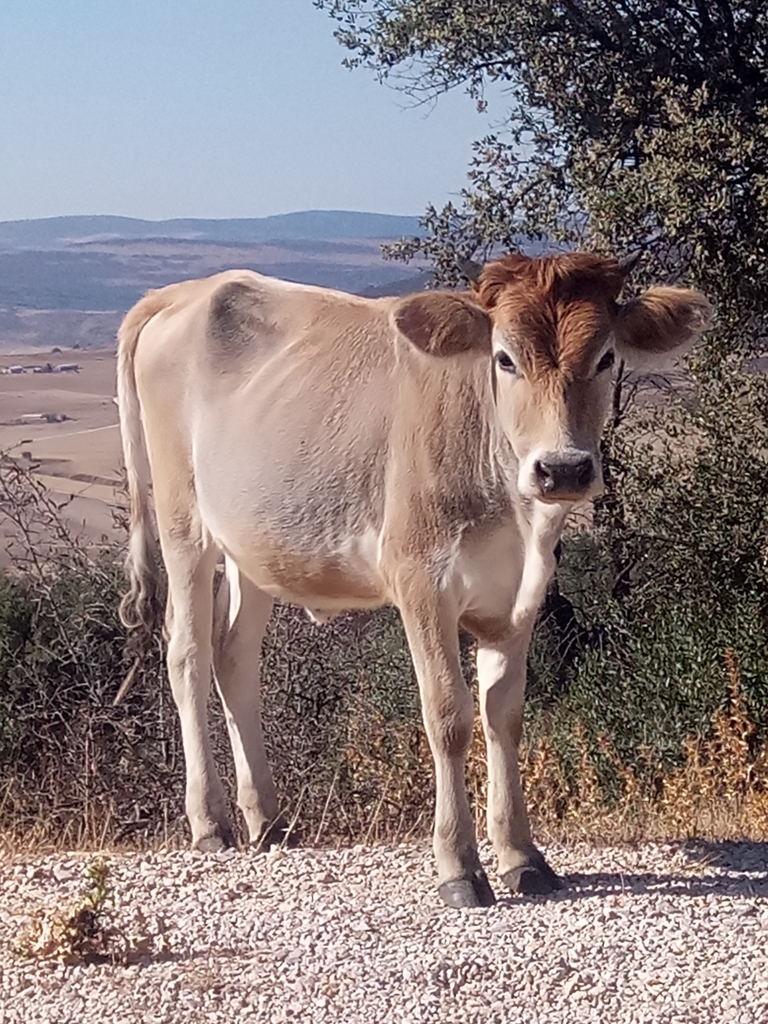
Domestic Cattle
Bos taurus
Cattle (Bos taurus) are large, domesticated, bovid ungulates widely kept as livestock. They are prominent modern members of the subfamily Bovinae and the most widespread species of the genus Bos.
Taurine cattle are widely distributed across Europe and temperate areas of Asia, the Americas, and Australia. Zebus are found mainly in India and tropical areas of Asia, America, and Australia. Sanga cattle are found primarily in sub-Saharan Africa. These types, sometimes classified as separate species or subspecies, are further divided into over 1,000 recognized breeds.
From the article Cattle on Wikipedia (CC BY-SA), quoted section by section
Description
Cattle are large artiodactyls, mammals with cloven hooves, meaning that they walk on two toes, the third and fourth digits. Like all bovid species, they can have horns, which are unbranched and are not shed annually. Coloration varies with breed; common colors are black, white, and red/brown, and some breeds are spotted or have mixed colors. Bulls are larger than cows of the same breed by up to a few hundred kilograms. British Hereford cows, for example, weigh 600–800 kg (1,300–1,800 lb), while the bulls weigh 1,000–1,200 kg (2,200–2,600 lb). Cattle breeds vary widely in size; the tallest and heaviest is the Chianina, where a mature bull may be up to 1.8 m (5 ft 11 in) at the shoulder, and may reach 1,280 kg (2,820 lb) in weight. The natural life of domestic cattle is some 25–30 years. Beef cattle go to slaughter at about 18 months, and dairy cows at about five years.
What it does
The gestation period for a cow is about nine months long. The ratio of male to female offspring at birth is approximately 52:48. A cow's udder has two pairs of mammary glands or teats. Farms often use artificial insemination, the artificial deposition of semen in the female's genital tract; this allows farmers to choose from a wide range of bulls to breed their cattle. Estrus too may be artificially induced to facilitate the process. Copulation lasts several seconds and consists of a single pelvic thrust. Cows seek secluded areas for calving. After their first mating, semi-wild Highland cattle heifers first give birth at 2 or 3 years of age, and the timing of birth is synchronized with increases in natural food quality. Average calving interval is 391 days, and calving mortality within the first year of life is 5%. Beef calves suckle an average of 5 times per day, spending some 46 minutes suckling. There is a diurnal rhythm in suckling, peaking at roughly 6am, 11:30am, and 7pm. Under natural conditions, calves stay with their mother until weaning at 8 to 11 months. Heifer and bull calves are equally attached to their mothers in the first few months of life.
Wikipedia: “Reproduction”
In human culture
The term cattle was borrowed from Anglo-Norman catel (replacing native Old English terms like kine, now considered archaic, poetic, or dialectal), itself from Medieval Latin capitāle 'principal sum of money, capital', itself derived in turn from Latin caput 'head'. Cattle originally meant movable personal property, especially livestock of any kind, as opposed to real property (the land, which also included wild or small free-roaming animals such as chickens—they were sold as part of the land). The word is a variant of chattel (a unit of personal property) and closely related to capital in the economic sense. The word cow came via Old English cū (plural cȳ), from Proto-Indo-European *gʷṓws (genitive *gʷéws) 'a bovine animal', cf. Persian: gâv, Sanskrit: gó. In older English sources such as the King James Version of the Bible, cattle often means livestock, as opposed to deer, which are wild.
Wikipedia: “Etymology”
Listen
Looking for field recordings…
Where it lives
Recorded sightings
—
geo-referenced records in GBIF, from museums, herbaria and field observers.
Drag the globe to turn it. Dots are where records exist, not a range map; darker means more records.
In the stacks
Searching the stacks…
Every page naming Bos taurus in the Biodiversity Heritage Library →
This page is assembled live from iNaturalist, GBIF, Wikipedia, the Source Library and the Internet Archive. It is not yet part of the hand-edited codex. iNaturalist taxon 74113.