- Plants
- ›Vascular Plants
- ›flowering plants
- ›Dicots
- ›pinks, cactuses, and allies
- ›pink family
- ›Caryophylloideae
- ›Sileneae
- ›Silene
- ›Lychnis
- ›Coccyganthe
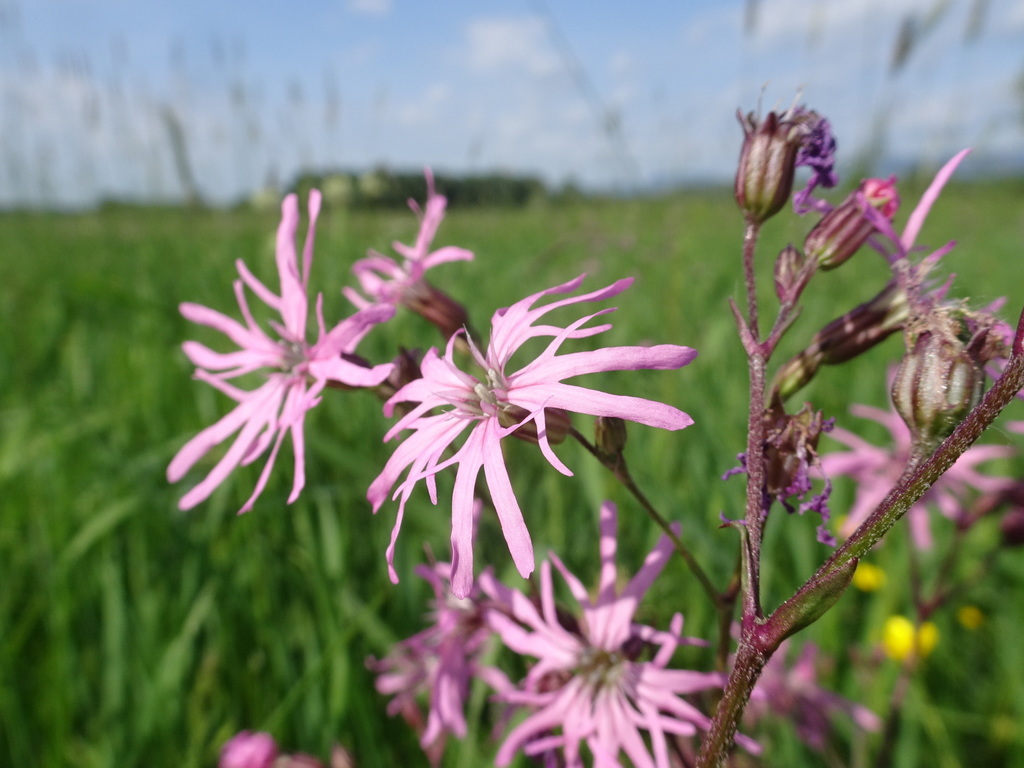
ragged-robin
Silene flos-cuculi
Silene flos-cuculi (syn. Lychnis flos-cuculi), commonly called ragged-robin, is a perennial herbaceous plant in the family Caryophyllaceae. This species is native to Europe and Asia, where it is found along roads and in wet meadows and pastures. In Britain it has declined in numbers because of modern farming techniques and draining of wet-lands and is no longer common. However, it has become naturalized in parts of the northern United States and eastern Canada.
From the article Silene flos-cuculi on Wikipedia (CC BY-SA), quoted section by section
Description
Silene flos-cuculi forms a rosette of low growing foliage with numerous stems 30 to 90 centimetres (12 to 35+1⁄2 inches) tall. The stems rise above the foliage and branch near the top of the stem. The leaves are paired, with the lower leaves spoon-shaped and stalked. The middle and upper leaves are linear-lanceolate with pointed apexes. All of the leaves are untoothed. The stems have barbed hairs pointing downward and these hairs make the plant rough to the touch. Blooming from May to August (and occasionally later), the pink flowers are 3 to 4 cm (1.2 to 1.6 in) wide. They have five narrow petals deeply divided into four lobes giving the flower an untidy, ragged appearance, hence its common name. The calyx tube is five-toothed with ten stamens. There are 5 separate styles. The fruits consist of small (6 to 10 mm) capsules opening on top by five teeth and containing many small seeds; they are found on the plants from August onward.
Range & habitat
The species is native to Europe and Asia, where it is found along roads and in wet meadows and pastures. It has also become naturalized in parts of the northern United States and eastern Canada.
Wikipedia: “Distribution and habitat”
What it does
Butterflies and long-tongued bees feed on the flowers' nectar. In addition to these pollinators, the flowers are visited by many types of insects, and can be characterized by a generalized pollination syndrome. In Britain it has declined in numbers because of modern farming techniques and draining of wet-lands and is no longer common.
Wikipedia: “Ecology”
How it is grown
Popular garden cultivars include:
'Alba' – white-flowered form Jenny = 'Lychjen' 'Nana' – dwarf form (4 inches) with smaller leaf rosettes and shorter flower stems 'Petite Jenny' 'White Robin'
== References ==
Wikipedia: “Cultivation”
Where it lives
Recorded sightings
—
geo-referenced records in GBIF, from museums, herbaria and field observers.
Drag the globe to turn it. Dots are where records exist, not a range map; darker means more records.
In the stacks
Searching the stacks…
Every page naming Silene flos-cuculi in the Biodiversity Heritage Library →
This page is assembled live from iNaturalist, GBIF, Wikipedia, the Source Library and the Internet Archive. It is not yet part of the hand-edited codex. iNaturalist taxon 740984.