- Animals
- ›Chordates
- ›Vertebrates
- ›Mammals
- ›Therians
- ›Placental Mammals
- ›Primates, Rodents, and Allies
- ›Primates
- ›Monkeys, Apes, and Tarsiers
- ›Monkeys and Apes
- ›New World Monkeys
- ›Spider, Howler, and Woolly Monkeys
- ›Howler Monkeys
- ›Alouatta
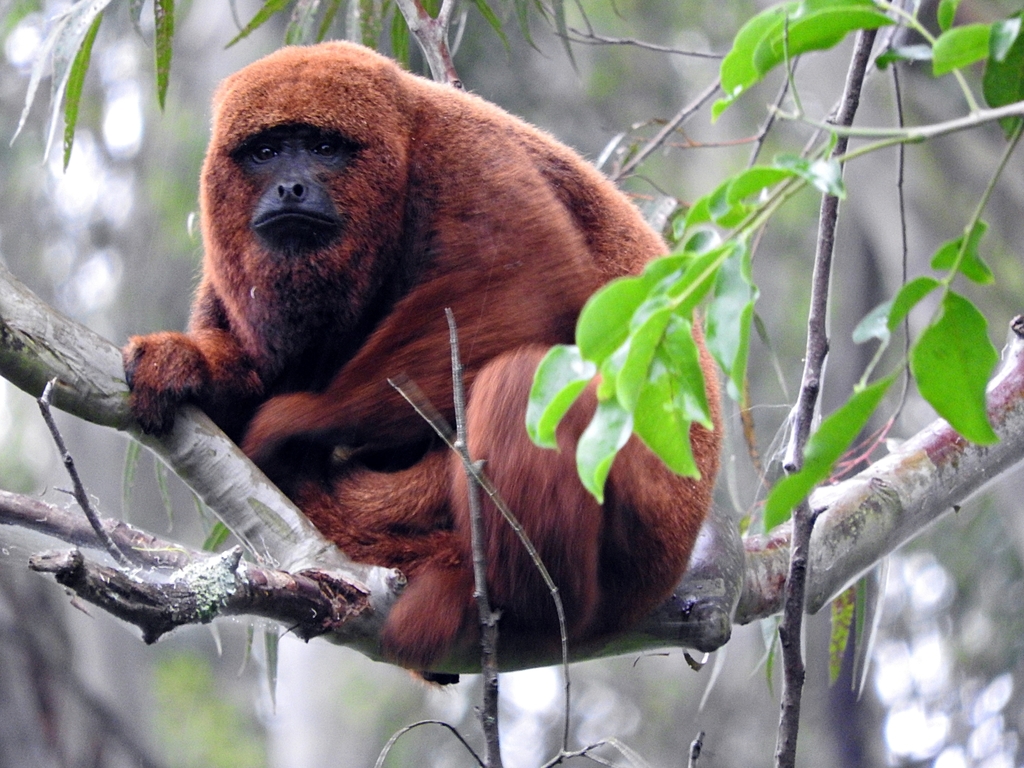
Brown Howler Monkey
Alouatta guariba
The brown howler (Alouatta guariba), also known as brown howler monkey, is a species of howler monkey, a type of New World monkey that lives in forests in south-eastern Brazil and far north-eastern Argentina (Misiones). It lives in groups of two to 11 individuals. Despite the name "brown howler", it is notably variable in colour, with some individuals appearing largely reddish-orange or black.
The two subspecies are:
From the article Brown howler on Wikipedia (CC BY-SA), quoted section by section
Range & habitat
The brown howler is found in the Atlantic forest of South America. The region spreads through the Brazilian states of Bahia and Espírito Santo through Rio Grande do Sul, and Misiones in Argentina.
Wikipedia: “Range”
What it does
Brown howler monkeys are folivores and frugivorous. The diet of the brown howler monkey consists primarily of leaves and trees. Of the food sources it seems that the genera Ficus, Zanthoxylum, and Eugenia are the most significant types consumed. Brown howler monkeys that live in higher latitudes tend to eat a lower percentage of leaves in their diet. Mature leaves are less nutritious and are more fibrous, than the preferred young leaves. A typical brown howler diet will also include mature fruit, wild figs, petioles, buds, flowers, seeds, moss, stems, and twigs The Atlantic forest, where brown howlers tend to live, has an increasing forest fragmentation. Forest fragmentation means that there would be a decrease in potential food supplies. The brown howler's feeding ecology, however, does not seem to be affected by the loss in habitat.
Wikipedia: “Diet”
Listen
Looking for field recordings…
Where it lives
Recorded sightings
—
geo-referenced records in GBIF, from museums, herbaria and field observers.
Drag the globe to turn it. Dots are where records exist, not a range map; darker means more records.
In the old herbals & bestiaries

In the stacks
Searching the stacks…
Every page naming Alouatta guariba in the Biodiversity Heritage Library →
This page is assembled live from iNaturalist, GBIF, Wikipedia, the Source Library and the Internet Archive. It is not yet part of the hand-edited codex. iNaturalist taxon 74053.