- Animals
- ›Chordates
- ›Vertebrates
- ›Reptiles
- ›Turtles and Tortoises
- ›Softshell and Flapshell Turtles
- ›Softshell Turtles
- ›Pelochelys
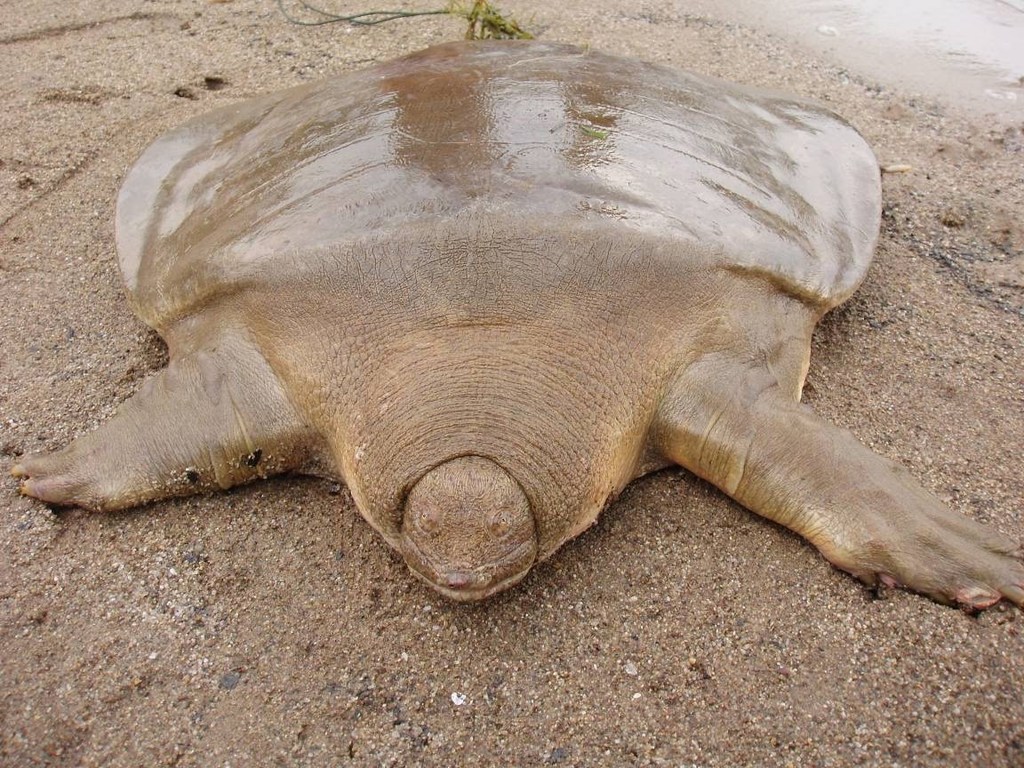
Cantor's Giant Softshell Turtle
Pelochelys cantorii
The Asian giant softshell turtle (Pelochelys cantorii), also known commonly as Cantor's giant softshell turtle and the frog-faced softshell turtle, is a species of freshwater turtle in the family Trionychidae. The species is native to Southeast Asia. The species is critically endangered and in the 20th century has disappeared from much of its former range.
From the article Asian giant softshell turtle on Wikipedia (CC BY-SA), quoted section by section
Description
The Asian giant softshell turtle has a broad head, and small eyes close to the tip of its snout. The carapace is smooth and olive-colored. Juveniles may have dark-spotted carapaces and heads, with yellow around the carapace. Despite reports that it can grow up to 1.8 metres (5.9 ft) in length and is the world's largest extant freshwater turtle, this maximum size and title is murky at best. Apparently the largest specimen carapace length, 129 cm (51 in), known is considered suspect and the heaviest specimen known (weighing approximately 250 kg (550 lb) was actually a misidentified Yangtze giant softshell turtle. A more realistic range of carapace length for this species is reportedly 70 to 100 cm (28 to 39 in) and it is one of about a half-dozen giant softshell turtles from three genera that reach exceptionally large sizes, i.e. in excess of 100 kg (220 lb) in mass.
Range & habitat
The species P. cantorii is primarily found in inland, slow-moving, freshwater rivers and streams. Some evidence indicates that its range extends to coastal areas, as well. It occurs in eastern and southern India, Bangladesh, Burma, Thailand, Malaysia, Laos, Cambodia, Vietnam, eastern and southern China, the Philippines (Luzon and Mindanao), and Indonesia (Kalimantan, Java, and Sumatra).
Wikipedia: “Geographic range and habitat”
What it does
P. cantorii is an ambush predator and primarily carnivorous, feeding on crustaceans, mollusks and fish (although some aquatic plants may also be eaten). The turtle spends 95% of its life buried and motionless, with only its eyes and mouth protruding from the sand. It surfaces only twice a day to take a breath, and lays 20–28 eggs sized around 3.0 to 3.6 centimetres (1.2 to 1.4 in) in diameter in February or March on riverbanks.
Wikipedia: “Behavior and reproduction”
In human culture
The specific name, cantorii, is in honor of Danish zoologist Theodore Edward Cantor. Additionally, they are named for their softshells because they have soft, leathery shells that are completely devoid of scales.
Wikipedia: “Etymology”
Where it lives
Recorded sightings
—
geo-referenced records in GBIF, from museums, herbaria and field observers.
Drag the globe to turn it. Dots are where records exist, not a range map; darker means more records.
In the stacks
Searching the stacks…
Every page naming Pelochelys cantorii in the Biodiversity Heritage Library →
This page is assembled live from iNaturalist, GBIF, Wikipedia, the Source Library and the Internet Archive. It is not yet part of the hand-edited codex. iNaturalist taxon 73893.