- Animals
- ›Chordates
- ›Vertebrates
- ›Reptiles
- ›Turtles and Tortoises
- ›Softshell and Flapshell Turtles
- ›Softshell Turtles
- ›Pelochelys
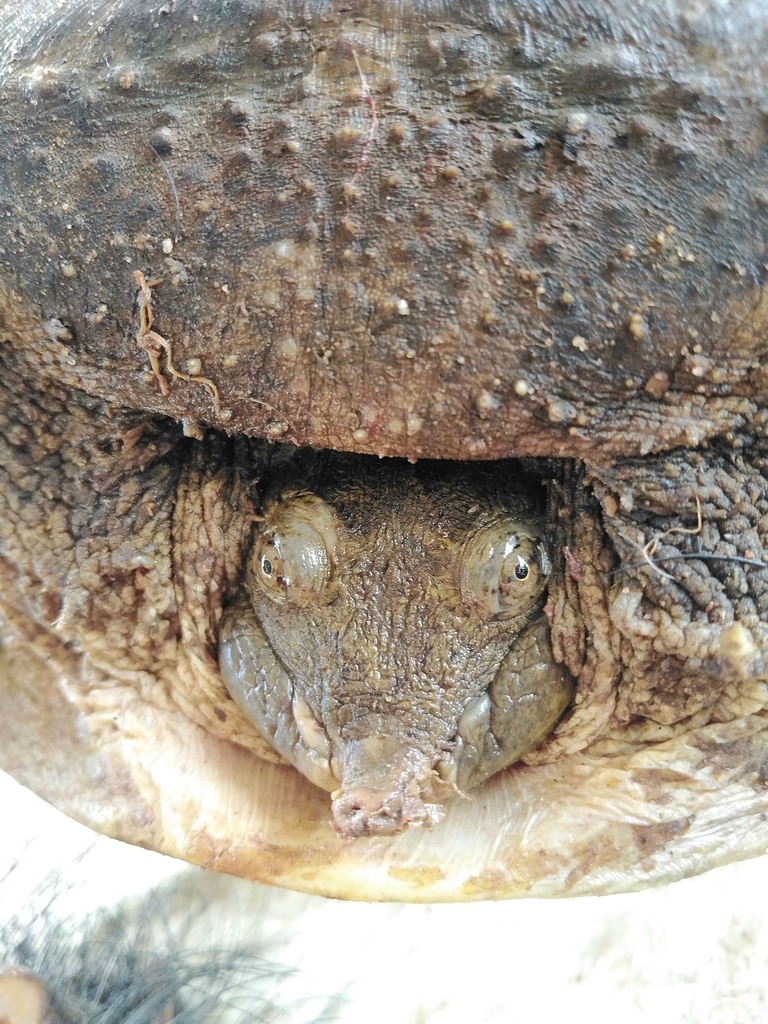
New Guinea Giant Softshell Turtle
Pelochelys bibroni
The southern New Guinea giant softshell turtle (Pelochelys bibroni) is a species of softshell turtle in the family Trionychidae. The species is endemic to the lowlands of southern New Guinea with occasional vagrant individuals sighted off the coast of northern Australia. There is no confirmed Australian record. P. bibroni is referred to by the Suki people as kiya eise, a reference to its flexible shell. In the Arammba language, it is called sokrere, meaning "earthquake". It is sometimes hunted by local villages for its meat and/or eggs, leading to some cases of chelonitoxism.
From the article Southern New Guinea giant softshell turtle on Wikipedia (CC BY-SA), quoted section by section
Description
P. bibroni is among the largest species of freshwater turtle, surpassed or matched only by other species of Pelochelys, as well as certain Chitra, Rafetus, and Macrochelys species. P. bibroni can reach up to 1 m (3.3 ft) in straight carapace length, and 120 kg (260 lb) in weight. It has a soft, subdermal carapace with a slightly flexible posterior region. Its neck is completely retractable, as are all four of its limbs. Its head is broad, with its nostrils at the end of a proboscis. Its digits are webbed, with eight digits on its fore limbs and five on its hind limbs. Its tail is very short.
Range & habitat
P. bibroni prefers lowland rivers and estuaries, but adjusts well to the saline environments of deltas and large estuaries.
Wikipedia: “Habitat”
What it does
The diet of P. bibroni is primarily carnivorous, consuming mostly fish, crabs, mollusks, and occasionally some vegetation. Its hunting strategy is not overly aggressive, but primarily being an ambush predator, it spends most of its time at the bottom of its chosen river bed, waiting for prey to wander by.
Wikipedia: “Diet”
Where it lives
Recorded sightings
—
geo-referenced records in GBIF, from museums, herbaria and field observers.
Drag the globe to turn it. Dots are where records exist, not a range map; darker means more records.
In the stacks
Searching the stacks…
Every page naming Pelochelys bibroni in the Biodiversity Heritage Library →
This page is assembled live from iNaturalist, GBIF, Wikipedia, the Source Library and the Internet Archive. It is not yet part of the hand-edited codex. iNaturalist taxon 73892.