- Animals
- ›Chordates
- ›Vertebrates
- ›Reptiles
- ›Turtles and Tortoises
- ›Sea Turtles
- ›Typical Sea Turtles
- ›Hawksbill, Loggerhead, and Ridley Sea Turtles
- ›Lepidochelys
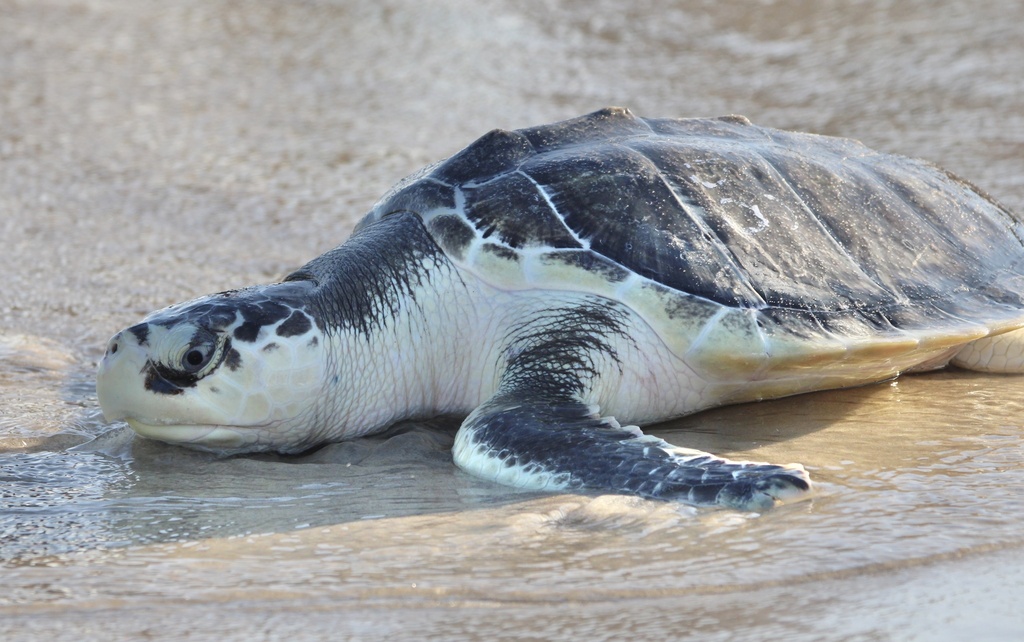
Kemp's Ridley Sea Turtle
Lepidochelys kempii
Kemp's ridley sea turtle (Lepidochelys kempii), also called commonly the Atlantic ridley sea turtle, Kemp's ridley turtle, and Kemp's ridley, is a species of turtle in the family Cheloniidae. L. kempii is the rarest species of sea turtle and is the world's most endangered species of sea turtle as well as the smallest. It is one of two living species in the genus Lepidochelys (the other one being L. olivacea, the olive ridley sea turtle). L. kempii primarily occupies habitat around the Gulf of Mexico, though its migrations into the Atlantic Ocean are being affected by rising temperatures. Rising sea temperatures expand this species' range, leaving them vulnerable to cold-shocking events when weather changes. Kemp's ridley sea turtle is listed as endangered under the Endangered Species Act (ESA), and conservation efforts are attempting to rebuild population numbers. Human activity, including habitat destruction, climate change, and oil spills, threatens populations.
From the article Kemp's ridley sea turtle on Wikipedia (CC BY-SA), quoted section by section
Description
Kemp's ridley is the smallest of all sea turtle species, with a carapace length of 58–70 cm (23–28 in) and weight of only 36–45 kg (80–100 lb) at maturity. Typical of sea turtles, it has a dorsoventrally depressed body with specially adapted flipper-like front limbs and a beak. Kemp's ridley turtle adults reach a maximum of 75 cm (30 in) in carapace length and weigh a maximum of 50 kg (110 lb). The adult's oval carapace is almost as wide as it is long and is usually olive-gray in color. The carapace has five pairs of costal scutes. In each bridge adjoining the plastron to the carapace are four inframarginal scutes, each of which is perforated by a pore. The head has two pairs of prefrontal scales. These turtles change color as they mature. As hatchlings, they are almost entirely a dark purple on both sides, but mature adults have a yellow-green or white plastron and a grey-green carapace. Kemp's ridley has a triangular-shaped head with a somewhat hooked beak with large crushing surfaces. The skull is similar to that of the olive ridley. Unlike other sea turtles, the surface on the squamosal bone where the jaw opening muscles originate faces to the side rather than to the back. They are the only sea turtles that nest during the day.
Range & habitat
The distribution of L. kempii is somewhat unusual compared to most reptiles, varying significantly among adults and juveniles, as well as males and females. Adults primarily live in the Gulf of Mexico, where they forage in the relatively shallow waters of the continental shelf (up to 409 m deep, but typically 50 m or less), with females ranging from the southern coast of the Florida Peninsula to the northern coast of the Yucatán Peninsula, while males have a tendency to remain closer to the nesting beaches in the Western Gulf waters of Texas (US), Tamaulipas, and Veracruz (Mexico). Adults of L. kempii are rarely found outside of the Gulf of Mexico and only 2–4% from the Atlantic are adults.
Juveniles and subadults, in contrast, regularly migrate into the Atlantic Ocean and occupy the coastal waters of the continental shelf of North America from southern Florida to Cape Cod, Massachusetts, and occasionally northward. The time periods of these migrations appear to be growing longer due to rising sea temperatures. Accidental and vagrant records are known with some regularity from throughout the northern Atlantic Ocean and Mediterranean Sea, where the Gulf Stream is believed to play a significant role in their dispersal. …
Wikipedia: “Distribution”
What it does
Kemp's ridley turtle feeds on mollusks, crustaceans (such as floating crabs and shrimp), jellyfish, fish, algae or seaweed, and sea urchins. Juveniles primarily are pelagic surface-feeders, while adults are opportunistic bottom-feeders that feed primarily on crabs. Research has shown that dives made by these turtles, including those made to forage, may be longer at night. Comparing dietary habits of head-started turtles (turtles raised in captivity before release) and wild turtles found little difference in variance in feeding habits, but variability exists in feeding habits due to habitat differences and maturation of the turtles. Variation in habitat region, as well as prey availability, was found to alter diet composition. Regional diet compositions aid in conservation efforts through enabling predicting food sources becoming affected by major events.
Wikipedia: “Feeding”
In human culture
Most females return each year to a single beach—Rancho Nuevo in the Mexican state of Tamaulipas—to lay eggs. The females arrive in large groups of hundreds or thousands in nesting aggregations called arribadas, which is a Spanish word for "arrivals". Males will typically stay closer to breeding grounds. Juvenile turtles tend to live in floating sargassum seaweed beds for their first years. Then, they range between northwest Atlantic waters and the Gulf of Mexico while growing into maturity. They reach sexual maturity at the age of 10–12. This is the only species that nests primarily during the day. The nesting season for these turtles is April to August. They nest mostly (95%) on a 16-mile beach in the Mexican state of Tamaulipas and on Padre Island in the US state of Texas, and elsewhere on the Gulf Coast. They mate offshore. Gravid females land in groups on beaches in arribadas or mass nesting. They prefer areas with dunes, or secondarily, swamps. The estimated number of nesting females in 1947 was 89,000, but shrank to an estimated 7,702 by 1985. Females nest one to four times during a season, keeping 10 to 20 days between nestings. Incubation takes 6–8 weeks. Around 100 eggs are in a clutch. The hatchlings' sex is decided by the temperature in the area during incubation. If the temperature is below 29.5 °C (85.1 °F), the offspring will be mainly male.
Wikipedia: “Life history”
Where it lives
Recorded sightings
—
geo-referenced records in GBIF, from museums, herbaria and field observers.
Drag the globe to turn it. Dots are where records exist, not a range map; darker means more records.
In the stacks
Searching the stacks…
Every page naming Lepidochelys kempii in the Biodiversity Heritage Library →
This page is assembled live from iNaturalist, GBIF, Wikipedia, the Source Library and the Internet Archive. It is not yet part of the hand-edited codex. iNaturalist taxon 73844.