- Animals
- ›Chordates
- ›Vertebrates
- ›Reptiles
- ›Turtles and Tortoises
- ›Eurasian Pond, River, and Neotropical Wood Turtles
- ›Geoemydinae
- ›Batagur
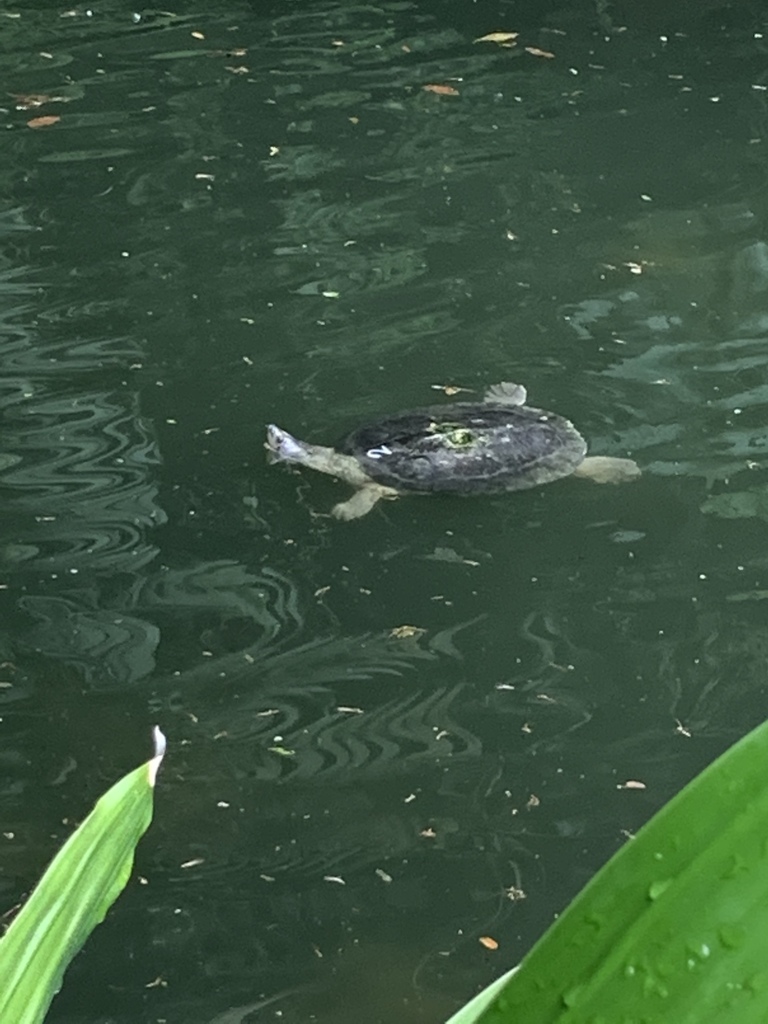
Burmese Roofed Turtle
Batagur trivittata
The Burmese roofed turtle (Batagur trivittata) is one of six turtle species in the genus Batagur of the family Geoemydidae.
It is a freshwater turtle endemic to the rivers of Myanmar. Once common and abundant in its habitat, the species experienced a rapid decline and was believed to be extinct until two subpopulations were rediscovered in 2001 in the Chindwin and Dokhtawady rivers. By 2018, fewer than 10 mature individuals were documented. The Burmese roofed turtle is among the world's most endangered turtle species.
From the article Burmese roofed turtle on Wikipedia (CC BY-SA), quoted section by section
Description
Adult male and female Burmese roofed turtles can be distinguished by their morphology. Adult males exhibit an olive-green carapace with a black stripe extending from the top of the head down the neck and three additional black stripes running along the carapace. They also have a more prominently elongated tail and an ivory-white plastron (underbelly). The male's typically green head transforms to a bright chartreuse-yellow with bold black markings during the breeding season. Female Burmese roofed turtles grow significantly larger than males. Adult females have a more uniform coloration, with the head, carapace, and plastron ranging from dark brown to grayish-black.
Wikipedia: “Morphology”
What it does
B. trivittata is a herbivorous turtle; it feeds primarily on the aquatic and semi-aquatic vegetation found in its habitat. In captivity, B. trivitatta is fed water spinach, fish food pellets, figs when in season, and other supplemental foods as needed.
Wikipedia: “Diet”
Where it lives
Recorded sightings
—
geo-referenced records in GBIF, from museums, herbaria and field observers.
Drag the globe to turn it. Dots are where records exist, not a range map; darker means more records.
In the stacks
Searching the stacks…
Every page naming Batagur trivittata in the Biodiversity Heritage Library →
This page is assembled live from iNaturalist, GBIF, Wikipedia, the Source Library and the Internet Archive. It is not yet part of the hand-edited codex. iNaturalist taxon 73700.