- Plants
- ›Vascular Plants
- ›flowering plants
- ›Dicots
- ›saxifrages, stonecrops, and allies
- ›stonecrop family
- ›Sempervivoideae
- ›Semperviveae
- ›Petrosedum
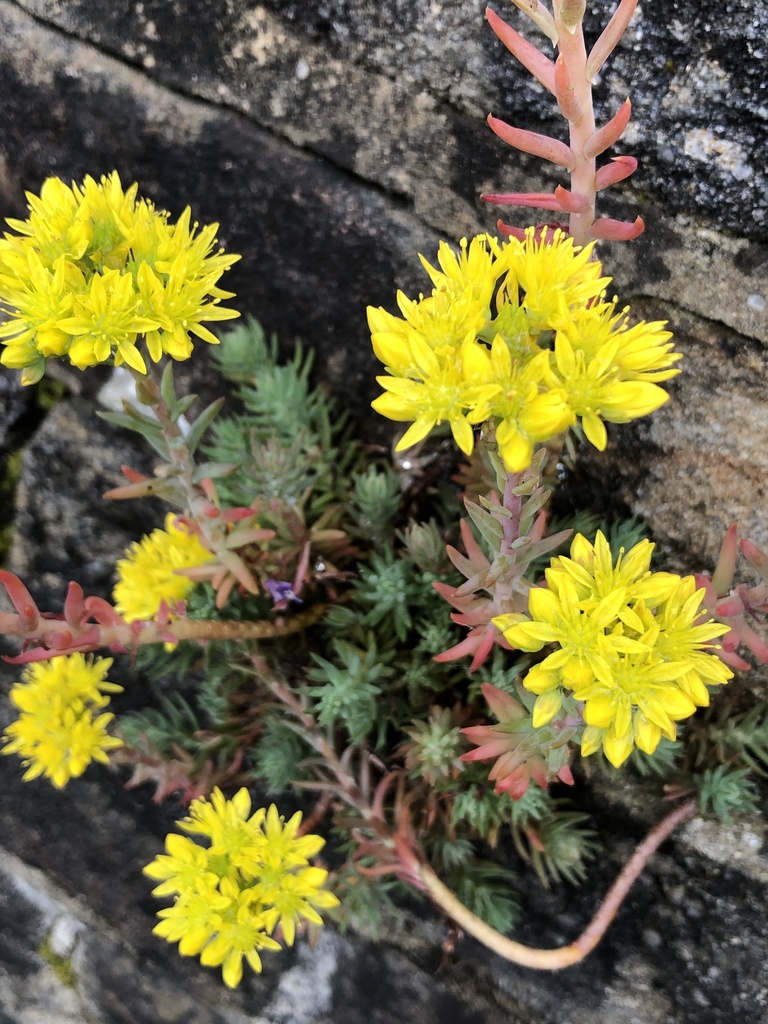
Reflexed Stonecrop
Petrosedum rupestre
Sedum reflexum or Sedum rupestre, also known as reflexed stonecrop, Jenny's stonecrop, blue stonecrop, stone orpine, prick-madam and trip-madam, is a species of perennial succulent plant of the genus Sedum, native to northern, central, and southern Europe. It is also known as Petrosedum reflexum.
From the article Petrosedum rupestre on Wikipedia (CC BY-SA), quoted section by section
Description
Petrosedum rupestre plants are typically up to 10 cm high, with sprawling stems and stiff foliage resembling spruce branches, with softer tissue. The leaves are frequently blue-gray to gray but range to light greens and yellows; the flowers are yellow. Like many Sedum species, it has a prostrate, spreading habit.
How it is grown
Petrosedum rupestre is a popular ornamental plant, grown in gardens, containers, and as houseplants. It is drought-tolerant. There are named cultivars with variegated (multi-colored) leaves. Through vegetative cloning it is propagated from cuttings. This sedum is prone to fasciation (cristate forms), which produces attractive cactus-like forms, with irregular curves. However it reverts easily, so all normal offshoots need to be removed quickly to maintain the cristate form. Petrosedum rupestre is occasionally used as a salad leaf or herb in Europe, including the United Kingdom. It is said to have a slightly astringent or sour taste.
Wikipedia: “Cultivation”
Where it lives
Recorded sightings
—
geo-referenced records in GBIF, from museums, herbaria and field observers.
Drag the globe to turn it. Dots are where records exist, not a range map; darker means more records.
In the stacks
Searching the stacks…
Every page naming Petrosedum rupestre in the Biodiversity Heritage Library →
This page is assembled live from iNaturalist, GBIF, Wikipedia, the Source Library and the Internet Archive. It is not yet part of the hand-edited codex. iNaturalist taxon 734805.