- Plants
- ›Vascular Plants
- ›flowering plants
- ›Dicots
- ›Nances, Willows, and Allies
- ›St. John's wort family
- ›St. John's worts tribe
- ›Hypericum
- ›Hirtella
- ›Platyadenum
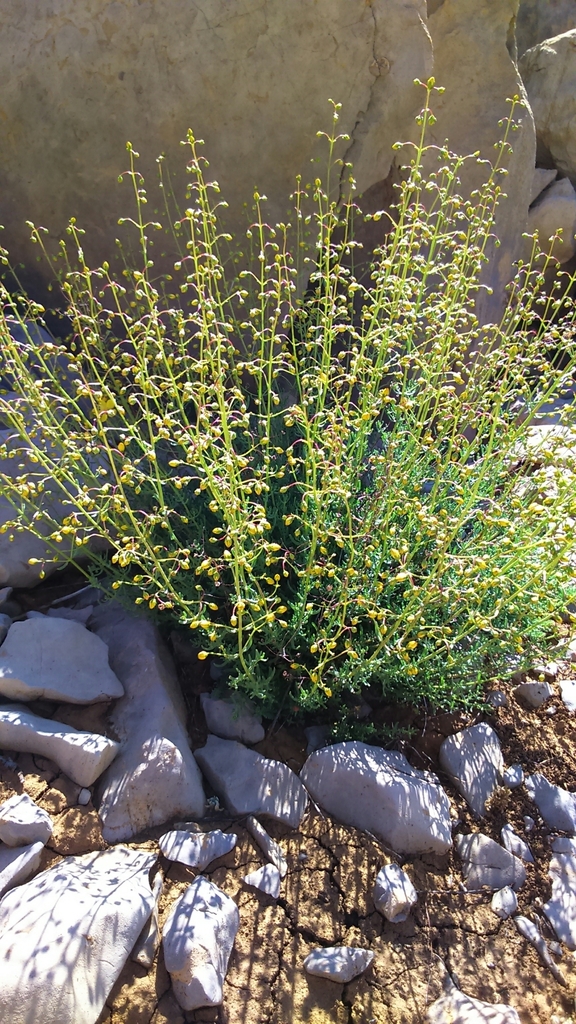
Hypericum libanoticum
Hypericum libanoticum, commonly referred to as the Lebanese St. John's-wort, is a perennial herbaceous plant species within the genus Hypericum and the family Hypericaceae. The species was first typified and taxonomically described by the British botanist Norman Robson in 1970 within Paul Mouterde's botanical compendium Nouvelle Flore du Liban et de la Syrie. Endemic to specific high-altitude limestone terrains of the Levant, the plant is primarily distributed across the mountain ranges of Lebanon and southwestern Syria.
From the article Hypericum libanoticum on Wikipedia (CC BY-SA), quoted section by section
Description
Hypericum libanoticum is a glabrous, suffrutescent perennial with numerous sterile, densely leafy stems at the base. The floriferous stems are erect or ascending, reaching heights of approximately 60 centimetres, and are marked longitudinally by two faint lines. Leaves on the flowering stems are 4–15 mm long and 1–2 mm wide, and are often curved. The margins of the leaves are more or less convolute, terminating in an apex that is either rounded or abruptly apiculate. The lamina is densely covered with transparent, pellucid punctures (internal glands). Axillary fascicles occur on the lower part of the flowering stems and on the sterile shoots. The inflorescence forms an elongated, narrowly pyramidal to spike-like cyme. The petals are pale golden-yellow and 6 to 10 mm long. The petals are unguiculate and pellucid-punctate, with short black glandular cilia or subsessile black glands along the margins. The stamens are long and arranged in three bundles. The capsule is ovoid to ovoid-pyramidal, 4–6 mm long and faintly striate, with three divergent or recurved style bases. The seeds are brown, papillose, curved-cylindric, and measure approximately 2 millimetres. Flowering occurs from May to August. It differs from H. retusum in lacking black punctation on the stems, leaves, sepals and petals. …
Range & habitat
Hypericum libanoticum is native to Lebanon and Syria. It grows on rocky limestone slopes, scree, and in open woodland at elevations of 1,700–1,800 m. In Lebanon, the species has been recorded at Jba'ah, Maasser Al-Chouf, Jabal Barouk, the Cedars of Ain Zhalta, Jabal al-Knayseh, Jabal Sannine, Hasroun, Zahlé, Wadi El-Arayesh, Yammoune, and the broader Beqaa Valley. In Syria, the species has been recorded at the upper slopes of Mount Hermon, Bloudan, Zabadani, Wadi Abou-el-Hom, Wadi-el-Harir, and Wadi-el-Qarn. The type specimen was gathered from the western slopes above Ain Zhalta at an elevation of 1,700–1,800 metres by J. Bornmüller (Specimen ID: Bornmüller 11533).
Wikipedia: “Distribution and habitat”
Where it lives
Recorded sightings
—
geo-referenced records in GBIF, from museums, herbaria and field observers.
Drag the globe to turn it. Dots are where records exist, not a range map; darker means more records.
In the stacks
Searching the stacks…
Every page naming Hypericum libanoticum in the Biodiversity Heritage Library →
This page is assembled live from iNaturalist, GBIF, Wikipedia, the Source Library and the Internet Archive. It is not yet part of the hand-edited codex. iNaturalist taxon 733427.