- Plants
- ›Vascular Plants
- ›flowering plants
- ›Dicots
- ›Mints, Plantains, Olives, and Allies
- ›figwort family
- ›Buddlejeae
- ›Buddleja
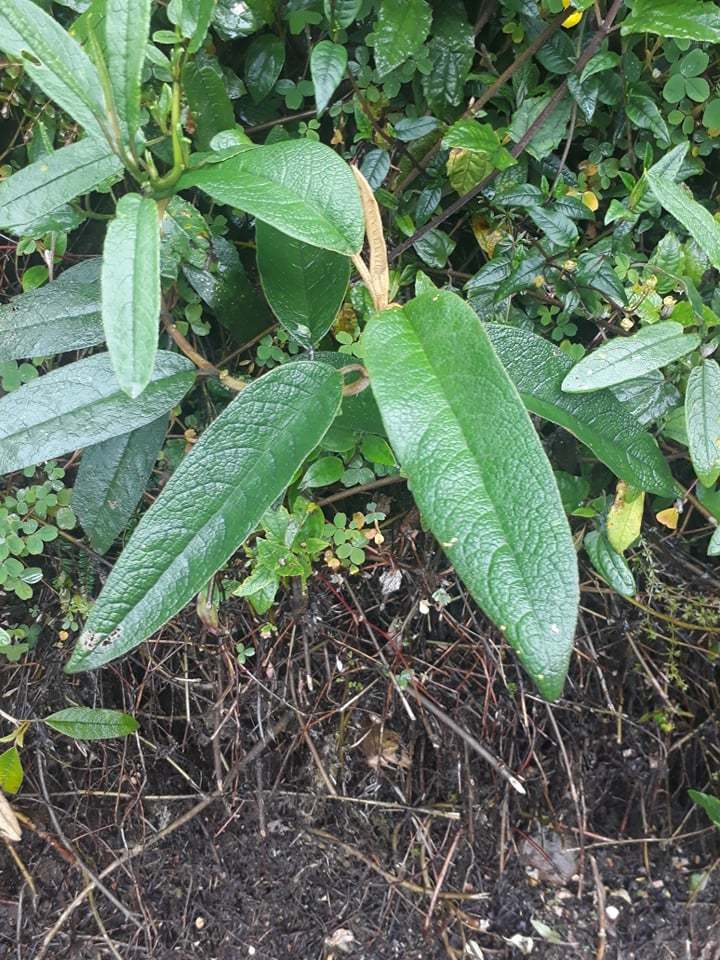
Buddleja bullata
Buddleja bullata is a variable species endemic to the Andes, from Venezuela south through Colombia and Ecuador to Peru, at elevations of 1,800–3,600 m, where it grows on stream beds and in the remnants of montane forest. The species was first described and named by Kunth in 1818.
From the article Buddleja bullata on Wikipedia (CC BY-SA), quoted section by section
Description
Buddleja bullata is a dioecious shrub or small tree 1 – 10 m high, with a greyish-tan bark. The branches are subquadrangular and tomentose. The membraneous or subcoriaceous leaves are elliptic, lanceolate or ovate, 8–22 cm long by 3–8 cm wide, glabrescent, often bullate, above and covered with a white or yellowish tomentum below. The cream or yellow inflorescences are paniculate 7–25 cm long by 7–20 cm wide, comprising globose heads about 1 cm in diameter, each with 6–12 flowers; the corollas are 2.5–3.5 mm long.
Where it lives
Recorded sightings
—
geo-referenced records in GBIF, from museums, herbaria and field observers.
Drag the globe to turn it. Dots are where records exist, not a range map; darker means more records.
In the stacks
Searching the stacks…
Every page naming Buddleja bullata in the Biodiversity Heritage Library →
This page is assembled live from iNaturalist, GBIF, Wikipedia, the Source Library and the Internet Archive. It is not yet part of the hand-edited codex. iNaturalist taxon 715296.