- Plants
- ›Vascular Plants
- ›flowering plants
- ›Dicots
- ›proteas, lotuses, planes, and allies
- ›Protea family
- ›Paired Proteas
- ›Banksieae
- ›Banksiinae
- ›Banksia
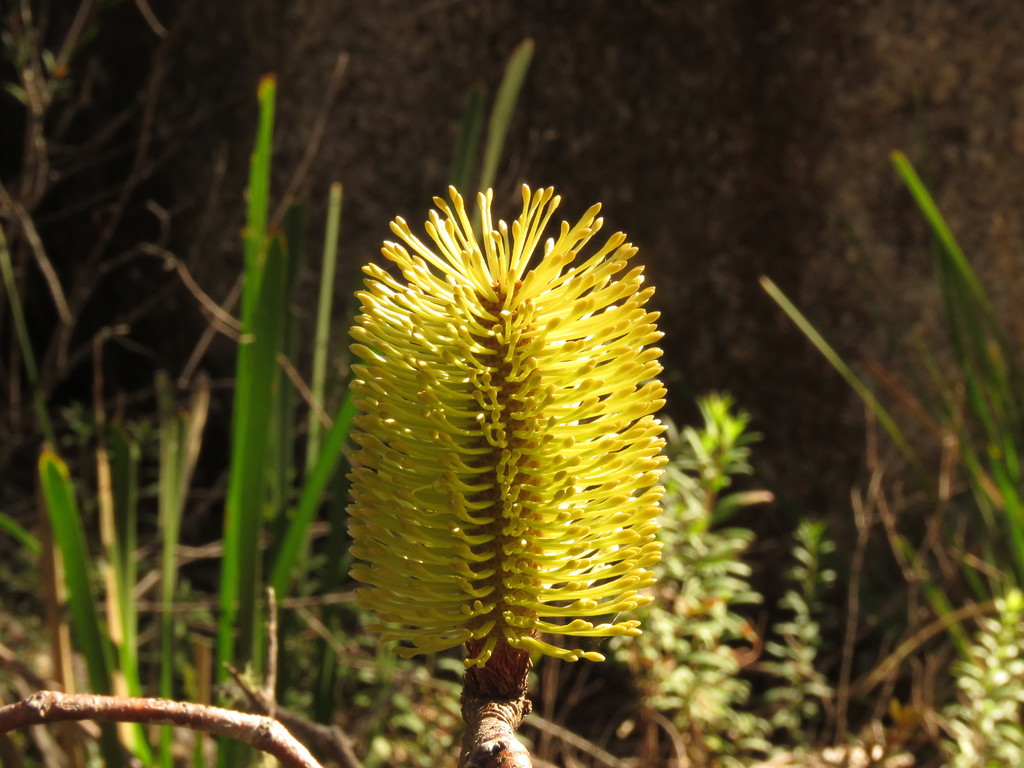
Mountain Banksia
Banksia canei
Banksia canei, commonly known as the mountain banksia, is a species of shrub that is endemic to southeastern Australia. It is generally encountered as a many-branched shrub that grows up to 3 m (10 ft) high, with narrow leaves and the yellow inflorescences (flower spikes) appearing from late summer to early winter. The old flowers fall off the spikes and up to 150 finely furred follicles develop, which remain closed until burnt in a bushfire. Each follicle bears two winged seeds. Response to fire is poorly known, although it is thought to regenerate by seed. Birds such as the yellow-tufted honeyeater and various insects forage among the flower spikes. It is frost tolerant in cultivation, but copes less well with aridity or humidity and is often short-lived in gardens. One cultivar, Banksia 'Celia Rosser', was registered in 1978, but has subsequently vanished.
Although no subspecies are recognised, four topodemes (geographically isolated populations) have been described, as there is significant variation in the shape of both adult and juvenile leaves between populations. Although superficially resembling B. marginata, it is more closely related to another subalpine species, B. saxicola.
From the article Banksia canei on Wikipedia (CC BY-SA), quoted section by section
Description
Banksia canei grows as a woody shrub to 3 m (10 ft) in height, usually with many branches. Its bark is smooth with horizontal lenticels, initially reddish-brown before fading to grey tones. The stiff leaves are arranged alternately along the stems and show significant variation in shape and size. Adult leaves are linear or narrowly obovate in shape, and generally measure 2–5 cm (0.8–2.0 in), though some populations have leaves as short as 1 cm (0.39 in) or as long as 10 cm (3.9 in). The juvenile leaves are generally larger and wider with dentate margins. New growth is seen mainly from February to April. The complex flower spikes, known as inflorescences, appear between December and May, peaking over February to April. They arise from nodes of 1–3-year-old branchlets or can be terminal. Cylindrical in shape, they are composed of a central woody spike, from which a large number of compact floral units arise perpendicularly to it. They are generally 5–10 cm (2.0–3.9 in) high and 3–5 cm (1.2–2.0 in) wide, but some do reach 15 cm (5.9 in) high. Mauve-tinted in bud, they generally open to become pale yellow in colour. As with most banksias, anthesis is acropetal; the opening of the individual buds proceeds up the flower spike from the base to the top. The flower limbs may be pale grey or blue-tinged, while the styles are yellow. …
Range & habitat
Several disjunct populations of Banksia canei have been recorded across alpine areas of southeastern Australia, generally at altitudes of 500 to 1,000 m (1,600 to 3,300 ft) in northeastern Victoria and southeastern New South Wales. One outlier at a lower altitude has been found on land partly cleared for agriculture at 250 m (820 ft) elevation at Yowrie. The species is listed as "Rare in Victoria" on the Department of Sustainability and Environment's Advisory List of Rare Or Threatened Plants In Victoria. In a 1978 paper reviewing the species, Alf Salkin coined the term topodeme to indicate a geographically isolated population of plants, derived from the Ancient Greek words topos "place" and deme "people" or "county (population)". Salkin described four populations (topodemes), each found in granite-based rocky soils in subalpine regions, and isolated from one another by wide river valleys. They would have occupied lower altitudes at cooler geological periods and higher altitudes in warmer times. Each of the main four populations varies from the others in their leaf morphology. …
Wikipedia: “Distribution and habitat”
What it does
Banksia flower spikes are important sources of nectar for mammals, insects and birds, particularly honeyeaters. Animals recorded foraging among the flower spikes of B. canei include the yellow-tufted honeyeater (Lichenostomus melanops), bees, wasps and ants. Banksia canei lacks a lignotuber and appears to regenerate from bushfire by seed, although its response to fire has been little studied. The follicles remain closed until burnt, although some do open spontaneously after five years or so. The fungus Banksiamyces toomansis, of the order Helotiales, infects older cones and seed, and hence seed older than about five years is often not viable. Plectronidium australiense is a species of anamorphic fungus that was recovered from a dead branch of B. canei at Healesville Sanctuary and described in 1986.
Wikipedia: “Ecology”
How it is grown
Banksia canei is somewhat slow-growing in cultivation, and takes around five to seven years to flower from seed. Its furry-follicled fruiting cones are attractive, although generally obscured by foliage. Although grown successfully in England and tolerant of temperatures to −12 °C (10 °F), Banksia canei has a reputation of being difficult to keep alive in Australian gardens. Plants often grow well as seedlings in pots, but perish once planted in the ground. The species is tolerant to frost, but not to aridity or possibly more humid conditions. The species prefers a sunny aspect and fair drainage. It has been grown in inland New South Wales on the Southern Tablelands and Rylstone. Banksia canei seed requires stratification – storing at 5 °C (41 °F) for 60 days – before it germinates, which takes a further 6 to 25 days. Salkin proposed this was necessary so that seed released in a summer or autumn bushfire would lie dormant over the winter months before germinating in the spring. Banksia saxicola and some Banksia marginata seeds of subalpine provenance also share this trait. In 1975, as part of a study on the four populations of B. canei, Salkin carried out germination experiments, producing around a thousand seedlings. In January that year, two seedlings from the Wulgulmerang population displayed deeply lobed (pinnatisect) leaves and a prostrate habit. …
Wikipedia: “Use in horticulture”
Where it lives
Recorded sightings
—
geo-referenced records in GBIF, from museums, herbaria and field observers.
Drag the globe to turn it. Dots are where records exist, not a range map; darker means more records.
In the stacks
Searching the stacks…
Every page naming Banksia canei in the Biodiversity Heritage Library →
This page is assembled live from iNaturalist, GBIF, Wikipedia, the Source Library and the Internet Archive. It is not yet part of the hand-edited codex. iNaturalist taxon 712973.