- Plants
- ›Vascular Plants
- ›flowering plants
- ›monocots
- ›grasses, sedges, cattails, and allies
- ›grasses
- ›Pooideae
- ›Poeae
- ›bluegrasses, timothies, foxtails, and allies
- ›Alopecurus
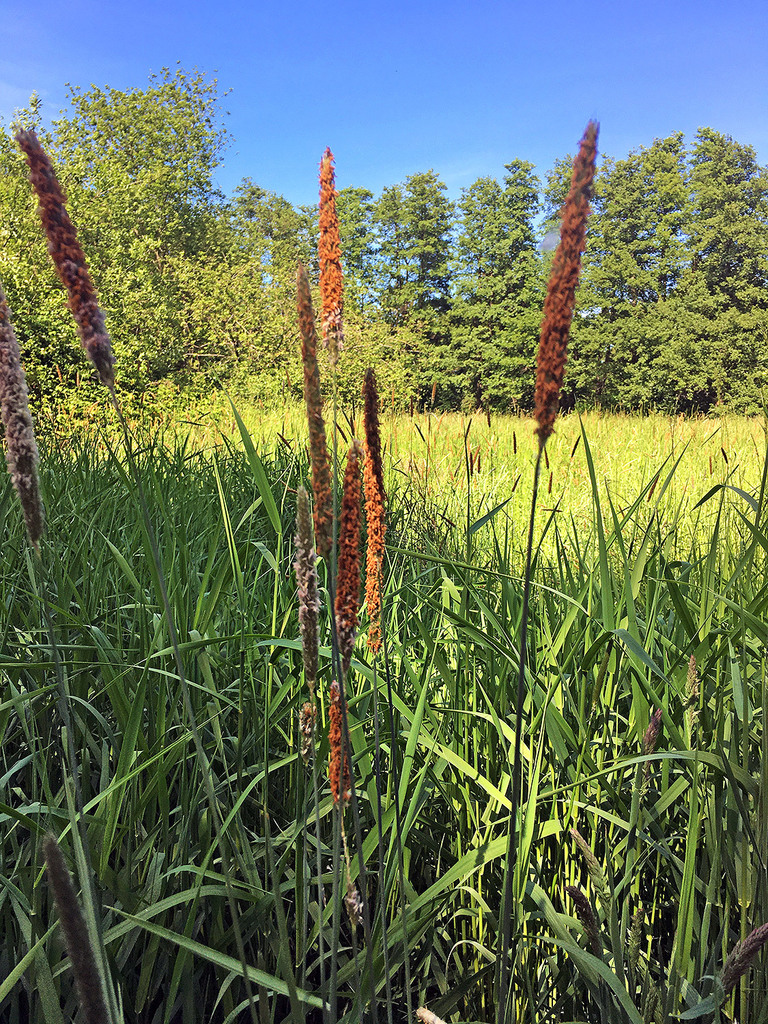
Meadow Foxtail
Alopecurus pratensis
Alopecurus pratensis, known as the meadow foxtail or the field meadow foxtail, is a perennial grass belonging to the grass family (Poaceae). It is native to Europe and Asia.
It is a common plant is found on grasslands, especially on neutral soils. It is found on moist, fertile soils, but avoids waterlogged, light or dry soils. It forms dense swards leading to low botanical diversity and is widely cultivated for pasture and hay, and has become naturalised in many areas outside its native range, including Australia and North America.
From the article Alopecurus pratensis on Wikipedia (CC BY-SA), quoted section by section
Description
It flowers from April until June – one of the earliest grasses to do so. Any survey work carried out in mid-summer may miss the grass as a result of this. It can grow to a height of about 110 centimetres (43 in). The stem is erect and hard at the shaft, the sheathes being smooth and cylindrical. The leaves are about 5 millimetres (0.20 in) wide and hairless. Meadow foxtail has a cylindrical inflorescence with glumes about 5–10 millimetres (0.20–0.39 in) wide and spikelets about 4–6 millimetres (0.16–0.24 in) long. The ligule is 1–2.5 millimetres (0.039–0.098 in) long, with a slightly tattered top.
What it does
The caterpillars of some lepidopterans use it as a foodplant, e.g. the Essex skipper (Thymelicus lineola). Additionally, male mosquitoes can often be found on this flower drinking the nectar out of it. It is a known host to fungi. These include:
Cladosporium phlei Claviceps purpurea Blumeria graminis Mastigosporium album Mastigosporium rubricosum Periconia hispidula Phaeoseptoria poae Rhynchosporium orthosporum
Wikipedia: “Ecology”
Where it lives
Recorded sightings
—
geo-referenced records in GBIF, from museums, herbaria and field observers.
Drag the globe to turn it. Dots are where records exist, not a range map; darker means more records.
In the stacks
Searching the stacks…
Every page naming Alopecurus pratensis in the Biodiversity Heritage Library →
This page is assembled live from iNaturalist, GBIF, Wikipedia, the Source Library and the Internet Archive. It is not yet part of the hand-edited codex. iNaturalist taxon 71141.