- Animals
- ›Chordates
- ›Vertebrates
- ›Amphibians
- ›Frogs and Toads
- ›Poison Frogs
- ›Poison Dart Frogs
- ›Dendrobatinae
- ›Ranitomeya
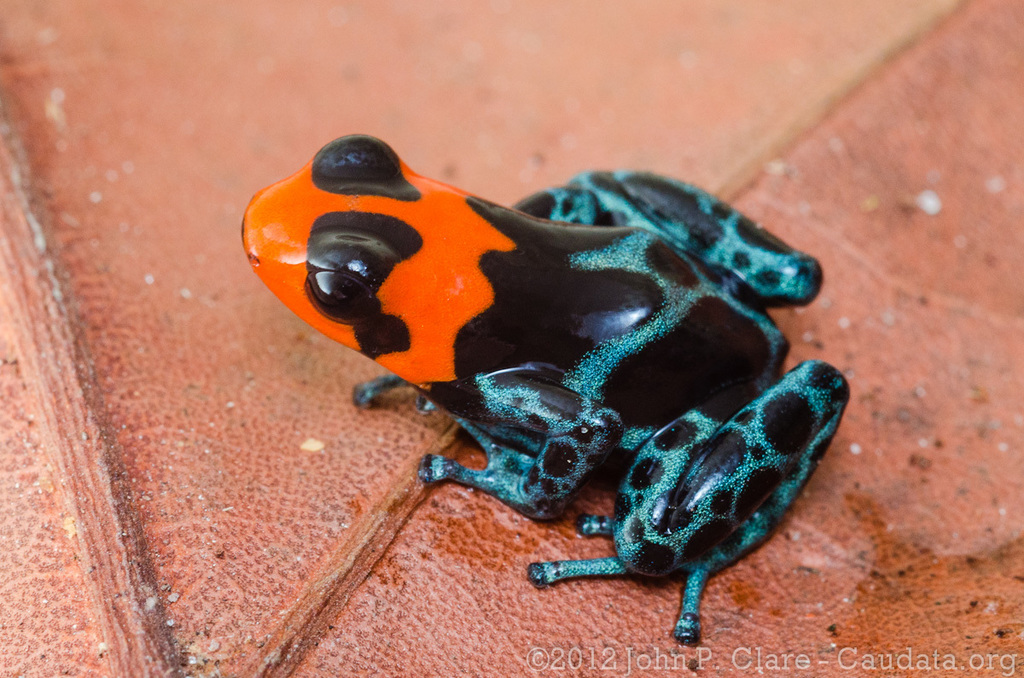
Blessed Poison Frog
Ranitomeya benedicta
Ranitomeya benedicta, sometimes called the blessed poison frog, is a species of poison dart frogs found in the lowland rainforest of the Pampas del Sacramento in southern Loreto and eastern San Martín Region, northeastern Peru. Before 2008, the species was considered a subspecies of Ranitomeya fantastica. The IUCN considers the species vulnerable because of limited habitat range, habitat loss, and collection for the pet trade.
From the article Ranitomeya benedicta on Wikipedia (CC BY-SA), quoted section by section
Description
Ranitomeya benedicta is one of the larger species of thumbnail poison dart frogs. It has a red head and a large snout to vent length which helps distinguish it from other Ranitomeya such as the smaller red-backed poison frog. Males can reach approximately 16.5 mm in length from snout to vent, while the larger females can reach approximately 18.4 mm with some reaching 20.2 mm. Besides their red head they also possess black markings over their eyes which resembles a W-shaped mask and have black colored limbs, dorsum, and venter with a blue reticulated pattern. In some populations, however, the reticulated pattern might not appear, instead showing some of the limbs or parts of the dorsum only being uniformly blue. While Ranitomeya fantastica might resemble this species, this species contains a head that's clearly red while R. fantastica head contains colors that are closer to a bright orange coloration.
Wikipedia: “Morphology”
Range & habitat
This frog inhabits lowland primary rainforest and older secondary rainforest. It has been observed between 150 and 405 meters (490 and 1,300 ft) above sea level. It has been seen in tangled branches and in dead trees on the ground. This frog is diurnal and partially terrestrial, though small-scale farmers and loggers have seen the frog jumping away when the trees are felled.
Wikipedia: “Habitat”
What it does
The male frog's voice sounds like a buzz. Scientists have never heard the frog call in the wild, but frogs in terrariums call at all times of day. The female frog lays 4–6 eggs per clutch. After the eggs hatch, the adult frog carries the tadpoles to different pools of water in bromeliad plants.
Wikipedia: “Life cycle”
Listen
Looking for field recordings…
Where it lives
Recorded sightings
—
geo-referenced records in GBIF, from museums, herbaria and field observers.
Drag the globe to turn it. Dots are where records exist, not a range map; darker means more records.
In the stacks
Searching the stacks…
Every page naming Ranitomeya benedicta in the Biodiversity Heritage Library →
This page is assembled live from iNaturalist, GBIF, Wikipedia, the Source Library and the Internet Archive. It is not yet part of the hand-edited codex. iNaturalist taxon 70902.