- Plants
- ›Vascular Plants
- ›flowering plants
- ›Dicots
- ›Buttercups, Poppies, and Allies
- ›buttercup family
- ›Columbines and Meadow-Rues
- ›Aquilegia
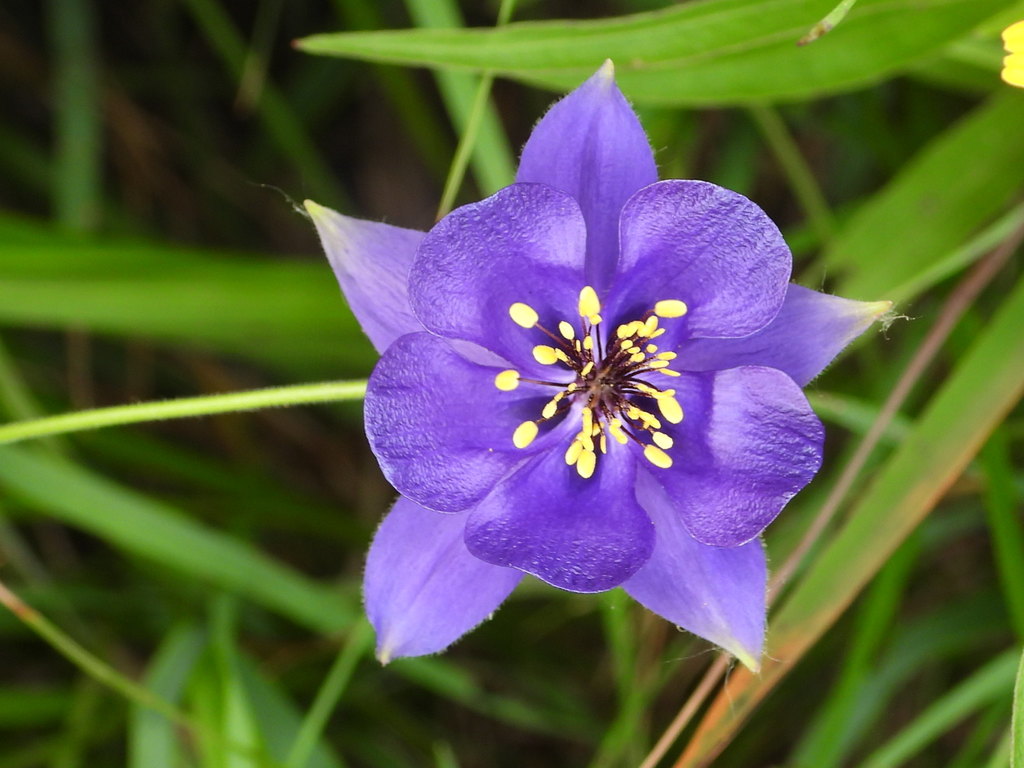
Aquilegia confusa
Aquilegia confusa is a partially accepted species of flowering plant of the genus Aquilegia (columbines) in the family Ranunculaceae that is endemic to the eastern and southern European Alps in Switzerland and Italy.
Growing between 8 cm (3.1 in) and 57 cm (22 in) tall, A. confusa produces fragrant violet flowers between June and September. The entirety of the plant, particularly its seeds, are toxic to humans.
From the article Aquilegia confusa on Wikipedia (CC BY-SA), quoted section by section
Description
Aquilegia confusa is a flowering perennial herbaceous plant in the genus Aquilegia in the family Ranunculaceae. The species possesses rootstocks that can be simple or branching. During its annual growth, the plant will project between one and four flowering stems. Aerial stems are slender and range in height between 8 cm (3.1 in) and 57 cm (22 in) tall. The stems are usually covered by a mix of glandular-pubescent simple hairs and glandular trichomes, with the trichomes becoming the predominant to exclusive hairs towards to top of the stem. Lower stems are rarely glabrous (hairless), with exceptional specimens being entirely glabrous. The plant's numerous basal leaves (leaves from the base of the plant) are arranged in a rosette. The largest leaves on a plant can range from 5 cm (2.0 in) to 24 cm (9.4 in) long. The petioles are long, at between 3 cm (1.2 in) and 17 cm (6.7 in). The ternate leaf sets appear either singly or as pairs. The leaf blades' topsides can be glabrous or somewhat pubescent, while the bottoms are glaucous (grey and waxy) and range from sparsely pubescent to wholly glabrous. The first-order leaflets are borne on petioles between 5 mm (0.20 in) and 45 mm (1.8 in) and appear as a single ternate set or as a single leaf with three-division compound leaf. On some plants, second-order leaflets are present. …
Range & habitat
Aquilegia confusa is a perennial that favors temperate environments, inhabiting the southern prealpine zone. A. confusa is endemic to the eastern and southern European Alps in Switzerland and Italy. In Italy, it is specifically endemic from Lombardy to Friuli. The distribution is coincident with ancient glacial shelters. This range developed during the advance of the Quaternary glaciations. As these glaciers eroded A. confusa's range and pushed its populations against the larger populations of A. eiseleana, degrading the physiognomical distinctiveness of eastern A. confusa populations. The glaciations also isolated A. confusa populations, with some surviving at the lower elevations at the margins of glaciers while others held out at higher elevations on mountains ringed by glaciers. This pressure is credited with A. confusa containing both sciophilous and heliophilous populations. A. confusa can be found at elevations between 350 m (1,150 ft) and 2,200 m (7,200 ft) above sea level. It prefers rocky environments within its range, including rocky pastures, screes, and riverbeds. The plant favors damp, rocky soil, particularly those comprising calcareous or dolomitic substrates. The species occasionally occupies granitic or gneissic soil.
== References ==
Wikipedia: “Distribution and habitat”
What it does
Due to the isolated character of Aquilegia confusa populations – the result of glaciers expanding and contracting – the species has distinctly sciophilous (shade-tolerant) and heliophilous (sun-tolerant) forms that favor the lower and upper elevation brackets respectively. In the species's eastern range, the species features glandular leaves. These glands are associated with smells that attract pollinators in environments that are more competitive as well as shaded, secluded locales. This eastern range coincides with the A. confusa's range overlapping with the more common Aquilegia einseleana. The absence of glandular leaves on A. confusa increases going west through its prealpine range until they disappear entirely, where the species not competing with A. eiseleana. The presence of fewer pollinators have resulted in lower genetic diversity within these higher-elevation A. confusa populations. Combined with the plant's capacity for self-fertilization, this has resulted in substantial phenotype differences between individual populations. In the eastern range of A. confusa, its physiognomical distinctiveness from A. eiseleana is reduced, with hybridization not uncommon. Aquilegia atrata's range also overlaps with that of A. confusa. Despite having different in flowering seasons and other ecological distinctions, hybridization between the two has also been observed. …
Wikipedia: “Ecology”
Where it lives
Recorded sightings
—
geo-referenced records in GBIF, from museums, herbaria and field observers.
Drag the globe to turn it. Dots are where records exist, not a range map; darker means more records.
In the stacks
Searching the stacks…
Every page naming Aquilegia confusa in the Biodiversity Heritage Library →
This page is assembled live from iNaturalist, GBIF, Wikipedia, the Source Library and the Internet Archive. It is not yet part of the hand-edited codex. iNaturalist taxon 705692.