- Plants
- ›Vascular Plants
- ›flowering plants
- ›Dicots
- ›Buttercups, Poppies, and Allies
- ›buttercup family
- ›Columbines and Meadow-Rues
- ›Aquilegia
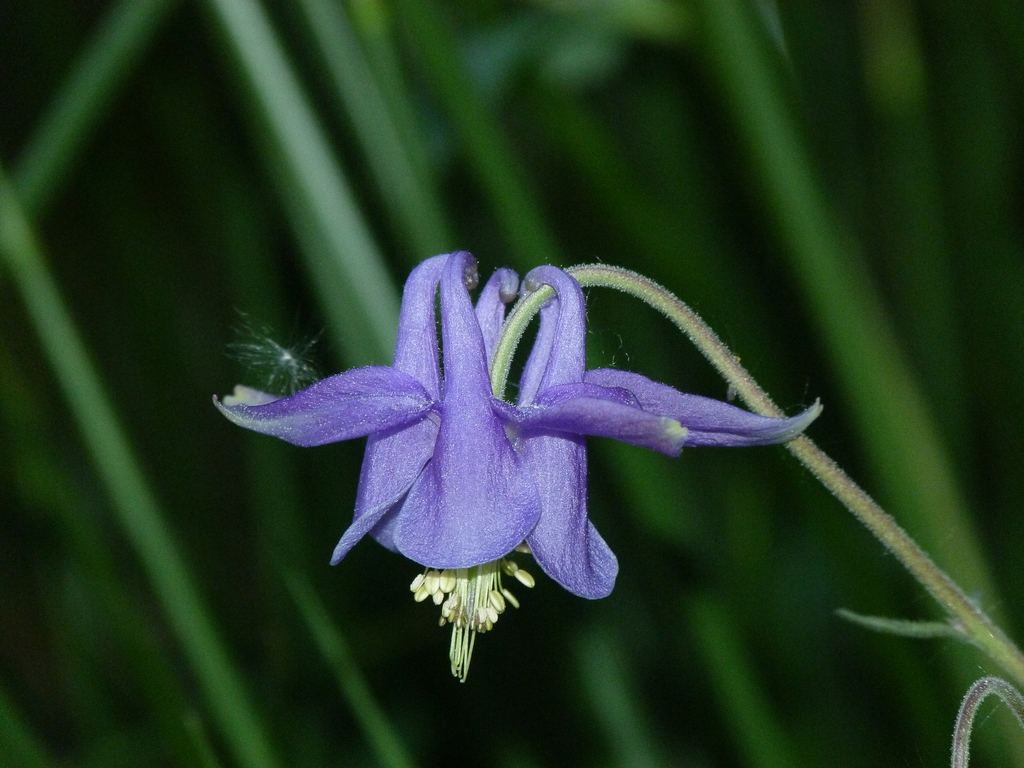
Aquilegia cazorlensis
Aquilegia cazorlensis is a perennial flowering plant in the family Ranunculaceae, endemic to southeastern Spain.
From the article Aquilegia cazorlensis on Wikipedia (CC BY-SA), quoted section by section
Description
Aquilegia cazorlensis is a perennial herb growing to 15–25 cm (6–10 in) in height with branched, grooved stems which can be smooth or hairy. The basal leaves are biternate and have stalks measuring 4–10 cm (1.6–3.9 in) long. The plant produces one to three (rarely up to five) nodding blue flowers with egg-shaped, green-tipped sepals 10–16 mm (0.4–0.6 in) in length. The petals are egg-shaped and 8–9 mm long, with a broad, slightly incurved nectar spur of 6–7 mm length. The anthers are yellow and the stamens extend beyond the end of the petals.
Range & habitat
Aquilegia cazorlensis is endemic to the Sierra de Cazorla in Andalusia, southern Spain. It grows in subalpine limestone screes at altitudes of 1,600–2,000 m (5,200–6,600 ft).
Wikipedia: “Distribution and habitat”
In human culture
The specific epithet cazorlensis is taken from the Sierra de Cazorla to which the species is endemic.
Wikipedia: “Etymology”
Where it lives
Recorded sightings
—
geo-referenced records in GBIF, from museums, herbaria and field observers.
Drag the globe to turn it. Dots are where records exist, not a range map; darker means more records.
In the stacks
Searching the stacks…
Every page naming Aquilegia cazorlensis in the Biodiversity Heritage Library →
This page is assembled live from iNaturalist, GBIF, Wikipedia, the Source Library and the Internet Archive. It is not yet part of the hand-edited codex. iNaturalist taxon 705690.