- Plants
- ›Vascular Plants
- ›flowering plants
- ›monocots
- ›Agaves, Orchids, Irises, and Allies
- ›Aloe family
- ›daylilies and allies
- ›Hemerocallis
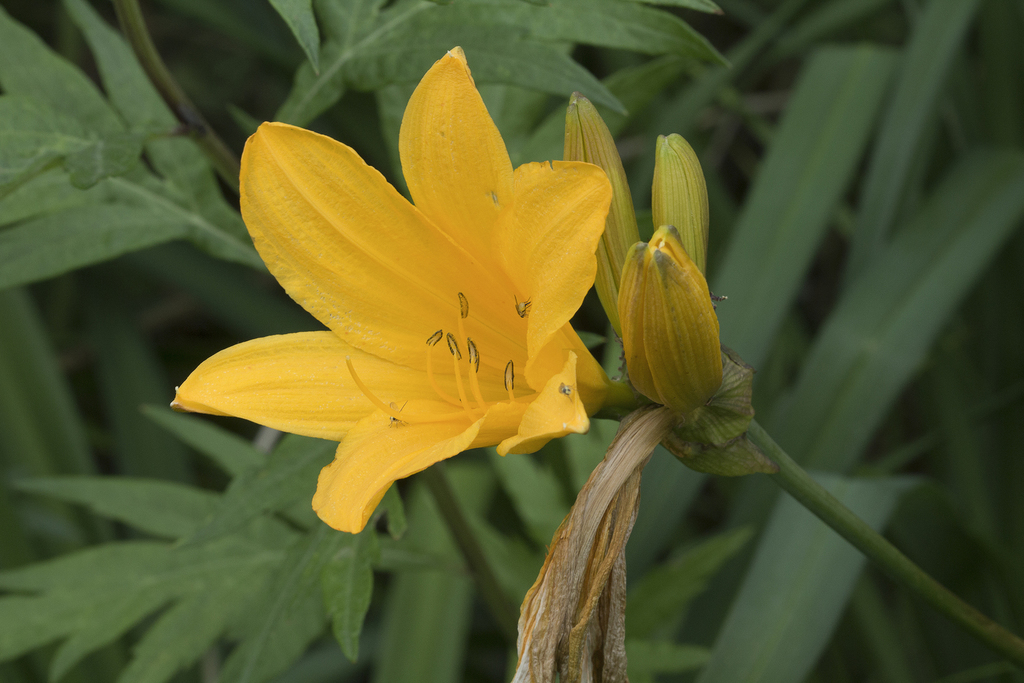
amur day-lily
Hemerocallis middendorffii
Hemerocallis middendorffii, known as Amur daylily, is a plant species in the subfamily Hemerocallidoideae of the family Asphodelaceae of the order Asparagales. It is native to the Russian Far East, northwest China, Korea, and Japan. It grows in meadows, mountain slopes, open woods, and scrub. It is cultivated in Asia for its edible flowers.
From the article Hemerocallis middendorffii on Wikipedia (CC BY-SA), quoted section by section
Description
Herbaceous perennial with linear arching leaves to 60 cm (24 in). Flower scapes 20–90 cm (8–35 in). Flowers 5–6, golden yellow to clear orange, large in a terminal head. Flowers in July for 2–3 weeks and often reblooms in September. Four varieties are recognized:
H. middendorffii var. middendorfii: To 90 cm (35 in). Flowers orange, odorless with elliptic to spathulate tepals. Bracts ovate, 2–2.5 cm (3⁄4–1 in). The range of the species. H. middendorffii var. esculenta (Koidz.) Ohwi: Japan H. middendorffii var. exaltata (Stout) M.Hotta: Japan H. middendorffii var. longibracteata Xiong: 20–35 cm (8–14 in). Flowers yellow, fragrant with lanceolate tepals. Bracts ovate-lanceolate, 3–6 cm (1+1⁄4–2+1⁄4 in). Endemic to China.
How it is grown
Easily cultivated on moist soil in a sunny site, but can tolerate poor soil and partial shade. Propagated by division and by seed. Takes 2–3 years to flower from seed. Plants prefer a neutral to slightly acid soil and will suffer in very acid or alkaline soils. Generally free from pests and diseases. Hardy to USDA zone 4.
== References ==
Wikipedia: “Cultivation”
Where it lives
Recorded sightings
—
geo-referenced records in GBIF, from museums, herbaria and field observers.
Drag the globe to turn it. Dots are where records exist, not a range map; darker means more records.
In the stacks
Searching the stacks…
Every page naming Hemerocallis middendorffii in the Biodiversity Heritage Library →
This page is assembled live from iNaturalist, GBIF, Wikipedia, the Source Library and the Internet Archive. It is not yet part of the hand-edited codex. iNaturalist taxon 702890.