- Plants
- ›Vascular Plants
- ›flowering plants
- ›Dicots
- ›Buttercups, Poppies, and Allies
- ›Poppy Family
- ›Poppy Subfamily
- ›Papavereae
- ›Argemone
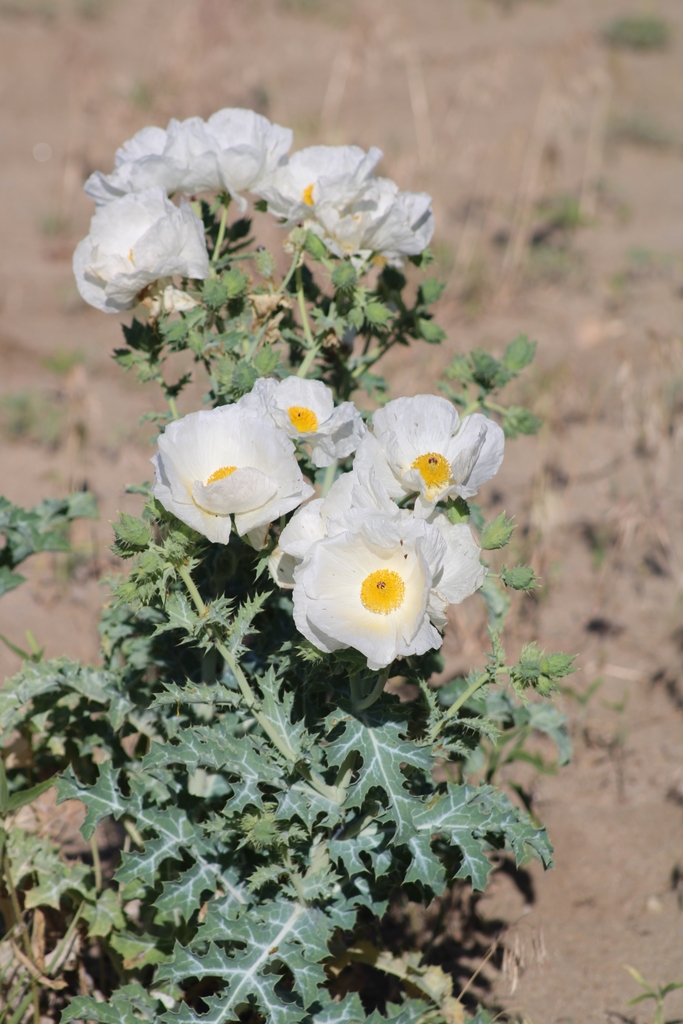
thistle poppy
Argemone polyanthemos
Argemone polyanthemos (crested pricklypoppy) is an annual plant with yellow sap and showy white flowers in the poppy family (Papaveraceae).:63 It can be found in areas with dry soil in most of the North American southwest.:63 Because of its prickly defenses, and acrid taste from its poisons, grazing animals tend to avoid it, so it increases in numbers compared to other plants in grazed areas.:63
From the article Argemone polyanthemos on Wikipedia (CC BY-SA), quoted section by section
Description
One of the distinguishing characteristics is the absence of prickles on upper leaf surfaces, though as with all species in the genus it has many prickles on stems and leaf margins. Plants are variable in height, but often grow to one meter, with exceptional individuals reaching 1.2 meters with deeply lobed 20 cm leaves. The leaves and stems are pale blue green. The 7-10 cm flowers bloom from late spring into summer. Each flower has 4-6 very thin translucent white petals that flutter in the wind and a dense center cluster of yellow stamens. In late summer the plant has sparsely prickly seed capsules with small black seeds. Broken or nicked stems produce thick orange-yellow sap. It has a large taproot for accessing water in freely draining soils. All parts of the plant are poisonous. Because of its prickly defenses, and acrid taste from its poisons, grazing animals tend to avoid it, so it increases in numbers compared to other plants in grazed areas. Argemone polyanthemos is not a long lived plant. Some individuals bloom in the first year of growth, but most bloom quite heavily in the second year of growth and then die. Occasionally, with adequate moisture, a plant will form new buds underground and sprout again.
Range & habitat
It can be found in areas with dry soil from Texas northward to North Dakota and as far west as Washington State. It has spread or been introduced to areas adjacent to its natural range, which was primarily east of the Rocky Mountains in the shortgrass and mixed grass prairies.
Wikipedia: “Distribution”
Where it lives
Recorded sightings
—
geo-referenced records in GBIF, from museums, herbaria and field observers.
Drag the globe to turn it. Dots are where records exist, not a range map; darker means more records.
In the stacks
Searching the stacks…
Every page naming Argemone polyanthemos in the Biodiversity Heritage Library →
This page is assembled live from iNaturalist, GBIF, Wikipedia, the Source Library and the Internet Archive. It is not yet part of the hand-edited codex. iNaturalist taxon 70097.