- Plants
- ›Vascular Plants
- ›flowering plants
- ›Dicots
- ›Mints, Plantains, Olives, and Allies
- ›bignonia family
- ›Tecomeae
- ›Catophractes
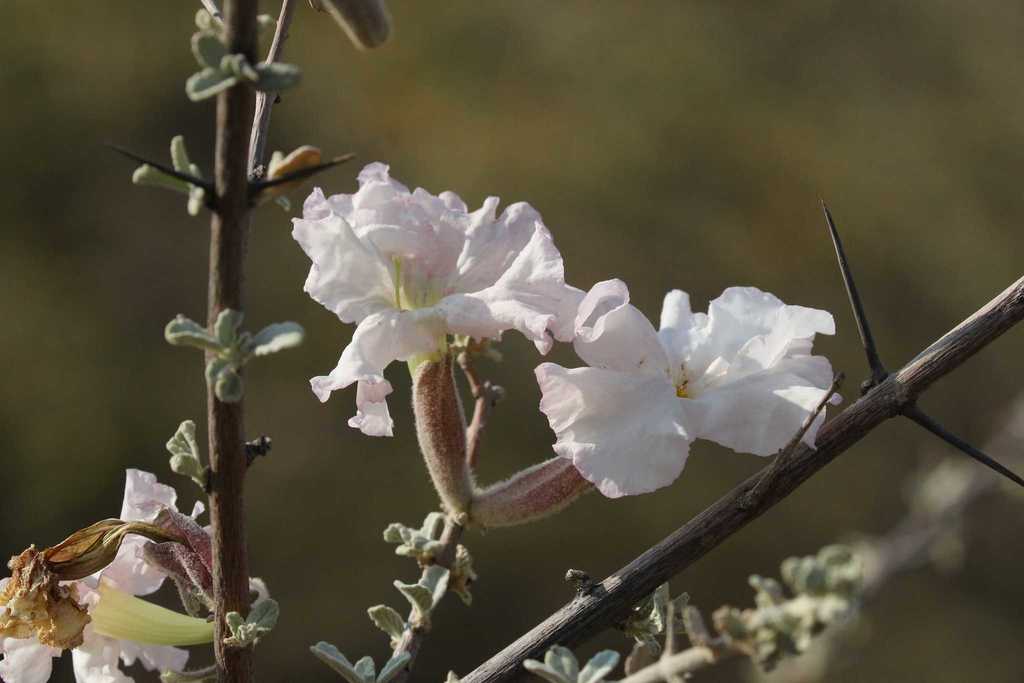
trumpet thorn
Catophractes alexandri
Catophractes alexandri, the only species in the genus Catophractes, is a spiny shrub or small tree up to 3m tall, belonging to the family Bignoniaceae and occurring in the hot, low-rainfall regions of Namibia, the Northern Cape, Kalahari Desert, Botswana, western Zimbabwe and Limpopo. Preferring calcrete, limestone outcrops and soils, the species often forms pure communities, or grows in association with Colophospermum mopane, Rhigozum virgatum, Phaeoptilum spinosum and Acacia nebrownii. It is parasitised by several Tapinanthus spp.
The specific name honours James Edward Alexander, the Victorian soldier and explorer, while the generic name refers to leaves and flowers arising from below the paired, decussate, opposite spines. Leaves are tufted (fascicled) or opposite, and densely tomentose and grey. They are simple and elliptic to obovate, up to 4 cm long, and with coarsely dentate or scalloped margins. The white or pink flowers, produced after rain, are about 10 cm in length, fragrant, showy or specious, 5-lobed, and with a yellow throat. Inside the tube there is a broad, villous band below the origin of the filaments. The calyx is tubular with linear teeth, and slit on one side. The fruit is a flattened, woody capsule, some 10 cm long, warty and splitting or dehiscing across the flat faces into two equal parts. Old fruits are pendant and produce a characteristic clicking sound in light breezes, caused by the castanet-like tapping of the two hollow parts. Seeds are papery and winged.
From the article Catophractes on Wikipedia (CC BY-SA), quoted section by section
In medicine
The root is chewed for stomach complaints, and when added to the root of Polygala leptophylla Burch., is used as a decoction for abdominal pain, especially in children. Leaf, root and bark infusions and decoctions are used to treat colds and coughs.
Wikipedia: “Medicinal use”
Where it lives
Recorded sightings
—
geo-referenced records in GBIF, from museums, herbaria and field observers.
Drag the globe to turn it. Dots are where records exist, not a range map; darker means more records.
In the stacks
Searching the stacks…
Every page naming Catophractes alexandri in the Biodiversity Heritage Library →
This page is assembled live from iNaturalist, GBIF, Wikipedia, the Source Library and the Internet Archive. It is not yet part of the hand-edited codex. iNaturalist taxon 70059.