- Plants
- ›Vascular Plants
- ›flowering plants
- ›monocots
- ›screwpines, stemona, and allies
- ›screwpine family
- ›Pandanus
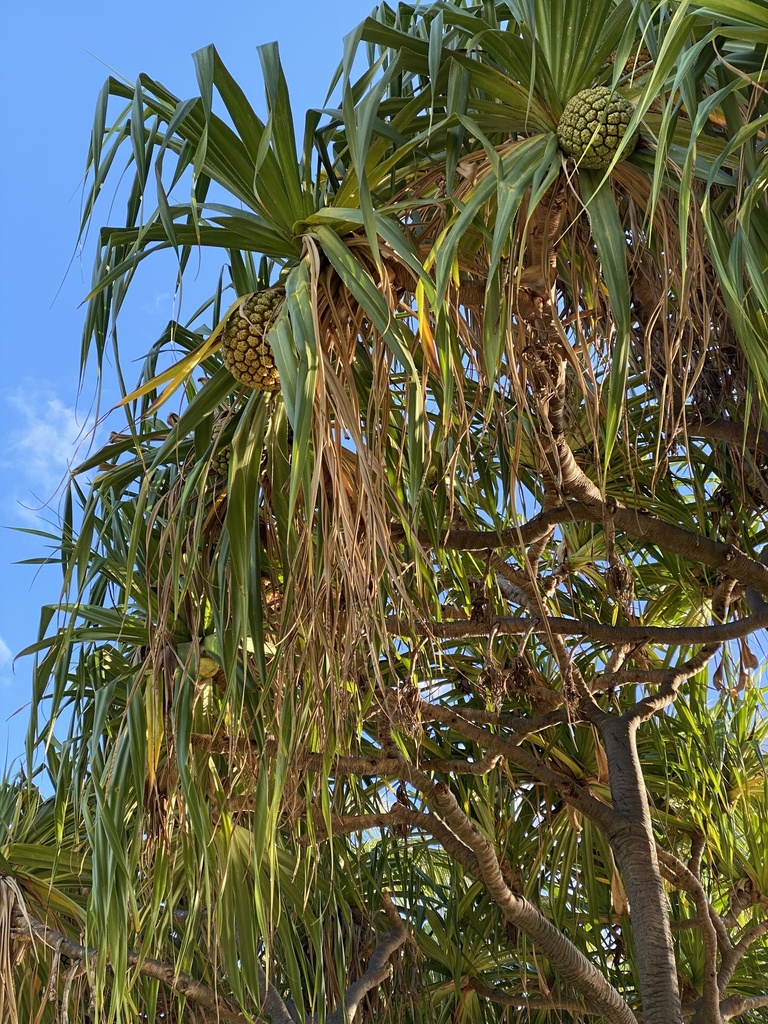
thatch screwpine
Pandanus tectorius
Pandanus tectorius is a species of Pandanus (screwpine) that is native to Malesia, Papuasia, eastern Australia, and the Pacific Islands. It grows in the coastal lowlands typically near the edge of the ocean. Common names in English include thatch screwpine, Tahitian screwpine, hala tree (pū hala in Hawaiian) and pandanus. The fruit is edible and sometimes known as hala fruit.
The local Hawaiian name hala derives ultimately from Proto-Malayo-Polynesian *paŋdan which is also the base for the Pandanus generic name via Malay: pandan; the Malay name for the plant itself is pandan laut (lit. 'sea pandan').
From the article Pandanus tectorius on Wikipedia (CC BY-SA), quoted section by section
Description
P. tectorius is a small tree that grows upright to reach 4–14 m (13–46 ft) in height. The single trunk is slender with brown ringed bark. It is spiny, grows to 4.5–11 m (15–35 ft) in width, and forks at a height of 4–8 metres (13–26 ft). It is supported by aerial roots (prop roots) that firmly anchors the tree to the ground. Roots sometimes grow along the branch, and they grow at wide angles in proportion to the trunk.
Leaves. The leaves are usually 90–150 cm (3–5 ft) in length and 5–7 cm (2–2+3⁄4 in) in width. They possess saw-like margins. Some varieties have spines along the edges and ribs throughout the leaves. The leaves are spirally arranged at the end of the branches.
Flowers. Pandanus tectorius is dioecious, meaning male and female flowers are borne on separate trees, with very different male and female flowers. Male flowers are arranged in racemes and are small, fragrant, and short-lived, lasting only a single day. The flowers are grouped in 3 and gathered in large clusters surrounded by big, white bracts. these clusters are about 1 ft in length and are fragrant. Female flowers resemble pineapples. In Hawaiʻi the male flower is called hīnano and the bracts are used for making very fine mats (moena hīnano' or ʻahu hīnano).
Fruit. The female P. tectorius trees produce a segmented, large fruit. Although not closely related, the fruit resembles a pineapple. …
Range & habitat
Pandanus tectorius grows natively from the Philippines through the Pacific Ocean to Hawaii. It is found in parts of Malesia (the Cocos (Keeling) Islands, Java, the Lesser Sunda Islands, the Maluku Islands and the Philippines), throughout Papuasia, and in most of the tropical Pacific.
In Australia, it is native to an area from Port Macquarie in New South Wales to northern Queensland. Both the US and the Hawaiian Islands recognize only one indigenous species, P. tectorius. Its exact native range is unknown due to extensive cultivation; it may be an early Polynesian introduction to many of the more isolated Pacific islands on which it occurs. These islands include Micronesia and Melanesia. In Hawaii, P. tectorius is found natively on all the main islands except Kahoʻolawe, and it is known to have predated human settlement, based on seed and pollen samples taken from Kauaʻi's Makauwahi Cave. Pandanus tectorius naturally grows in coastal regions, such as on mangrove margins and beaches, at elevations from sea level to 610 m (2,000 ft). It requires 1,500–4,000 mm (59–157 in) of annual rainfall and seasons will fluctuate from wet to dry. Pandanus tectorius is considered more drought tolerant than coconut trees. The trees have adapted to drought by reducing fruiting. …
Wikipedia: “Distribution and habitat”
What it does
There are a wide range of natural enemies that pose a threat to P. tectorius such as parasites, pathogens, and herbivores. They attack the leaves, roots, stems, and growing points. The stick insect Megacrania batesii lives and feeds only on P. tectorius and two other Pandanus species. Pandanus tectorius in Australia is threatened by a sap-sucking insect, Jamella australiae, a species of the genus Jamella of the subfamily Flatinae, known as the Pandanus planthopper. It has caused much damage to plants on the northern coast of New South Wales, before making its way up the coast to Noosa and the Gold Coast in Queensland in the 1990s. Since then it has infested pandanus further north, killing about 80 per cent of the P. tectorius population to the south of Gladstone, Queensland, and has since reached Yeppoon on the Capricorn Coast, where P. tectorius plays an important part in preventing coastal erosion. A natural predator in the form of a wasp native to northern Queensland, Aphanomerus pusillus, has been introduced on Fraser Island and in Byfield National Park as one of methods used to combat the pest. Other methods used on Fraser Island including the injection of insecticide into the plant, stripping infested leaves away, and breeding new plants from local stock. …
Wikipedia: “Ecology”
At the table
The fruit is edible. Some varieties and cultivars contain significant amounts of calcium oxalate, and thus need thorough cooking before being consumed. Other cultivars contain very little to no calcium oxalate and can be eaten raw. It is an important food source in the atolls of Micronesia and Polynesia, with the fruit commonly eaten raw or turned into a dried paste (such as mokwan in the Marshall Islands or te tuae in Kiribati) or flour. It is also one of the traditional foods of Maldivian cuisine. The fibrous nature of the fruit also serves as a natural dental floss. It is also used in Samoan culture as a ula fala, a necklace made out of the dried fruit painted in red and worn by the matai during special occasions and functions. Australian Aboriginal peoples extracted the slender, edible seeds. This seed, and the fruit, was an important food. The tree's leaves are often used as flavoring for sweet dishes. It is also used in Sri Lankan cookery, where the leaves are used to flavor a variety of curries. Leaves were used by the Polynesians to make baskets, mats, outrigger canoe sails, thatch roofs, and grass skirts. …
Wikipedia: “Uses”
How it is grown
Pandanus tectorius may be grown from seed or cuttings – the former will flower at around 15 years and the latter usually flowers by 3 to 4 years of age. Female trees typically flower one to three times per year while male trees will flower every 2 months. It is thought to reproduce sexually in Hawaii, but there is some evidence that apomixis occurs. Small insects, such as bees, and wind are usually the pollinators. It takes 1 to 2 years from pollination to produce fruit on female trees. Seasons vary amongst locations and varieties. For example, in Fiji the pollination season is March to May, in northern Australia it is April to August, and in Micronesia, there are two season December to March and July to September. Most varieties produce 8 to 12 fruits per tree every 2 years. Each fruit usually weighs between 7 and 15 kg (15 and 33 lb) and contains 35 to 80 edible keys. Pandanus tectorius plants are usually propagated by seed in Hawaii. Soak the keys in cool tap water for 5 days while frequently changing the water. Viable keys will float, so it is important to keep them. In Growing native Hawaiian plants: a how-to guide for the gardner, Bornhorst says to remove the fleshy layer of the key and then bury the seed half-way in planting soil. It is important to keep the soil moist. P. tectorius can also be grown from large cuttings. …
Wikipedia: “Cultivation”
In human culture
The seal of Punahou School in Honolulu, Hawaii, features the hala tree, in part because lauhala, the art of weaving with the leaves of that tree, is pivotal to the history of the island, with everything from houses to pillows being made in this fashion. Local legend tells of an aged Hawaiian couple who lived long ago above the present Punahou campus, and had to travel far for water. They prayed each night for a spring, but to no avail. Finally one night, in a dream answering their prayers, they were told to uproot the stump of an old hala tree. They did as they were told and found a spring of clear, sweet water, which they named Ka Punahou, the New Spring. According to legend, Punahou School's lily pond is fed by this same spring.
Wikipedia: “In culture”
Where it lives
Recorded sightings
—
geo-referenced records in GBIF, from museums, herbaria and field observers.
Drag the globe to turn it. Dots are where records exist, not a range map; darker means more records.
In the stacks
Searching the stacks…
Every page naming Pandanus tectorius in the Biodiversity Heritage Library →
This page is assembled live from iNaturalist, GBIF, Wikipedia, the Source Library and the Internet Archive. It is not yet part of the hand-edited codex. iNaturalist taxon 70026.