- Plants
- ›Vascular Plants
- ›flowering plants
- ›monocots
- ›screwpines, stemona, and allies
- ›screwpine family
- ›Pandanus
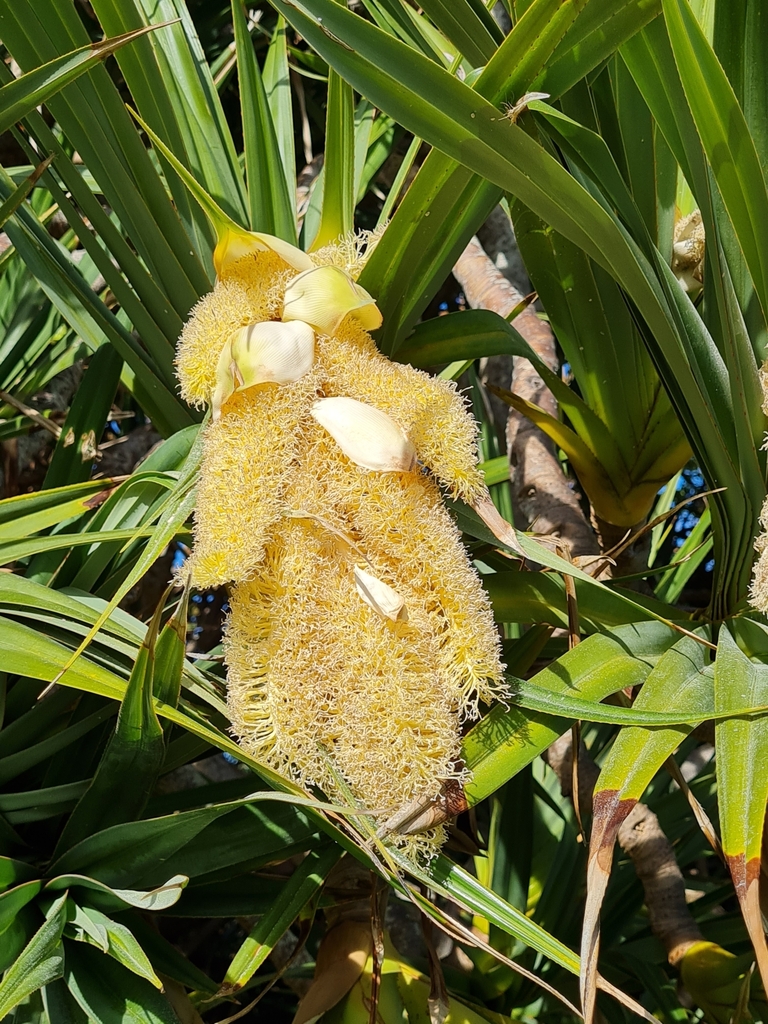
Common screwpine
Pandanus utilis
Pandanus utilis, commonly known as common screwpine or pimento thatch, is a species of monocot in the genus Pandanus, native to the Mascarene Islands of Mauritius, Rodrigues, and Réunion, and naturalised in Madagascar (where it has often been thought native), the Seychelles, and elsewhere.
From the article Pandanus utilis on Wikipedia (CC BY-SA), quoted section by section
Description
Within the family Pandanaceae, the genus Pandanus composes the largest genus. It is estimated that there are between 500 and 1,000 species within this genus; the Plants of the World Online database accepts 562 species. Pandanus utilis, otherwise known as the common screwpine, is one species in this genus. It was discovered by the French naturalist Jean Baptiste Bory de Saint-Vincent in 1801–02 and described in 1804. The origin of P. utilis has traditionally been thought to be Madagascar, but more recently the Mascarene Islands have been suggested as a possible place of origin. A long history of cultivation and transport to many parts of the world makes the origin difficult to trace. However, it is now grown in Senegal, Benin, Tanzania, Madagascar, Réunion, Maldives and Mauritius. P. utilis has been introduced to many tropical and subtropical regions, including Central America, the Caribbean, the United States (southern Florida, Puerto Rico), Brazil, India, Japan (Okinawa), and Indonesia.
Morphology. Pandanus utilis is a palm-like evergreen tree, ranging in height up to 20 metres (66 ft). As with many Pandanus, the trunk has aerial prop roots. It is found in tropical areas, and has an upright trunk that is smooth with many horizontal spreading branches with annular leaf scars. Old leaf scars spiral around the branches and trunk, like a screw. …
What it does
P. utilis grows well near the sea, being salt-tolerant. It is a strictly tropical tree that will not survive frost. It grows in full sun to partial shade but prefers at least 6 hours of direct sunlight. Seeds take two to three months to germinate.
Wikipedia: “Ecology”
Where it lives
Recorded sightings
—
geo-referenced records in GBIF, from museums, herbaria and field observers.
Drag the globe to turn it. Dots are where records exist, not a range map; darker means more records.
In the stacks
Searching the stacks…
Every page naming Pandanus utilis in the Biodiversity Heritage Library →
This page is assembled live from iNaturalist, GBIF, Wikipedia, the Source Library and the Internet Archive. It is not yet part of the hand-edited codex. iNaturalist taxon 70022.