- Plants
- ›Vascular Plants
- ›flowering plants
- ›monocots
- ›lilies, supplejacks, and allies
- ›lily family
- ›fairybells, fetid adderstongues, and twistedstalks
- ›Prosartes
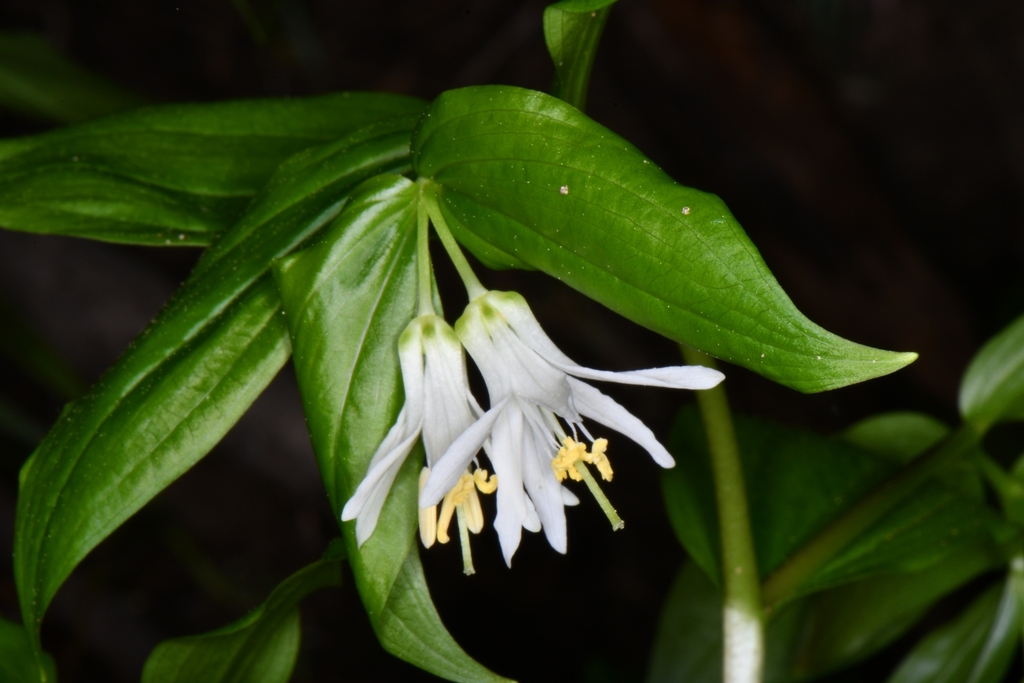
rough-fruited fairybells
Prosartes trachycarpa
Prosartes trachycarpa, the roughfruit fairybells, rough-fruited fairybells or rough-fruited mandarin, is a North American species of plants in the lily family. The species is widespread, known from British Columbia to Ontario and south to Arizona and New Mexico. One isolated population was reported from Isle Royale in Lake Superior.
From the article Prosartes trachycarpa on Wikipedia (CC BY-SA), quoted section by section
Description
This herbaceous perennial is 30 centimeters (12 in) to 80 centimeters (31 in) in height. The stems are only sparingly branched and have a softly fuzzy texture when young and become smooth or nearly so with age. The leaves are alternate and are about 4 centimeters (1.6 in) to 12 centimeters (4.7 in) long. The flowers are delicate and hang down from the stem tips, each flower has four pedals. The berry is larger than a Saskatoon, pincherry or chokecherry, about the size of a grocery store cherry or small grape. The rough-fruited fairybell can be found in the same locale as other native fruits such as Saskatoons and chokecherries. Berries begin yellow, then orange and when fully ripe are red, often with all three colors on the same raceme. Typically 2—3 berries grow on each stem tip. The surface of the fruit feels fuzzy and velvety. The berries are edible, but bland. The species is listed amongst plants found in the Prince Albert National Park and Riding Mountain National Park and are considered a common range plant of northern Saskatchewan.
Where it lives
Recorded sightings
—
geo-referenced records in GBIF, from museums, herbaria and field observers.
Drag the globe to turn it. Dots are where records exist, not a range map; darker means more records.
In the stacks
Searching the stacks…
Every page naming Prosartes trachycarpa in the Biodiversity Heritage Library →
This page is assembled live from iNaturalist, GBIF, Wikipedia, the Source Library and the Internet Archive. It is not yet part of the hand-edited codex. iNaturalist taxon 68917.