- Plants
- ›Vascular Plants
- ›flowering plants
- ›monocots
- ›Agaves, Orchids, Irises, and Allies
- ›agave and allies
- ›Hyacinth subfamily
- ›hyacinth tribe
- ›Muscari
- ›Muscari
- ›Muscari neglectum
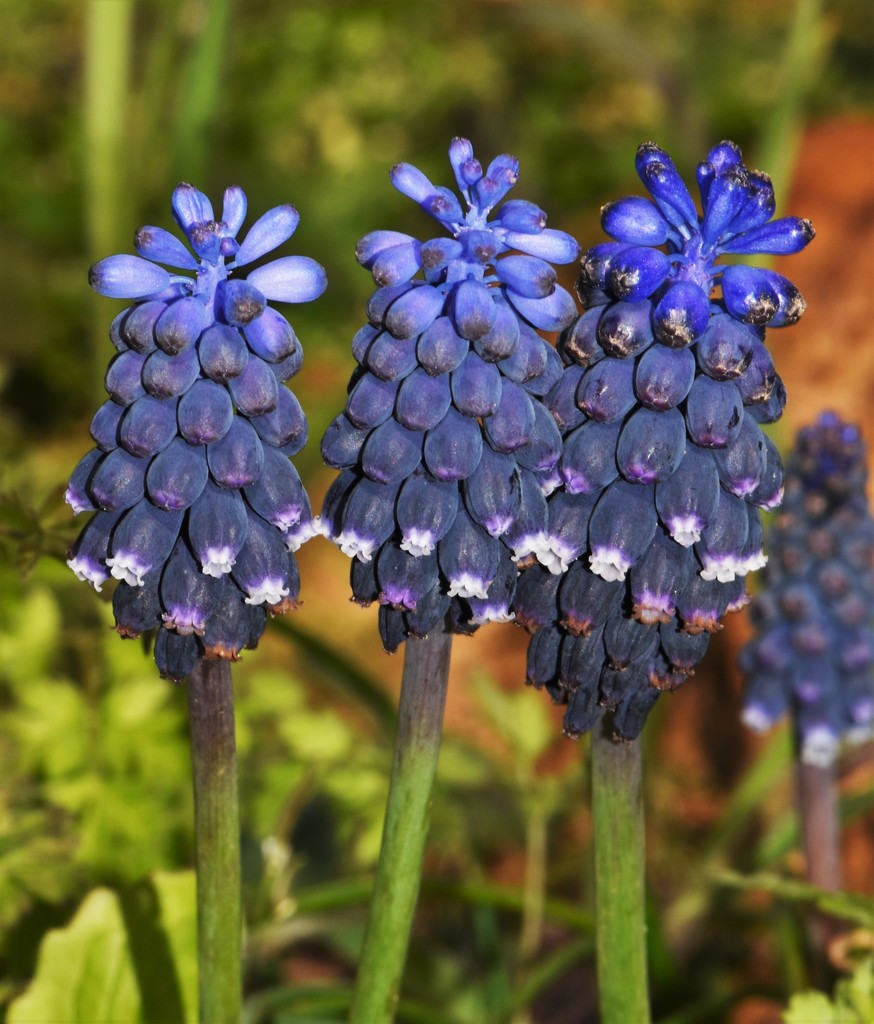
Musk Hyacinth
Muscari neglectum
Muscari neglectum is a perennial bulbous flowering plant in the asparagus family Asparagaceae. Members of this genus are commonly known as grape hyacinths, and M. neglectum is known as common grape hyacinth or starch grape hyacinth. Muscari are perennial bulbous plants native to Eurasia. They produce spikes of dense, commonly blue, urn-shaped flowers. It is sometimes grown as an ornamental plant, for example, in temperate climates as a spring bulb.
From the article Muscari neglectum on Wikipedia (CC BY-SA), quoted section by section
Description
Muscari neglectum is a herbaceous plant growing from a bulb. The flower stems are 5–20 cm (2.0–7.9 in) tall. The flowers are arranged in a spike or raceme and are dark blue with white lobes at their tips (teeth); there may be a cluster of paler sterile flowers at the top of the spike. The raceme is 2–6 cm (0.8–2.4 in) long. The fruit is a 3-celled capsule with two ovules in each cell. It is a very well known species in cultivation (being described as the "common" grape hyacinth by Brian Mathew); it increases rapidly and can become invasive.
Range & habitat
The native range of Muscari neglectum extends around the Mediterranean basin including North Africa, Southern Europe, and Western Asia, and to Central Europe, Ukraine, European Russia, the Caucasus, Iran, Afghanistan, Pakistan, and Central Asia.
Wikipedia: “Range”
Where it lives
Recorded sightings
—
geo-referenced records in GBIF, from museums, herbaria and field observers.
Drag the globe to turn it. Dots are where records exist, not a range map; darker means more records.
In the stacks
Searching the stacks…
Every page naming Muscari neglectum in the Biodiversity Heritage Library →
This page is assembled live from iNaturalist, GBIF, Wikipedia, the Source Library and the Internet Archive. It is not yet part of the hand-edited codex. iNaturalist taxon 68846.