- Animals
- ›Chordates
- ›Vertebrates
- ›Reptiles
- ›Turtles and Tortoises
- ›Eurasian Pond, River, and Neotropical Wood Turtles
- ›Geoemydinae
- ›Batagur
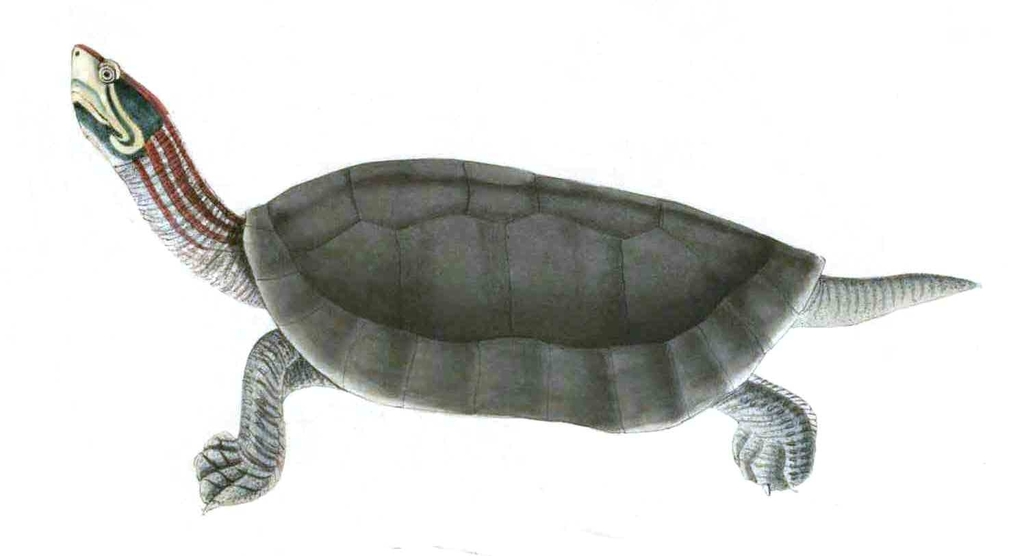
Red-crowned Roofed Turtle
Batagur kachuga
The red-crowned roofed turtle or Bengal roof turtle (Batagur kachuga) is a species of freshwater turtle endemic to South Asia. It was the type species of its former genus Kachuga. Females can grow to a shell length of 56 cm (22 in) and weigh 25 kilograms (55 lb), but males are considerably smaller. The turtles like to bask in the sun on land. In the breeding season, the heads and necks of male turtles exhibit bright red, yellow and blue coloration. The females excavate nests in which they lay clutches of up to thirty eggs.
Historically, this turtle was found in central Nepal, northeastern India, Bangladesh and probably Burma (Myanmar), but it has suffered declines in population due to being harvested for meat and shells, drowned in fishing nets, water pollution, hydro-electric schemes and habitat loss. Fewer than four hundred adult females are thought to remain in the wild, with the International Union for Conservation of Nature rating this turtle as being "critically endangered". India has put conservation measures in place, and a captive breeding programme has been initiated.
From the article Red-crowned roofed turtle on Wikipedia (CC BY-SA), quoted section by section
Description
It can weigh up to 25 kilograms (55 lb) and have shells as long as 56 centimeters (22 in). Males reach only half the length of females. At the end of the rainy season, the heads and necks of male turtles develop a brilliant courtship coloration of red, yellow, white, and blue, with 6 distinctive bright red stripes on top of the head.
The carapace of the young is strongly keeled. The keels are tubercular posteriorly on the second and third vertebral shields. The posterior margin is strongly crenulated. The marginal serrature disappears in adolescent specimens and the vertebral keel, after being reduced to a series of low knobs, vanishes entirely in the full-grown, the carapace of which is very convex. The nuchal shield is small, trapezoidal and broadest posteriorly. The first vertebral is as broad or broader in front as behind. The second vertebral is longer than the third, with which it forms a straight transverse suture. The fourth is longest and forms a broad suture with the third. The second vertebral is broader than long in the young, and as long as broad in the adult. Plastron is angulate laterally in the young. The anterior and posterior lobes are rather narrow and shorter than the width of the bridge, truncate anteriorly and are openly notched posteriorly. …
Range & habitat
This reptile was historically widespread in Central Nepal, NE India, Bangladesh, primarily in deep flowing freshwater rivers with terrestrial nest sites in the watershed of the Ganges River and probably NW Burma. Type locality: "India"; restricted by M.A. Smith 1931:131, to "N. India."
The National Chambal Sanctuary portion of the Chambal River has received moderate protection since 1979 as India's only protected riverine habitat. It is believed to be one of the last viable habitats for this species, though even here, B. kachuga are rare.
Recent annual nesting surveys indicate fewer than 400 adult females remaining in the wild.
Wikipedia: “Geographic range”
What it does
They leave the water to thermoregulate by basking in the sun on rocks, logs, and sandbanks.
Wikipedia: “Behavior”
Where it lives
Recorded sightings
—
geo-referenced records in GBIF, from museums, herbaria and field observers.
Drag the globe to turn it. Dots are where records exist, not a range map; darker means more records.
In the stacks
Searching the stacks…
Every page naming Batagur kachuga in the Biodiversity Heritage Library →
This page is assembled live from iNaturalist, GBIF, Wikipedia, the Source Library and the Internet Archive. It is not yet part of the hand-edited codex. iNaturalist taxon 68487.