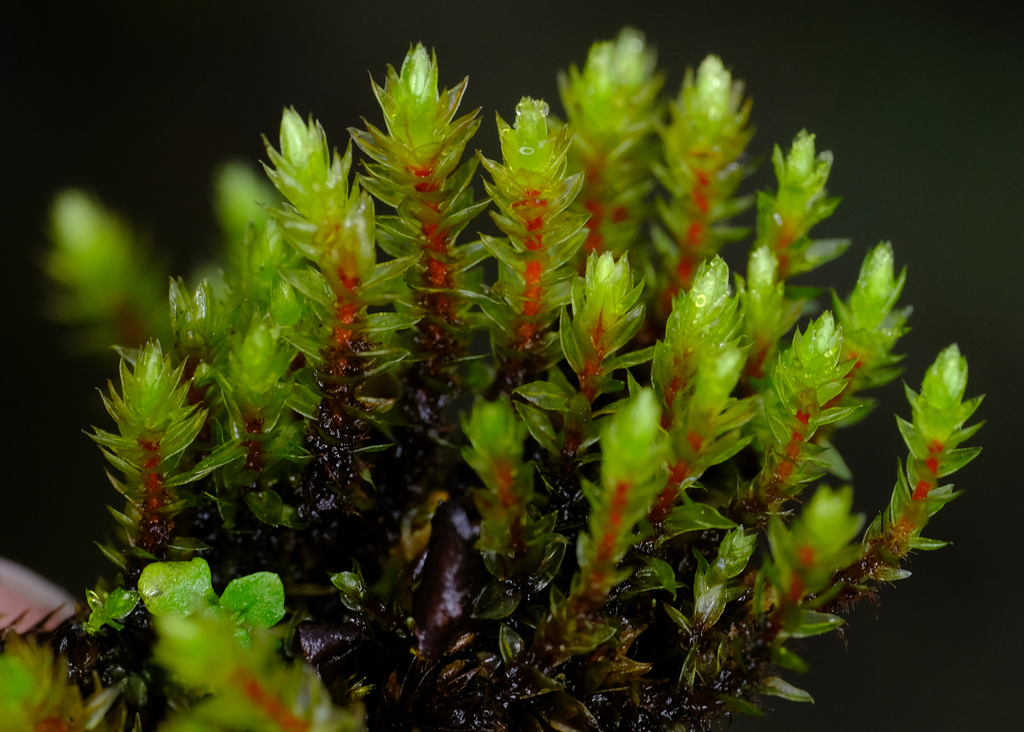
Long-leaved Thread Moss
Ptychostomum pseudotriquetrum
Ptychostomum pseudotriquetrum, commonly known as marsh bryum, is a species of moss belonging to the family Bryaceae. It is distinguished by its strongly decurrent leaves that extend down the stem, central leaf stalks which may extend slightly beyond the tip of the leaf, dioicy, and long stems densely matted with rhizoids. It is found worldwide, excluding the tropics.
From the article Ptychostomum pseudotriquetrum on Wikipedia (CC BY-SA), quoted section by section
Description
Ptychstomum pseudotriquem is a medium to large moss with an acrocarpous growth form. It is a yellow-green moss that becomes red-brown with age. The stems occur in dense turfs. The stems usually grow to lengths of 2–4 cm but can be as short as 1 cm and long as 6 cm. The stems may be weakly comose (i.e. crowned with a tuft of soft leaves) or evenly foliate. The lower part of the stem is matted with papillose red-brown rhizoids. The stems branch sparingly by means of subfloral innovations, which are elongate and evenly foliate. The leaves typically measure 2–3 mm in length, but may as short as 1 mm or as long as 4 mm. The leaves are glossy and green, red-green, or yellow-green when young. They become dull brown-red or brick-red with age. They are twisted and contorted when dry. When moist, they are erect spreading, oblong‑lanceolate to ovate‑lanceolate, and flat to weakly concave. This means that the leaves are widest near the base and taper to a point. The leaves' cell walls are firm to incrassate and sometimes porose. The reddish basal cells are rectangular. The distal cells are rhomboidal-hexagonal to hexagonal, with a length of 20–40 μm and a width of 12–20 μm. The leaves are bordered by 2–3 rows of narrow, thick-walled, usually red cells. The leaf margins are revolute (i.e. rolled downward) from the base of the blade to the middle of the leaf or further. …
Range & habitat
P. pseudotriquetrum has a bipolar distribution and is additionally found in temperate regions in the Southern Hemisphere. It is found on all continents, including Antarctica, but is largely absent from the tropics, subtropics, and islands in the central Pacific Ocean. It grows on rocks and wet soil by streams and lakes and in fens, wet heaths, and marshes. at elevations of 0–4000 m.
== References ==
Wikipedia: “Distribution and habitat”
Where it lives
Recorded sightings
—
geo-referenced records in GBIF, from museums, herbaria and field observers.
Drag the globe to turn it. Dots are where records exist, not a range map; darker means more records.
In the stacks
This page is assembled live from iNaturalist, GBIF, Wikipedia, the Source Library and the Internet Archive. It is not yet part of the hand-edited codex. iNaturalist taxon 68300.