- Plants
- ›Vascular Plants
- ›flowering plants
- ›Dicots
- ›carrots, ivies, and allies
- ›carrot family
- ›Apioideae
- ›Smyrnieae
- ›Smyrnium
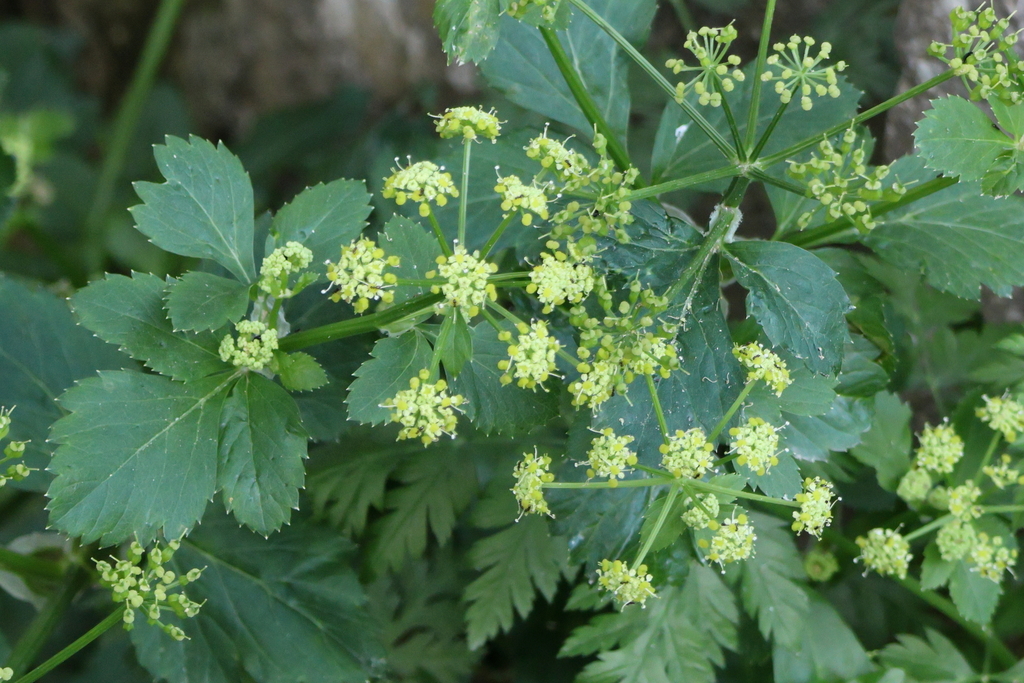
Alexanders
Smyrnium olusatrum
Smyrnium olusatrum, common name alexanders (or alisander), is an edible flowering plant of the family Apiaceae (Umbelliferae) which grows on waste ground and in hedges around the Mediterranean and Atlantic coastal regions of Europe. It was formerly widely grown as a pot herb, but is now appreciated mostly by foragers.
From the article Smyrnium olusatrum on Wikipedia (CC BY-SA), quoted section by section
Description
Smyrnium olusatrum is a stout, glabrous (hairless) biennial growing to 150 cm (60 in) tall (exceptionally 180 cm), with a solid stem up to 22 mm in diameter, which becomes hollow and grooved with age. It has a tuberous taproot which can be 60 cm long, as well as fibrous lateral roots.
The stem leaves are arranged in a spiral (although the upper cauline ones are often opposite and sometimes in whorls of 3), with an inflated, purple-striped, fleshy petiole that has papery margins towards the base. The compound leaves are broadly diamond-shaped, 2- or 3-times ternately (sometimes pinnately) divided. Sometimes they are slightly hairy towards the base. The individual leaflets are dark green above, pale green below, flat, lobed and serrated with obtuse teeth that have a tiny white hydathode at the tip.
Inflorescences are terminal or in the leaf axils and consist of a compound umbel of individual umbels, the former 6–7 cm in diameter, with 5–25 penducle rays which are glabrous, ridged and 2–4 cm long. There are 3–4 bracts, which are small, pale and inconspicuous (or absent), and the peduncle is usually longer than its rays. The individual umbels are 1–2 cm across with 10–20 flowers and 1–5 tiny bracteoles. …
Range & habitat
Alexanders is widespread in Britain, where it is frequent in coastal areas in the south, becoming progressively rarer towards the north of Scotland, and absent from Orkney and Shetland. Inland, it is often found close to the sites of medieval monastery gardens and other historical places such as castles. In Ireland it is common around the south and east coasts, but rare inland and to the west.
More generally in Europe, it occurs throughout the Mediterranean, where it is recorded in all coastal areas, including the islands, and it extends as far as Crimea and the Black Sea. It is also found along the Atlantic coast of the continent from the Iberian Peninsula northwards through France, Belgium, the Netherlands, Denmark and (recently) into Norway; and westwards to the Azores. In north Africa it is restricted to the Mediterranean and Atlantic regions, including the Canary Islands. The conservation status of alexanders in Britain and France is Least Concern, and it is not considered to be threatened in any region, although it is rare in some countries, such as Belgium. It is recorded as an introduction in New Zealand, Australia and Bermuda. It is a strictly lowland plant in northern Europe. In Britain, it is recorded no higher than 290 m, at Davidstow Airfield in Cornwall.
Wikipedia: “Distribution and status”
What it does
In Britain and the more northerly parts of Europe, the main habitat for alexanders is tall grassland, typically on road verges and woodland edges. It favours some soil disturbance initially, but once established it can be so dominant as to suppress most other plants. In the British National Vegetation Classification this habitat is described as a herb-rich type of MG1 false oat-grass community which, under other circumstances, would likely be dominated by cow parsley. A similar habitat occurs on the edges of scrub communities such as W21 hawthorn, W22 blackthorn or W24 bramble scrub. It is common on waste ground and field margins, especially near the sea, where it may also be found on cliff paths and near the shore. Its Ellenberg values in Britain are L = 7, F = 5, R = 7, N = 7, and S = 0, which describe its requirements as fairly well-lit places on well-drained soils, neutral pH, medium fertility and no need for salinity. Although it is more common around the coast than inland, it has little tolerance for salt and its occurrence there may have more to do with milder temperatures found near the sea. In France it is considered a characteristic species of seasonally dry river valleys with chaste tree scrub in the Mediterranean region. …
Wikipedia: “Habitat and ecology”
At the table
The plant is best collected before the flowers open and the stems can be cooked like asparagus. It was once highly valued in northern Europe as an early vegetable: one of the few fresh plants that can be eaten in February or March. In the west of Britain, it had a reputation amongst sailors of "clearing the blood" and curing scurvy, and in Dorset it was known as "helrut", which is possibly a corruption of "heal root". The seeds have also been used as a cure for scurvy. One 17th-century text describes young shoots used in salads or a "vernal pottage" and an early 18th-century recipe recorded by Caleb Threlkeld for Irish Lenten Potage includes alexanders, watercress and nettles. In Turkey, where it is known as Baldiran or Göret, the young shoots and leaves are cooked and eaten with yoghurt, or eaten fresh as a salad, while the roots are also eaten, either cooked or fresh. These are considered to be the best part, and are dug up during the winter, when the tubers are most fleshy, although foragers in Britain often overlook them, as it is illegal to uproot wild plants. The young foliage is intermediate in flavor between celery and parsley and the seeds have an acrid, peppery taste. However, alexanders is botanically more closely related to carrot and chervil than to celery or parsley. …
Wikipedia: “Uses”
In human culture
Alexanders is commonly supposed to be the herb described by Dioscorides as Hipposelinum, which the Romans called olusatrum. William Turner, writing in the late 16th century, explained how this was the accepted wisdom of his "masters", Antonius Musa, Fuchsius and Ruellius (referring to their herbals). However, after reading Dioscorides's De Materia Medica he realised that "our [i.e. English] Alexander is not Smyrniū in Dioscorides," because that species had paler leaves than parsley, a purplish colour, and a white root. Dioscorides himself had said as much, writing "Hipposelinum is different to that which is properly called smyrnium". It therefore appears as if the words "smyrnium'" and '"olusatrum" originally named different plants but were confused by European herbalists. This confusion only deepened in the following years. In the mid-17th century Nicholas Culpeper explained that "alisander... is sold in apothecaries' shops as Macedonian parsley-seed." However, he acknowledged that it was grown in "all the gardens in Europe, and so well known, that it needs no farther description." John Ray explained in 1660 that alexanders was so called because in Italy and Germany it was known as herba alexandrina, having been supposed to have been brought from Alexandria. Alexanders (i.e. …
Wikipedia: “In culture”
Where it lives
Recorded sightings
—
geo-referenced records in GBIF, from museums, herbaria and field observers.
Drag the globe to turn it. Dots are where records exist, not a range map; darker means more records.
In the old herbals & bestiaries

Notable Commentaries on the History of Plants
Leonhart Fuchs · 1542 · p.361

Notable Commentaries on the History of Plants
Leonhart Fuchs · 1549 · p.792

Notable Commentaries on the History of Plants
Leonhart Fuchs · 1549 · p.359

Commentaries on the Six Books of Dioscorides
Pietro Andrea Mattioli · 1560 · p.550

Commentaries on the Six Books of Dioscorides on Medical Matter
Pietro Andrea Mattioli · 1563 · p.507

A New Herbal, or History of Plants
Rembert Dodoens (trans. Henry Lyte) · 1578 · p.638

Six Groups of the History of Plants
Rembert Dodoens · 1583 · p.707

Description of Less Known and Rare Plants
Fabio Colonna · 1616 · p.463
In the stacks
Searching the stacks…
Every page naming Smyrnium olusatrum in the Biodiversity Heritage Library →
This page is assembled live from iNaturalist, GBIF, Wikipedia, the Source Library and the Internet Archive. It is not yet part of the hand-edited codex. iNaturalist taxon 68007.